Monday, February 22, 2016

It's Oumguil Time


What time is it? Make no mistake - the watch on the left wrist, the drawing on the cassette shell, the festive star- and comet-shaped holes in the shell, all of them leave you no doubt that it's Oumguil time!


When is Oumguil time? When that Middle Atlas bendir-driven groove kicks it off, when Mustapha calls out the name of your town, be it Ouled Youssef, Fkih Ben Salah, Khouribga, Tangier, or even Milano, when he calls out "Aji nqessrou, rah ellil tawil / Wa khuya nnsaou fih lmachakil (Come on let's stay up, the night is long / Brother, we'll forget our troubles in it)" - yep, it's Oumguil o'clock!


Add this one to the previous Oumguil twofer we served up - You've got yourself a good night's worth of shimmying and derdeg-ing. Enjoy!

Mustapha Oumguil - Âmmer Daoud Ma Iâoud (Tassjilat El Hajeb cassette 28/10, 2010)
1) Elli Ma Jal Ma Âref Bhaqq Errjal
2) Khrejti Âliha ya Ellil
3) Awah Awah Ktab Âliya
4) Âmmer Daoud Ma Iâoud
5) Aji Nqessrou Rah Ellil Tawil
6) Zaêri

Get it all here.

Thursday, December 24, 2015

Houssa Ahbar 97


Here's some late '90s Middle Atlas Amazigh viola-driven pop music. On the spectrum between the two Amazigh viola tapes I shared on this post last year, this falls closer to the earlier, folkier, acoustic end.

I couldn't find out much online about Houssa Ahbar (or Ahbbar, not to be confused with the prolific Houssa 46). This tape predates anything of his I found online. The j-card bills him as "The Star of Khenifra", implying that he comes from the same city as Rouicha.

Houssa appears to remain active via recordings and live performances. You can find some recent albums of his over at izlanzik.org. Interesting to compare the sound of these newer albums to the one offered here. Production values for Middle Atlas popular music have sure changed since the late '90s. No autotune, no keyboard, no lotar. Just the viola, bendir, men's and women's voices, and what sounds like a darbuka added to the percussion section.

Iconographic query: Here is the logo for the label Ain Asserdoun Disque. "Ain Asserdoun" is the name of the lovely spring up the mountain above Beni Mellal. The word "Asserdoun" means "mule" in Tamazight, and "Ain" means "spring" or, literally, "eye". So Ain Asserdoun could be translated as The Mule Spring or the Mule's Eye. So can anyone explain to me what is depicted in this logo?

Houssa Ahbar - New 97 (Ain Asserdoun Disque cassette 51)
Excerpt from Track 4 (of 6)

Get it all here.

Saturday, December 12, 2015

Mohamed Amrrakchi - Amarg Fusion, 90s style


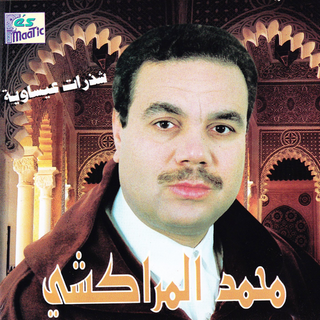
Here's a well-loved cassette from my first trip to Marrakech in 1992. The j-card went missing years ago, but I did manage to scribble "Mohamed Marrakchi" on the box. Preliminary googling only resulted in references to an Arabic singer in Fessi chaabi style:


This was a far cry from the Soussi Berber rrbab-driven sounds on my old tape. Some additional googling turned up a better result, using the more Berber-ish spelling "Amrrakchi":


Blogger Ourchifali, who has several posts including lyrics of Mohamed Amrrakchi as well as this great photo here tags these posts with the term "Amarg Fusion". While nowhere near as fusion-y as music from the 2000s by the actual group Amarg Fusion, the electric guitar and drum kit do give the music a bit of what, at the time, was a modern edge. I love the punchy sound added by the kit and guitar. To my ear, they complement rather than undercut the banjo and rrbab. And the melodies are insidiously catchy. Here's some video footage of Amrrakchi with this sort of ensemble:


Mohammed Amrrakchi appears to be the brother of the more well-known Houcine Amrrakchi, who was featured some time ago over at the defunct-but-not-forgotten Snap Crackle and Pop blog.

Mohamed Amrrakchi - Sawt al Ahbab cassette (1992)
Track 1 (of 6) 


Get 'em all here.