There are so many recordings by the late Mohamed Rouicha (1950-2012) - they all sound pretty similar, and they're all pretty great - well recorded, solid performances, killer grooves, entrancing lotar plucking, soulful baritone singing from Rouicha in call/response with the piercing soprano voices of the backup singers, all animated by the incessant buzzy time-keeping of the bendir frame drums.
I've identified at least 65 cassette releases by Rouicha on the Tichkaphone label. These were preceded by some 7" vinyl releases on Koutoubiaphone (which later became Tichkaphone) and on Bouissiphone, and followed by some cassette/CD releases on the MasterOne label in the last decade of his life, including his famous late-career hit "Inas Inas".
Many of the Tichkaphone albums can be found on YouTube, but the digital transfers are often thin-sounding and sometimes corrupted. This cassette rip comes to us from Peter Doolan (blogmaster at มนต์รักเพลงไทย), and it's a great improvement over what you can hear elsewhere online.
For those who want to dig into some of the meanings of Rouicha's songs, here's a recent article in English:
There's not much scholarly or critical writing on Rouicha - I hope more will appear!
Rouicha Mohamed رويشة محمد Tichkaphone cassette TCK 1157 تشكافون A1 Ana Noussik أنا نوصيك A2 La Smaha Lli Kan Sbab لاسماحة اللي كان سباب B1 Hatta Line حتى لين B2 Lahbiba Latgouli Lawah لحبيبة لا تڭولي لواه
Here's a killer tape that comes to us from Friend-of-the-Stash Polina. It's a vintage 1990s cassette from the Zayane region - Tamazight speakers from the area of Beni Mellal/Zaouiat Cheikh/Khenifra - before the era of auto-tune and drum programming. Scratchy viola, buzzy bendirs, and powerful vocals from the singer Aicha. The cassette j-card refers to her as Najmat Zayane (The Zayane Star) and Alfannana Aicha (The Artist Aicha). The Aicha pictured on the j-card resembles the singer in this GREAT clip - Aicha el Hajeb عائشة الحاجب, also known as Aicha Oulbomzough:
It looks like the same Aicha to me, but all the music I can find online by Aicha el Hajeb is very traditional, slow-tempo music. What's on this cassette is of a much more uptempo variety, and I'm not sure whether the voice is the same:
If this is indeed Aicha el Hajeb, then this tape is something of a rarity - I've seen no other listing of recordings by her, but many YouTube commenters have praised her artistry and lamented her retirement from performing.
To complicate matters, the artwork from the j-card indicates that it was published by Nachat Ezzaouia (perhaps it is a company from the city of Zaouiat Cheikh), whereas the cassette shell reads "Ain Asserdoun Disque عين إسردون ديسك", a company from Beni Mellal. So it's possible that the music on the cassette does not match the artist in the photograph.
Whatever the case may be, the music is some down-home Zayane goodness. Thanks Polina for the share, and Happy Thanksgiving to our US American friends.
Alfannana Aicha الفنانة عائشة Najmat Zayane نجمة زيان Nachat Ezzaouia cassette 123 نشاط الزاوية
Here's another Rouicha album that I don't see on any of the streaming platforms.
Rouicha's albums are always sung either completely in Arabic (Moroccan darija) or completely in Tamazight (Middle Atlas dialect). Today's offering is the first one I've shared where he sings in Tamazight. Although the grooves and rhythms are basically the same as on his Arabic songs, the melodies tend to be a little different - less wide ranging, remaining in a narrow ambitus. Interestingly on this tape there are 3 distinct vocal groups - Rouicha singing solo, a female respondent group, and a male respondent group.
Enjoy!
Rouicha نجم الموسم رويشة و مجموعته Tichkaphone cassette TCK788 تشكافون
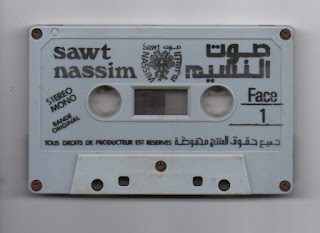
Well here's something old yet different - it's a tape of songs by lotar-master Rouicha, performed by a 1980s chaâbi orchestre - viola, drum kit, and darbuka, and driven by an electric guitar! I was just remarking a couple weeks ago how Middle Atlas lotar songs work so well in a chaâbi context and vice versa. Here is more evidence (apologies - the audio quality is not the best, but the grooves are so good!):
The vibe here ☝️ reminds me somewhat of the âita-based guitar-driven sound of Noujoum el Haouz. The drum kit is similarly propulsive, and the darbuka and viola pull the track toward the âita sound world. On another track 👇 however, the âita/chaâbi stylings fall away - there is no viola, the singing is in Tamazight, and the drum kit and darbuka switch from chaâbi propulsion to a laid-back Middle Atlas swing. This foreshadows a bit the flangey acoustic guitar-driven Middle Atlas grooves that Moulay Ahmed el Hassani would popularize a few years later.
Unfortunately, I have no idea who are the musicians on the cassette or from where they hail. The Sawt Nassim label was (is?) based in Casablanca, but that doesn't guarantee that the ensemble was based there. I hope someone in YouTube comments can identify the musicians!
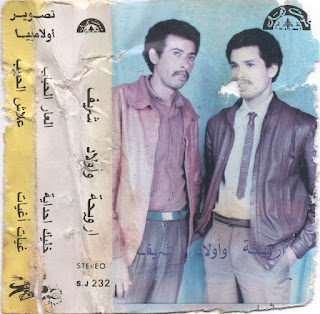
By the way, this cassette came to me from Essaouira (shukran T!) with the j-card pictured at right. I was looking forward to hearing it - the duo Arouiha and Oulad Cherif were featured in this old post over at Awesome Tapes From Africa. Was disappointed that the tape did not match the j-card. Luckily, the Sawt Nassim tape it housed is pretty great. Still - that leather tie!
The songs on side B of this album are both featured on Rouicha's fabulous album TCK790, still available here: https://moroccantapestash.blogspot.com/2011/06/mohammed-rouicha-afak-al-hwa-hda-liya.html. I couldn't identify the first track on side A, but the second track, 'Mani L3ahd Mani L3zazit' (featured in the YouTube clip above) can be found on YouTube in several versions, one of which is attributed to Rouicha. (There's no discographic information, but a YouTube commenter claims it was recorded by Rouicha in 1981). It clearly remains a well-known song, as one can find versions of it performed by many artists on YouTube.
Editing note: Side A and Side B of the tape both end with instrumental intros, and both sides begin with intros cut off. So I grafted the intro from the end of each side to the first track on the other side.
Pluck Yeah! 1980s Electric Guitar Chaâbi Orchestre Plays Rouicha Unknown Guitar-Driven Chaâbi Orchestre Sawt Nassim cassette
A1 Piste 01 A2 Mani L3ahd Mani L3zazit ماني العهد ماني العزازيث (video embedded above) B1 Toub Toub A Rasi توب توب اراس (audio embedded above) B2 Lawah a Lawah Ammi Lhubb Iâddeb لواه امي لواه الحب يعدب
A pair of albums this week, from lotar player and singer Hamid Almou. Like Rouicha, Almou has a groovy touch on the lotar, has a smooth, low baritone voice, and has had success recording in both Arabic (darija) and Tamazight. There's not much information about him online, but I gather from YouTube comments that he hails from Meknes, specifically the Toulal neighborhood.
These two albums feature Almou singing in Arabic. I dubbed them from original copies in 1992 or 1993 in Marrakech. The song "Tfah Jnane Bghitou" that opens the first of these albums is somewhat well known. Several other recorded versions of it can be found online, including one by famed âita singer Khadija al Bidaouia (https://www.youtube.com/watch?v=X7I-aX2jwPU). I don't know whether Almou is the originator of the song or whether the song existed before he recorded it. It works remarkably well as both a viola-driven âita-styled chaâbi song and as a lotar-driven Zayane-styled chaâbi song.
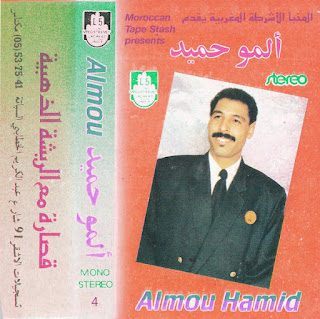
Digital research note: As with any Arabic or Amazigh name, there are many different ways of transcribing المو حميد with Roman letters. A Google search for the name returned results that included Hamid Almou, Hamid Al Mou, Hamid El Mou, and Hamid Alemmou. it also returned this image:
Iconographic note: Since I didn't have images of the original j-cards, i
went fishing on the internet to find something appropriate. I did find
an entry on Discogs
for an album by Almou, also on the imprint Enregistrement Lachkar,
though it's not the same album as either of my dubs. The album refers to
Almou as الريشة الذهبية "The Golden Plectrum" (richa being the Arabic word for both 'feather' and 'plectrum'). Anyway, I pilfered the image of the j-card and tweaked the colors to create mock j-cards for these 2 albums, shamelessly adding Moroccan Tape Stash branding in English and Arabic. Thanks and apologies to the original uploader Hackente.
More fun facts from Discogs: The Spanish rock band Les Conches Velasques adapted a song of Almou's in their song "Cosas de usar", the opening track on their 2021 album Celebración del trance profano (which also includes a version of Nass el Ghiwane's "Mahmouma").
Hamid Almou does not appear to have a web presence on either Facebook or YouTube. As far as I can tell, he is still active and performing. He sounds good in this live clip from 2014:
A1 Âchiri Lli Wellfou Guelbi Ya Hasra A2 Min Zinek Ya Lil Ch'hal Dlamek Khwaf B1 Had Denb A L-Hbiba Machi Denbi B2 Tir Tir Bnit Lu Chebbak Hrir B3 Galt Lbniya L-Baha Lach T'hdini
Here's a beautiful album by a trio of great artists from Khenifra (Magni and Cherifa) and Khemisset (Boutmazought). I love the sparse texture of this recording - just the lotar, a single bendir, and verses sung in rotating fashion by each of the three distinctive singers. In the clip below, the first singer is Maghni, followed by Cherifa and then by Omar:
We wrote about Maghni in our previous post. The fiery Cherifa Kersit is among the most celebrated singers of the Middle Atlas region. You can find her biographical sketch and more of her music at the Arab Tunes blog. The deep-voiced Omar Boutmazought is a singer and lotar player whose career dates back to the 1990s. You can find more of his music at the Moroccan Tapes site.
This album comes not from my physical media stash but from my hard drive (aka my file stash). It was shared 11 years ago by AbdelSMB at his long dormant site
The Silence Has a Voice, and the Real Music Teach You the Silence. Shout out and well wishes to Abdel, wherever he may be - he has disappeared from Facebook and Twitter. I've uploaded his audio and image files and retagged the songs to include their titles. The CD appears to have been issued in 2007, but an image of the cassette issue of the album indicates a 2003 release date (https://www.youtube.com/watch?v=7ZPy1D_kImg).
Cherifa (Kersit), (Mohamed) Maghni, and Omar Boutmazought الشريفة و مغني و عمر بوتمزوغت Edition Wislane CD 09/01/07 2003
Back to Khenifra this week for a tape by the renowned Amazigh singer, songwriter, and lotar player Mohamed Maghni. Born in 1950, Maghni comes from the same generation and milieu as Rouicha. Though he is less well known than Roucha, Maghni's songs are considered by aficionados of Amazigh song to be of higher artistic stature.
I'm not able to find many sources of information about Maghni's career and music, though all sources note the sensitivity and deep feeling of Maghni's poetry and melody. Two articles ([1] and [2]) state that Maghni's songs directly address social issues related to the experience of Imazighen, and that his uncompromising artistic stance led to his marginalization for many years outside of the mainstream of Moroccan music. (His Arabic Wikipedia entry states that worse things happened to him as well.)
Maghni has worked with other great singers of the region such as Hadda Ouakki and Cherifa Kersit. I don't know who is singing with him on this particular tape.
Maghni appears to be alive, well, and celebrated today. He was honored at the 2014 National Festival of the Lotar [3], and was even fêted in an episode of the Moroccan celebrity tv program Masar in 2016 (https://www.youtube.com/watch?v=ezPGoN0Ffqo).
Continuing with another Tamazight tape this week, this one by the powerhouse singer Hassania. Born in Errachidia, she grew up in Azrou, where she continues to perform. This album is on the imprint Masterone out of Fes. In the late 2000s/early 2010s, the great Rouicha Mohamed was also recording for Masterone, and Hassania was featured as a vocalist on 4 of his albums during this period. [1]
Tracks A1 and B1 are more pop-oriented, featuring prominent use of keyboard and other instruments as well as wider sung melodic ranges, while tracks A2 and B2 stick more closely to the bendir and viola format, with the narrower melodic ambitus typical of Middle Atlas Amazigh song. I wish I could understand the lyrics, but even without that, the expressive power of her singing is formidable.
Another track from this album was uploaded to YouTube by Izlan.fr. The clip includes the Tamazight lyrics transcribed in both Roman and Arabic letters. It also credits the track to Hassania along with the viola player El Mansouri Houssa. You may also enjoy the accompanying video of someone driving around northern Bretagne.
Hassania is still active performing. Here is a great live clip from a party in Azrou just before COVID, accompanied by a nice band with drum kit, several bendirs, viola, and an unobtrusive keyboard.
Here's another viola driven Middle Atlas Amazigh album for ya. Said Akchmir is a viola player and singer, I believe from Khenifra. I don't know who is the female singer on this tape, but her opening autotuned solo vocal passage blew my socks off. I also love the syncopated pattern the bendir is holding down.
As with Ouaboud Mohamed, whose tape was featured here last week, Said Akchmir appears to use studio synth instruments in his albums, but not in live performances. Here is a video clip of him, doing the live thing with the typical ensemble of several bendirs and male singers, one viola, and a female singer (plus a quartet of dancing ladies):
Ouaboud Mohamed is a singer and bendir player from the region of Khenifra. Most recordings of Middle Atlas Amazigh music seem to be published under the name of the viola or lotar player (who is often the male lead singer) or that of the lead female singer. Thesinging male bendir player is typically anonymous in these recordings, being more of a support role than a star role. I love that Ouaboud plays this support role but also can be the lead singer and release his own recordings. (Full disclosure: I am a singing bendir player who likes the spotlight once in a while but also loves to play a support role in an ensemble. Maybe it comes from also being a bass player.)
I picked up this tape in Beni Mellal in 2012. I couldn't find info online about Ouaboud, but he does maintain a Facebook page and a YouTube channel. He appears to remain quite active performing at private events (weddings and other parties, and private music salons) in the Khenifra area in formations with various viola players like Moha Amzyan and Mustapha Sghir, and female singers such as Fatima Talgadit and Naima Kouda. The ensembles typically consist of several bendirs, one violist, and one or more female singers. In the clip below, Ouaboud is playing the white high-pitched bendir, and he throws in some great syncopated accents in the 2nd half of the clip.
In addition to live performances, Ouaboud has made several studio recordings under his name, but I don't find any of them on the typical streaming platforms like Ournia or even on Izlanzik, which specializes in Middle Atlas Amazigh music. There a number of clips, however, on YouTube. Unlike in live performances like the one above, most of the studio recordings take place with an ensemble augmented by other instruments including, you guessed it, a keyboard bass.
On this tape, the studio has "chaâbified" the songs not only by using additional instruments, but also by adding instrumental "refrains" to the arrangements. The first 4 tracks of this tape each begin with a short instrumental section that features a melody played by synth strings and synth banjo (track 1) or flute (tracks 2-4). This melody is, in each case, unrelated to the sung melody of the song (other than being in the same melodic mode). Once the melody is played once or twice, the synth strings drop out and the live, scratchy Amazigh viola enters, playing the actual sung melody. After a couple iterations of this melody, Ouaboud enters, singing, followed by the female lead after a couple of verses. After a few back-and-forth verses between the two singers, the synth strings and banjo or flute return, playing the instrumental refrain from the opening of the song:
Even with these chaâbi tropes, the album still highlights the timbres of the scratchy viola and the buzzy bendir. In contrast to the first 4 tracks, the album closes with a short track that recalls the excitement of the live setting by losing the synth strings, ramping up the tempo, and letting the bendir come to the front of the mix in all of its syncopated glory! (Stream Track 5 below.)
Ouaboud Mohamed أعبود محمد Tasjilat Igly cassette 5/08/2010 تسجيلات اگلي
In 1959, noted American author and
composer Paul Bowles made several trips around Morocco recording as many strains of Moroccan traditional music as he could capture. Bowles curated some of these recordings for release on a 1972 2-LP set "Music of Morocco" issued by the Library of Congress.
Bowles recounts some of the experiences of the 1959 recording project in the essay "The Rif, to Music" in his essay collection "Their Heads Are Green and Their Hands Are Blue". For a deep dive into Bowles' musical upbringing and aesthetics and how these inform his recording project, it's well worth seeking out Philip Schuyler's essay "Music of Morocco: The Paul Bowles Collection", included in the 4-CD reissue and expansion of the Library of Congress album, released in 2016 by Dust to Digital. This release is one of the most beautiful artifacts in my own stash - from the ornate box to the leatherette-bound booklet down to the track selection, sequencing, and notes, everything was done with great care, thought, and taste.
If you can't find the box set, the album is available to purchase digitally at Bandcamp, including a pdf of the booklet. The album is also available to stream online through various platforms, though of course without the reading materials:
I had meant to post something about this back in 2016, but did not manage to do so. While scrolling through Twitter last week, I stumbled across a YouTube clip of a Gnawa recording I'd not heard before, originating from the Bowles' collection, but not issued as part of the LP or CD sets. The video was uploaded by Archnet, a digital resource sponsored by MIT and the Agha Khan Trust for Culture.
It turns out that Archnet has made the entire collection available online in YouTube form! 60 reels of tape! As Michael Toler of Archnet explains on his blog, these clips are raw transfers of the original tapes, so do not expect them to sound like the versions on Dust to Digital's release, which were nicely mastered to improve sound quality.
Still, what an amazing gift to be able to hear these tapes! As an additional gift, Archnet has uploaded a scan of Bowles' own typed notes on the recordings, which accompanied their submission to the Library of Congress: http://archnet.org/publications/10093. Excerpts from these notes appear in the Dust to Digital booklet, but you can now see the whole set.
I found the Archnet website difficult to navigate, and the way they have named the YouTube videoclips is inconsistent and often incomplete. So for my own benefit and yours, I have grouped the clips into YouTube playlists, which I hope are easier to navigate. The playlists are linked below. I generally named them by recording date, artist name/style and location. A small number of things listed by Archnet or in Bowles' notes are missing or mislabeled, but the links below will get you to nearly everything he recorded for the Library of Congress from August to December of 1959:
1956-08 Gnawa Tangier - This recording was submitted by Bowles to the LOC as a supplement to the 1959 recordings. It was made with "inferior equipment", but he deemed it to be important enough to submit.
1959-09-25 Andaluz Music of Fez - Abdelkrim·Rais, director (and rebab), Fez, Musée du Batha - Bowles' notes indicate that 2 reels of music were captured from the group: 26B and 27A. However, Archnet's link to 26B is broken, and their video for 27A contains the music from 27B (Taqtoqa Jabaliya).
1959-12-13 Chanson Moderne - Mohammed Mohiyeddine and his Orchestra, Meknes - Bowles calls this "chaabiya" in his liner notes. Perhaps it was described to him as "chaabi" or "popular", but it's not what we would call chaabi today, but rather âsri or chanson moderne. Also, Archnet has mislabeled 57A as 57B, and vice versa.
If time permits, I'll comment on some of the individual tapes in future posts. I'm of course loving the additional Gnawa material, in particular the hour's worth of material from 1956 (the first playlist above). Until then, there's plenty for you to explore!
Here's a vintage stash of folk music field recordings made and released in the 1950s and 1960s by one Jean Mazel, a French cinéaste and ethnologue, about whom I can find little information online. Most of his published recordings (and a disambiguation with anamesake) can be found here, and a number of his publications are listed here.
Jean Mazel
The recordings presented here were originally released on one 10-inch album (33 RPM) four 7-inch EPs (45 RPM). They have been resequenced and made available for streaming/download by the "UK-based one-man trancedental-drone band" Tuluum Shimmering:
In addition to being offered in their raw form, the Moroccan recordings have been incorporated into 3 CDs worth of Tuluun Shimmering's psychedelic recordings, also available from their Bandcamp page, or as CDs from their homepage.
The original 10-inch album features linking narration in French. If you're interested to hear it in its original state, check the YouTube clips below. (I'm happy to have the narration removed in Tuluum's version. It reminded me of the
pretentious voiceovers I heard between acts at the Folklore festival in
Marrakech in 1995.)
I went looking online for the original artwork/notes, and to see where the original tracks fit into Tuluum's sequence. If you're interested in that sort of thing, you can find the images I collected and my crosswalk spreadsheet here.
Thanks to tape aficiondo and old Berkeley pal @boxwalla for calling my attention to this.
Here's a 2009 tape from guitarist/singer Moulay Ahmed Elhassani. An early tape of his was featured in one of the first posts on Moroccan Tape Stash. That tape featured singing in Tamazight. It seems that over the years he has produced more albums like this one, singing in Arabic rather than in Tamazight.
News out of Beni Mellal recently has been unpleasant, though some positive outcomes ultimately emerged. Let's enjoy some bluesy Mellali tunes and hope for safer, more tolerant and groovy times ahead.
Moulay Ahmed Elassani - لفنان مولاي أحمد الحسني Passeport Bla Chane - باسبور بلا شان Tasjilate Alhane Alhassani cassette BMDA 302.06 (2009)
1) Passeport Bla Chane - باسبور بلا شان 2) Qtlatha Leghbina - قتلاتها الغبینة 3) Raha Telget - راها طلقت 4) Taârida 5) Ach Dani Leblad Had Ennas - اشداني لبلاد الناس 6) Lguelb el M’alem - القلب مألم 7) Assbar Ikafih Llah - الصبار إكافيه الله
Here's some late '90s Middle Atlas Amazigh viola-driven pop music. On the spectrum between the two Amazigh viola tapes I shared on this post last year, this falls closer to the earlier, folkier, acoustic end.
I couldn't find out much online about Houssa Ahbar (or Ahbbar, not to be confused with the prolific Houssa 46). This tape predates anything of his I found online. The j-card bills him as "The Star of Khenifra", implying that he comes from the same city as Rouicha.
Houssa appears to remain active via recordings and live performances. You can find some recent albums of his over at izlanzik.org. Interesting to compare the sound of these newer albums to the one offered here. Production values for Middle Atlas popular music have sure changed since the late '90s. No autotune, no keyboard, no lotar. Just the viola, bendir, men's and women's voices, and what sounds like a darbuka added to the percussion section.
Iconographic query: Here is the logo for the label Ain Asserdoun Disque. "Ain Asserdoun" is the name of the lovely spring up the mountain above Beni Mellal. The word "Asserdoun" means "mule" in Tamazight, and "Ain" means "spring" or, literally, "eye". So Ain Asserdoun could be translated as The Mule Spring or the Mule's Eye. So can anyone explain to me what is depicted in this logo?
Houssa Ahbar - New 97 (Ain Asserdoun Disque cassette 51)
Paris, Beirut, Syria, Iraq, et al. Wishing relief to those mourning, scared, suffering. Music blogging may not count for much in the big picture, but if it brings some smiles and spreads a little cross-cultural grooving, it's a positive activity.
Here's a pair of albums from violist Mustapha Oumguil. A prolific artist, Oumguil has recorded extensively, singing in both Moroccan Arabic (darija) and Central Atlas Tamazight. He hails from El Hajeb (between Meknes and Azrou), as reflected in the name of his cassette label, Tasjilat el Hajeb (El Hajeb Recordings).
This is music for shimmying and shaking in a Middle Atlas sort of way. Check the dancing ladies in the concert footage below - hips don't lie, and Oumghil keeps 'em gyrating all night long. Thousands of Moroccans agree, as evidenced by his appearance at the huge Mawazine festival in Rabat this year:
This is 21st century chaâbi, keyboard-heavy and auto-tuned, but with enough local flavor to keep it countrified. This can be heard in melodies themselves, especially those of the Tamazight language songs. The always-prominent bendir frame drums also keep that Middle Atlas feel prominent.
The Tamazight album comes from a CD that passed through my house earlier this week. It had no artwork, only the name of Oumguil and the title "Tarbat Ighoudan" (a song that is featured in the concert video above). The Arabic tape is one that I picked up in Beni Mellal in 2012. If you want more Oumguil, there are loads of other Arabic albums at Yala and Amazigh albums at IzlanZik. There's even a $2 album over at Amazon! And check out this this post from last year featuring Abdelâziz Ahouzar, an artist working in a vein similar to Oumguil.
AND Mustapha Oumghil - Lghaleb Allah ya Bent Ennass (Tasjilat el Hajeb cassette, 2012)
01 Lghaleb Allah ya Bent Ennass
02 Tekmi Garou ou Chicha
03 Talian Ghadrouni b S7ab
04 De7hki ou Tmedghi fel Meska
05 Siri Siri Ghir Nsay 06 Zaêri
Here's a live album from Najat Aâtabou released around 1985, not long after she first burst onto the Moroccan music scene. She's in fine form here, performing in Paris at The Olympia with oud,bendir-s, a darbuka and the backup singing of the male band members.
The album opens with an evocative (orientalist?) intro featuring audio snippets of a Middle Atlas ahaidous communal dance (one wonders if there was video at the concert as well) with a spoken narration extolling the bounties of Moroccan traditional music, before introducing Najat herself.
Tracks 3 and 4 are sung in her native Central Atlas Tamazight dialect, while the others are sung in darija (Moroccan Arabic). I've become obsessed in particular with Track 4, "Nikkine Admough" or "Ad 3mough Izri". Here's a different live performance, longer than the one on the album. The moment where the band stops and Najat continues singing a capella breaks my heart:
According to this interview and performance from Moroccan TV, the lyrics are about a woman who was separated from her lover because of travel. Upon her return she finds that he has died, and she cries at his grave. (A kind soul has also translated some of the lyrics from Tamazight to French in the comments.)
Another native speaker of Central Atlas Tamazight who found success using Arabic lyrics with Berber musical forms was Mohamed Rouicha. However, Rouicha recorded some entire albums in Tamazight, whereas I don't
think Najat ever released an album in Tamazight. I have found only a few
live performance clips on YouTube from her early days where she performs songs
in Tamazight. Conveniently, they are all linked from this page at izlanzik.org. I'd love to be proved wrong, though - does anyone know if she ever made studio recordings in Tamazight?
Najat Aâtabou at L'Olympia (EH1280)
1) intro
2) La Tbkich (= El Mektab)
3) Mani Lâhad
4) Nikkine Admongh
5) J'en ai Marre
6) 1, 2, 3
Here's a nice album from the late, sorely-missed Rouicha. I picked this up in 2012 - The Tichkaphone catalog number seems to indicate (from my estimate) that it dates from the mid-1990s.
I particularly like the opening lotar solo on track 2 - Rouicha has such a fluid, rapid, percussive strum, it sounds almost flamenco! (Or maybe it's just that the melody sounds like the Concierto de Aranjuez...) At any rate, enjoy!
We've got more Rouicha in the stash here and here. And Yala has scads of Rouicha available for listening, though not this particular album.
We love dem scratchy violas here at Moroccan Tape Stash! Usually, we like 'em served them up with some shikhat in old-school âita fashion. But great fiddlin' exists in Berber traditions as well. Here are two tapes of viola-driven ensembles, picked up in Beni Mellal 20 years apart.
Prelude spiel and questions about the viola in Moroccan ensembles: The European viola seems to have existed in North Africa for many many years. A couple of centuries, I'd guess. I don't know if it replaced indigenous bowed instruments in folk performance, or if it carved out its own place. Two Moroccan "art music" traditions - Arab-Andalusian âla and Soussi Berber amarg (music/song of the rwayes) - feature indigenous bowed instruments, both called rrbab, but completely different in construction and sound. The lone rebab in Arab Andalusian orchestras was joined (some would say overwhelmed) years ago by an entire section of violas. (I personally like the sound of the string section in that music.) The Soussi rrbab, on the other hand, seems to have retained its place as the sole bowed instrument inTachelhit music traditions - even modern synth pop like this.
I don't know of any indigenous fiddles out of the Middle AtlasBerber (Tamazight) areas. If they did exist, they seem to have been completely replaced by the European viola. The iconic indigenous stringed instrument for the area is the plucked lotar, most famously played by Rouicha. The rhythmic instrument of choice in the region is the bendir, heard in everything from communal ahaidous song/dance performances to izlan sung poetry to the latest synth-pop. Yet violas do abound...
Our first tape is from Mohamed Alqat (or Mohamed Qat), on the label Edition al Khair out of Beni Mellal (j-card picture above). I picked this up in Beni Mellal in 1992. The ensemble sounds like viola, oud, and a pair of bendir-s.
The use of the oud, that most Arab of instruments, seems representative of the relative fluidity between Middle Atlas Arab and Berber musical styles and traditions. Many performers in the region double in Arab and Berber music. Rouicha and Najat Aatabou both became national starts through recordings in Arabic. Even Hadda Ouakki, perhaps the most famous "traditional" Tamazight singer in Morocco, grew up performing both Berber song and Arabic âita.
This tape has a very country feel to it, and is not too far removed from âita zaêriya of the neighboring regions.
The one videoclip I found of Mohamed Qat features an ensemble with both viola and lotar:
Alqat Muhammad wal Majmuâa (Édition al Khair 55) Track 1 (excerpt) of 4
Today's second tape is from Abdelâziz Ahouzar. Yala's biography page says he's from the area of Khenifra and has been active since the 1980's. I picked up this tape in Beni Mellal in 2012.
Both tapes feature Tamazight song with men and women alternating sung verses/refrains, violas leading the ensembles, and prominent bendir. The similarity ends there, however.
Ahouzar's music has a very urban, chaâbi feel to it.Indeed, Ahouzar's catalogue, lots of which you can hear over at YalaOurnia, contains Arabic chaâbi albums in addition to offerings in Tamazight. Ahouzar's viola riffs and instrumental bridges are right out of the chaâbi playbook.
Although the bendir-s are prominently featured in the mix, Ahouzar's rhythm section features a drum kit and/or darbuka as well, adding some chaâbi propulsion. And the keyboard bass and comping give this tape a very chaâbi texture.
Some differences between the two tapes stem from the 20-year difference between them. The faux-live-audience heard at the beginning of tracks 1-4 is something that started appearing in chaâbi recordings about 10 years ago - I first remember hearing these in Daoudi's recordings. And of course, the auto-tuned voices throughout the tape give this a contemporary flavor too. I like the way it sounds on this album - the high-pitched women's auto-tuned quarter tone pitches on track 2 are fantastic!
Discographic note: This album of Ahouzar, as well as most of those featured at Yala, are released on a label called Ahouzar Phone, out of Azrou. Is this Abdelâziz' own label? Why is there a picture of a lion's face in the company logo? I don't know, but would love to find out.
Here's Abdelaziz Ahouzar at the gynormous Mawazine festival in Rabat, 2010. Like the clip of Mohamed Qat above, the ensemble here features a lotar:
Amazon has an mp3 album of Ahouzar - a steal at $2.99. Plus there's loads of his stuff over at YalaOurnia.
Hi everyone. I was a little busy and distracted in the late spring, and my posts have been sporadic of late. But summer is officially here, and I should have something new for ya later this weekend.
In the meantime, sending out props for some great Moroccan tape-cd-lp posts over the last few weeks. If you missed these, do yourself a favor and check 'em out!!
Mr. Tear at Snap, Crackle & Pop served up a slice of old-school rock 'n' rai from the Frères Bouchenak c.1984. Similar to what Raina Rai were doing across the border in Sidi Bel Abbes, the Bouchenak brothers in Oujda were playing their rai with a full rock band (complete with ripping electric guitar solos). The Bouchenaks would abandon this format for the prevailing synthesizer-based format a few years later. Great to hear this oldie! Check it out here.
Gary at Bodega Pop dropped this goodie from the kings of aita marswawiya, the Ouled Bouazzaoui. These are all remakes of songs recorded in the past by Bouchaib el Bidaoui. Khaled, the singer/violist of the group, sounds so much like Bouchaib el Bidaoui, it's scary! Great to have some hi-fi versions of these old school classics! Check it out here.
Brian at Awesome Tapes from Africa laid down this one from the reigning diva of Middle Atlas tamazight song, Hadda Ouakki. A bit heavy on the synth violins for my taste, but her voice remains in great form! Dig it here.
And finally, Abdel at FolkMusicSMB rolled out this unbelievably great Hamid Zahir album! As I mentioned in my last post, it's nice when Zahir stretches his chaabi chops and veers away from his usual dkitikat-based typical Marrakchi street & party singalongs. There are some almost aita-ish melodies on this one - well worth a listen! Connect here.