Here's a nice old-school Gnawa cassette from Mâalem Mohamed Daoui. During my research days (late 1990s - early 2000s), Daoui was the most well known Gnawa mâalem from Meknes. I believe he was the primary interlocutor for the German researcher Frank Welte, whose Der Gnawa-Kult: Trancespiele, Geisterbeschwörung und Besessenheit in Marokko (1990) was one of the first books on Gnawa ritual and repertoire.
The cassette contains 3 tracks - the first is a 25-minute non-stop suite of songs from various sections of the Gnawa lila ceremony (black, blue, and red songs). This track crosses sides 1 and 2 of the cassette, but I was able to edit them together relatively seamlessly.
The track that destroyed me was the second track. I made the mistake of transferring this tape when I was trying to do work for my day job. "Moulay Abdellah Ben Lhoucine" came out of the speakers and within about a minute my hair was down and I was stamping the floor with my bare feet and banging my hands on my desk/workstation. (Good thing I am working remotely these days...) The singing unfolds at its own pace, going on as long as it needs to, to give a listener (trancer) the lines of text that invoke the ambience of wali (saint), while the guinbri marks time, provocatively, underneath, and the choral responders keep the energy high and provacative. On the ritual floor, singing would continue until the mâalem judges that trancers are competently riding the groove and are ready to interact directly with the guinbi. His manipulation of riffs responds to (or provokes) the movements of whatever trancing body is directly in front of him, moving in dialogue or in concert with his guinbri. In this state of heightened musical awareness, trancers are keenly aware of the slightest variations of phrase, accent, and volume level. The job of the mâalem is to give the trancer the musical support to express in movement whatever needs to expressed. This track, better than most Gnawa tracks you will hear, gives a sense of how that conversation unfolds - though of course you are only hearing one side of it.
I had asked the tape seller if he had any Gnawa tapes. He pulled down this one, popped it in the deck for me, and pushed play. I thought to myself this seems to me like anti-Gnawa. I wanted the warm, woody, resonant rumble of the sintir and call & response vocals of full-throated baritones. What I got was some crazy electro-drum-and-synth driving home the perpetual Moroccan chaabi 6/8 beat, and a young lady leading the call and response vocals. And yet the j-card read "Special Gnawa" and had pictures of Gnawa musicians on it, so I grabbed it, figuring it would at least be interesting to figure out what about this music signified "Gnawa".
Now after many years of thinking and inking about Gnawa music, I return to this tape. What does my Gnawacized (mguennoui) ear tell me about this tape with the benefit of hindsight (hind-hearing? hind-audition?) Well, one of these songs would be heard during the trance part of the Gnawa lila ceremony, namely "Jilali Dawi Hali". (Type that title into the search bar on this blog and you'll find at least 4 Gnawa tapes that feature the song.) Many of the other songs can be heard at the end of lila ceremonies when Gnawa musicians play the fun popular songs they call chaabi or more specifically Soussia. Despite the Gnawi connotations of this album's songs, the musical arrangements aren't particularly Gnawa-inflected. They are, however, unusual.
There's not much information about Aziza El Meknassia online, but the good folks over at Moroccan Tapes have shared another tape from this artist. Their description of the unusual rhythmic texture heard in Aziza's recordings is worth quoting here:
"One of her signatures that one can hear across most of her records is a
unique way of arranging the typical Chaabi rhythm... [The] driving hi-hat and tam-tam give us a
double-time 12/8 feel, while the kick and snare create a half-time 4/4
feel, almost like a rock backbeat (if you hear it the wrong way)."
Hope you enjoy it!
Aziza El Meknassia عزيزة المكناسية Special Gnawa - Volume II Voix Bab Mansour cassette 38 صوت باب منصور
01 Al Mwima Lhbiba الميمة لحبيبة 02 Ribou Ya Douk Lejbal ريبو يا دوك لجبال Ana Lli Dert Khairi Ou Ma Ouella Liya انا لي درت خيري وما ولا ليا
03 Chailah شايلاه Qalbi Derni Ana Zayra Moulay Ibrahim Lalla Chafia 04 Marrakech مراكش Laman Wahia Laman Jilali Dawi Hali Touria Laghzal
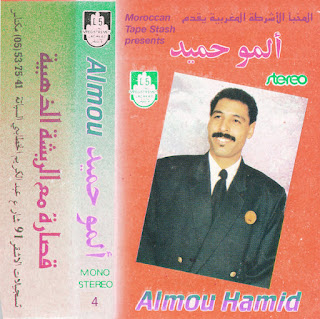
A pair of albums this week, from lotar player and singer Hamid Almou. Like Rouicha, Almou has a groovy touch on the lotar, has a smooth, low baritone voice, and has had success recording in both Arabic (darija) and Tamazight. There's not much information about him online, but I gather from YouTube comments that he hails from Meknes, specifically the Toulal neighborhood.
These two albums feature Almou singing in Arabic. I dubbed them from original copies in 1992 or 1993 in Marrakech. The song "Tfah Jnane Bghitou" that opens the first of these albums is somewhat well known. Several other recorded versions of it can be found online, including one by famed âita singer Khadija al Bidaouia (https://www.youtube.com/watch?v=X7I-aX2jwPU). I don't know whether Almou is the originator of the song or whether the song existed before he recorded it. It works remarkably well as both a viola-driven âita-styled chaâbi song and as a lotar-driven Zayane-styled chaâbi song.
Digital research note: As with any Arabic or Amazigh name, there are many different ways of transcribing المو حميد with Roman letters. A Google search for the name returned results that included Hamid Almou, Hamid Al Mou, Hamid El Mou, and Hamid Alemmou. it also returned this image:
Iconographic note: Since I didn't have images of the original j-cards, i
went fishing on the internet to find something appropriate. I did find
an entry on Discogs
for an album by Almou, also on the imprint Enregistrement Lachkar,
though it's not the same album as either of my dubs. The album refers to
Almou as الريشة الذهبية "The Golden Plectrum" (richa being the Arabic word for both 'feather' and 'plectrum'). Anyway, I pilfered the image of the j-card and tweaked the colors to create mock j-cards for these 2 albums, shamelessly adding Moroccan Tape Stash branding in English and Arabic. Thanks and apologies to the original uploader Hackente.
More fun facts from Discogs: The Spanish rock band Les Conches Velasques adapted a song of Almou's in their song "Cosas de usar", the opening track on their 2021 album Celebración del trance profano (which also includes a version of Nass el Ghiwane's "Mahmouma").
Hamid Almou does not appear to have a web presence on either Facebook or YouTube. As far as I can tell, he is still active and performing. He sounds good in this live clip from 2014:
A1 Âchiri Lli Wellfou Guelbi Ya Hasra A2 Min Zinek Ya Lil Ch'hal Dlamek Khwaf B1 Had Denb A L-Hbiba Machi Denbi B2 Tir Tir Bnit Lu Chebbak Hrir B3 Galt Lbniya L-Baha Lach T'hdini
Here's a sampler from the label Sawt Bab Mansour out of Meknes. 4 long tracks each by a different artist. This was released in the sunny spring of 2001 when Orchestre Hamri scored a smash hit with "Samaoui". The song remains popular today. On revisiting the tape, I recognized another song, "Soussia", that is something of a standard at Moroccan parties (at least at the ones I attend in the San Francisco Bay Area). The two songs are quite different, but they share something in common - they both exist within the realm of Moroccan chaabi music, but refer (sometimes with lyrics, sometimes with musical tropes, and sometimes with both) to musical traditions and bodily experiences not native to the chaabi dance floor.
SAMAOUI
In spring 2001, this song was everywhere in Morocco, coming out of every tape deck, played at every wedding. I even heard Hassan Dariouki's aita haouzia group sing it at a soiree for a bunch of ethnomusicologists in Tangier!
In the early days of Moroccan Tape Stash, I wrote about the early 2000s wave of chaâbi hits that made reference to trance or trance brotherhoods:
"I don't mean pop versions of Gnawa or Jilala songs. Rather, I mean NEW songs with lyrics referring to the spirits or to the experience of trance.
What struck me as odd was that most of these songs made no musical
reference to trance music of the Gnawa, Jilala or other groups. Rather,
they fit the basic mold of chaâbi songs, ready to slip into the repertoire of a wedding band with a viola player and a nicely dressed lead singer"
In retrospect, Al Hamri's "Samaoui / Ha Huma Jaw", while featuring smooth smooth vocals and moderne orchestral string glissandos, does actually make some musical references to the trance traditions. The bendir frame drum is being played in the loopy, topsy-turvy, syncopated way that Jilala musicians play it. The solo viola (as opposed to the orchestral strings) has the unusual processed, throbbing sound featured in Said Senhaji's hit "Aicha al Mejdouba" which, as I noted previously, resembles the throb of the Jilala gasba flute. And the cymbals of the tar tambourine are being played in a way that resembles the qarqaba metal clackers used by Jilala and Gnawa musicians. It's still to my ear a strange juxtaposition:
And yet... the song is undeniably catchy! Our local Moroccan DJ played it at the most recent party I attended, and the crowd ate it up! On the dance floor, everyone sang along "Wa Samaoui / Allah idawi / Aw s7ab el 7aaaaaaal". Samaoui is one of the entities invoked during Gnawa ceremonies. "Oh Samaoui / God heals / Oh friends of the traaaaaance / Bring the incense / bring the charcoal burner / I want to trance". Of course, none of us did trance - there was no incense, no ritual specialist, no guinbri, so it was probably for the best. And yet there we were, miming some of the gestures of trance, mouthing signifiers of trance, to a simulacrum of some of the sounds of trance music. And we enjoyed it, like we did 19 summers ago!
SOUSSIA
Another staple of our local Moroccan parties is the second song on this tape, here called "Soussia". The term soussia is a noun/adjective that refers to something or someone (female) from the Moroccan Souss region. I don't know whether there is an "original" version of this song, but if there is, I'm guessing this is not it. I've never known a proper title for the song - I just think of it as "A Mwi Lalla", or "that Berber-sounding song that gets sung at non-Berber parties".
In this version, sung by Mustapha Baidou, a metal percussion instrument sounds like a naqqus, drums sound like those used in ahwach
performances, melody is based in the Soussi pentatonic scales. Yet the
lead singer has that smooth delivery of a wedding band singer, and we
again hear orchestral string phrases. And at the end of the track, the
music shifts into typical chaabitaârida riffing, dropping the pentatonic mode and the naqqus sound.
A quick Google search for chaabi songs called "Soussia" revealed not the same song, but different songs that featured similarly Soussi-styled melodies (pentatonic) and musical tropes (drum timbres, naqqus-sounding percussion, sometimes a synth banjo), typically with lyrics in darija (Moroccan Arabic). An example:
As "Samaoui" invites dancers to simulate the hair-flipping, head-bopping of Jilala or Gnawa trance on a chaabi dance floor, when "Soussia" songs get played, dancers' movements immediately shift from the hips to the shoulders, simulating the style of an ahwach dance.
WEDDINGS, PARTIES, ANYTHING
Trance- and Soussi-styled songs make sense in the repertoire of a well-rounded Moroccan urban Arabophone wedding/party band. When you're playing at a party that goes on for hours, you want to be able to vary things up and pace the event. Wedding parties usually start off with slow and stately music to welcome and ease people into the event. So a wedding band should know at least one or two songs from the Andalusi and/or melhun repertoire to provide this function, as well as some long-form chanson moderne classics from the likes of Abdelwahab Doukkali or Abdelhadi Belkhayat. Wedding musicians don't need to be experts in those repertoires - just need to do a passable job on a couple of songs. They will probably throw in some well-known Middle Eastern hits from Egypt or Lebanon early on, to mix up the groove and allow dancers to mix up their moves. But eventually the floor succumbs to the inexorable pull toward theinfectious chaabi beat.
Chaabi (literally, "popular"), is a wide field, that ranges from urbane Andalusi melodies to country aita-based melodies and regional varieties, from simmering slow jams to raucous, explosive bangers, from Houcine Slaoui classics from the 1940s to Hamid Zahir hits from the 1960s to Najat Aatabou hits from the 1980s to Daoudi hits from the 2000s to the latest offerings on YouTube. The viola and the darbuka reign supreme. Ouds may or may not appear. (Of course a keyboard can give you that plucked-string sound, and double as a qanun
zither, a banjo, or a horn section too.) Chords were once provided by
electric guitars, but those have given way to keyboards as well. But whatever the origins or musical textures of songs may be, chaabi performers slot them into musical suites that inevitably end up with the climactic, raucous, joyful 6/8 groove.
Musics come in and out of the urban wedding band repertoire as the years roll on. When rai music was popular in the 1990s, you sometimes heard a few rai songs at weddings. I'm told that in the 1980s, wedding bands would sometimes have some Bollywood tunes ready (or perhaps some faux-Bollywood-styled chaabi tunes?) in case the bride's array of costumes included an Indian-styled outfit. In my day, said array typically included a Berber-styled outfit, so some Berber-styled songs come in very handy in the repertoire for the moment the bride switches to that outfit.
So "Soussi" songs serve a function within a wedding band repertoire, accompanying a particular moment in the itinerary of the bride's clothing trajectory. On another level, they release the dance floor, temporarily, to a different way of celebrating, a different way for the body to let loose and move. This is also the case with chaabi pop-trance songs like "Samaoui" - the dance floor is given over, momentarily, to trance movements and lyrics, letting people groove and move in a different way. But the chaabi imperative eventually brings the floor back from these excursions. Both "Samaoui" and "Soussia" on this tape finish up with an exit from Soussi- and trance-styled lyrics and sounds, bringing it all back home chaabi-style.
Weddings, parties, anything - and trance and Soussi jams a speciality...
Sawt Bab Mansour presents صوت باب منصور يقدم Samaoui السماوي Sawt Bab Mansour cassette, 2001
Al Hamri الحمري
1) Samaoui السماوي
2) Ha Huma Jaw هاهما جاو
3) Shera3 oul Qanun الشراع و القانون
Mustapha Baidou مصطفى بايدو
1) Soussia السوسية
Âbd al Hamid عبد الحميد
1) Almajdoubiate المجدوبيات
2) Sidi ouel Qalb M3akoum سيدي والقلب معاكم
3) Galuli Ghir Ensah كلولي غير انساه
Al Berbouchi البربوشي
1) 3lach A Lalla علاش الالة
2) Ouahia Almra Ouahia واهيا المراة واهيا
Here's a tape from Meknassi mâllem Hamid al-Hadri. Another tape of his, available in the Stash here, features songs from the opening Ouled Bambara section of the Gnawi lila ceremony. This tape features songs from the very end of the ceremony.
The tape opens with "Lalla Malika", part of the suite of Yellow songs/spirits from the end of the trance phase of the lila. al-Hadri then segues directly into the Soussiya 'popular' repertoire with which Gnawa typically close the night-long ceremony. (I wrote a little bit on Soussiya songs in this early blog post.) And he keeps going, non-stop, for the rest of the album, which fades out at the end of Face B.
This is a nice and unusual tape of Soussiya songs. In performance, Soussiya songs are typically given over to dancing, and are usually pretty raucous. Their light-hearted, fun nature feels like a collective sigh of relief and celebration from musicians, participants and spectators, coming after a long night of plumbing the depths and dreads of the Gnawa palette of colors, spirits and grooves. So it's unusual here that once "Lalla Malika" is finished and we move into Soussiya proper, the qraqeb metal percussion devices drop away, leaving just the guinbri, clapping and vocals. In my experience in Marrakech, the qraqeb get LOUDER during the Soussiya, since more people tend to get up and dance at that point, and they want that driving rhythm that the qraqeb provide. Maybe it's a Meknes thing for the qraqeb to drop out. Or just a quirk of this recording. At any rate, the singing is easy to hear and understand, for a change, so it's nice to get a good earful of these fun songs.
As Chaâbane winds down, here's some Gnawa music for you, before Ramadan arrives.
One of two Gnawa tapes I picked up in 1999 in Meknes, this is credited to "Hamid Laguenawi" (Hamid the Gnawi). The other tape is credited to a Hamid al-Hadri, and at one point I wondered if they were the same musician. I just compared them, and they sound nothing like each other - neither the voice nor the guinbri playing. What was I thinking?
Like my other Meknassi tape, this one features songs from the Ouled Bambara suite that opens the Gnawa lila ceremony. In fact, the sequence of songs on the 2 tapes is identical from "Fangoro Fangoro" forward. This suggests to me that this is the typical order of songs in the Meknes lila. (The sequence is different in several ways from the sequence I know from Marrakech.)
Thanks, everyone, for visiting the stash. I'm not sure if I'll be posting during Ramadan, so it may be a few weeks before I'm back here. Best Wishes for a magical summer. And to those of you observing Ramadan, may it be a time of reflection, insight, and inspiration.
Hamid Laguenawi - Sawt el Ismailia 30
Habib el Mal (includes Zid el Mal, Ye Lalla Ya Bungra)
Continuing with my recent set of trance brotherhood music tapes from the Meknes area (after Aissawa and Gnawa), here's a tape of Hamadsha tunes. The performer is from Fez, but I picked up the tape in Meknes in '99.
The Hamadsha are followers of Sidi Ali ben Hamdush, a saint whose shrine is in the Jbel Zerhun mountainous area north of Fez and Meknes. They specialize in working with people possessed by the notorious jinniya Lalla Aisha. The Gnawa also perform music for Aisha's trances, and it is derived from the 5/4 melodies heard here. (Gnawa versions of these tunes, which they call "Hamdushiya", can be heard elsewhere on this blog.) Lalla Aisha is usually identified as Aisha Qandisha, but this is contested by some, including the performer featured on this tape.
The performer, Abderrahim Amrani, is the muqaddem of a Fez branch of the brotherhood as well as a versatile musician proficient in a number of genres. See yala.fm for his biography (and some questionable pop versions of Moroccan trance tunes.) Or check out more tunes and video on the Fez Hamadsha website or on their MySpace page!
The music on this tape features the guinbri (not the large guinbri used by the Gnawa, but a smaller variety) and the large clay goblet drum known as gwal, along with clapping and singing. Not heard here is the ghaita oboe, which the Hamadsha use in some parts of their ceremony.
BTW - thanks for all your comments recently - I haven't had a chance to reply to all, but hope to do so soon. I do appreciate the feedback and the conversation!
---
UPDATE - JAN 14, 2013 - Happy to say that Mr. Abderrahim Amrani has seen this blog post and shared more information about Lalla Aisha with followers of the blog! Please see here.
In the weeks following the Eid al Miloud, pilgrimage celebrations (moussem-s) are held all over Morocco at the shrines of local awliya saints. Possibly the biggest of these celebrations is the moussem in Meknes for L-Hadi ben Aissa, eponym of the Aissawa brotherhood. Pilgrims from across the region and across the country descend on Meknes for a 2 weeks of devotion and renewal, and nights of trance music.
Here are 2 tapes of Aissawa music I picked up in Meknes ca. '99. Unlike the released CDs of Aissawa music available in da West (featuring groups from Meknes, Marrakech, and Fes), these tapes make no pretense of presenting a balanced overview of the Aissawa ritual. That is, they don't include any of the lovely sung poetry in honor of the Hadi ben Aissa that would typically open a ritual performance. They cut straight to the chase, hitting the ground running with with blaring ghaita oboes and pounding tbel drums!
I'm not familiar enough with Aissawa music to know if these tunes are from the trance repertoire or from the street/processional repertoire. Whichever it is, these are some serious long jams - the group riffs it non-stop for 3+ sides of these 2 volumes:
Most of Vol 2 side 2 is taken up with a suite of melodies in 5/4 - it sounds like the rhythm used by the Hamadsha brotherhood.
If anyone can identify any of the melodies or the context of these recordings, please let me know!
At any rate, this is definitely a live performance - either the musicians, the microphone, or all of them are in motion - the oboes and drums change places in the mix constantly during the recording. Add to that some weird phasing that carries on through most of the tape, just the right amount of crowd noise, chattering and occasional chanting, and you've got an unintentionally awesome Brian Jones Presents the Pipes of Pan at Joujouka vibe!
Hard days in the music blogosphere. Sad to find the great Holy Warbles took a hit, though I have no doubt that the Owl will rise again! Hope I can continue sharing with you here. I try to keep my posts to music that is out of print and/or impossible to find. Thanks Gary at Bodega Pop for his thoughtful and passionate comments.
Carrying on with another Gnawa cassette for ya, this one picked up in Meknes c.1999. In the popular imagination (within Morocco and without...) Gnawa are associated primarily with Essaouira (where they are heavily promoted/exploited by the tourist industry) and Marrakech (where they probably exist in the greatest numbers of any Moroccan city). However, Gnawa practices and the musicians who animate them can be found in cities across Morocco, from Tangier to Oujda to Merzouga to Agadir...
The Meknes Gnawa tradition is well established and well documented. It appears to be more prominent than that of neighboring Fez. Perhaps the presence in Meknes of the zawiya (shrine) of the Hadi ben Aissa, patron saint of the Aissawa brotherhood, makes Meknes more conducive to trance-music practitioners. Still, Gnawa from Meknes have rarely been featured in international or even nationwide recordings. One recent exception is Maalem Abdenbi el Meknassi.
I don't know anything about the performer here, al-Hadri Hamid, though I have another cassette from Meknes that I believe features him as well. This tape is all Ouled Bambara - that is, it features songs from the opening phase of the lila ceremony. Unusually, they are performed here with qarqaba rather than with the interlocking clapping that is typical of this phase. Some of the typical Ouled Bambara songs are featured here (Bangara Bangara, Chalaba Titara, etc.). But there are also some rarely performed pieces, including a version of Tintinbara, which traditionally features a very funny pantomime where a Gnawi dancer (male) dresses up as a pregnant woman.
8) Baniya yar kama - Allah Mitara Chkam Bambara - Wahyana waye - 'Ar Allah 'Ar N-nbi - Sadi w-Llah - Serku Balaji ya Huma - Tintinbara - Allah ya Mbwirika, Siydek rah ja (take 1)