More of that good âita zaêriya from Shikh el Moutchou. Check here for an earlier post with some info about him (courtesy of Hammer's comments) and about the âita genre (courtesy of Ahmed Aydoun's book). And check below for a sample. Grab the whole thing to hear the bitchin' 9/8 opening track. It's on Production Hicham al Atlas, so you know it's rocks!
Shikh al Moutchou and Ibrahim - Jaîdan (Hicham al Atlas 52/10)
01 Jaîdan
02 Zaêri
03 Saken
04 Ya Chabba Ya Khumriya
05 Alawah Alawah 06 Ben Mousa Saken
I noticed recently that an old post of mine on Shikh El Houcine el Khouribgui was getting a lot of hits recently. I also noticed that Moroccan TV (الاولى) had broadcast a documentary on Shikh el Houcine. (I wandered into the living room one evening and found his scratchy viola and distinctive face coming thru the TV!) I wonder if the broadcast led to web searches that led to the stash!
I was able to find the documentary on YouTube. It's all in Moroccan Arabic, including interviews with musicians that worked with Shikh El Houcine, but there are some nice performance clips as well that non-Arabic speakers may enjoy. No live clips of Shikh El Houcine, but clips of other artists performing songs associated with him, including Ould Mbarek Khribgui, Abderrahim Meskini (heard in the stash here), and Stati Abdelaziz.
I thought I had another tape of Shikh El Houcine in the stash, but alas, there were no more to be found. I did, however, find a fine tape by Shikh Mohammed al Khirani Khribgui, who was featured in a post about a year back. This tape, again from the fabulous Production Hicham El Atlas, is a great recording featuring a side-long zaêri performance, couplets following couplets, with slow, groovy riffing alternating with ta'rija-punctuated rhythmic rave-ups for shimmying. I never get tired of this stuff. Hope you enjoy it too!
PS - thanks to those who have taken the time to leave comments. I apologize for not responding recently. I'm hoping to sit down soon and write back - I do appreciate the encouragement, feedback, and conversation!
El Khirani Mohamed - Production Hicham El Atlas cassette 2001
Track 2 (excerpt) of 4
Ramadan Mubarak, and prayers for the bereaved in Iraq, Syria, Palestine/Israel, the relatives of those lost over the skies of Ukraine, and all those suffering around our blue warming sphere.
Another âita tape, however great, may seem a distraction in these troubled days. I'm offering it in hopes that it warms the heart and reaffirms humanity for a moment.
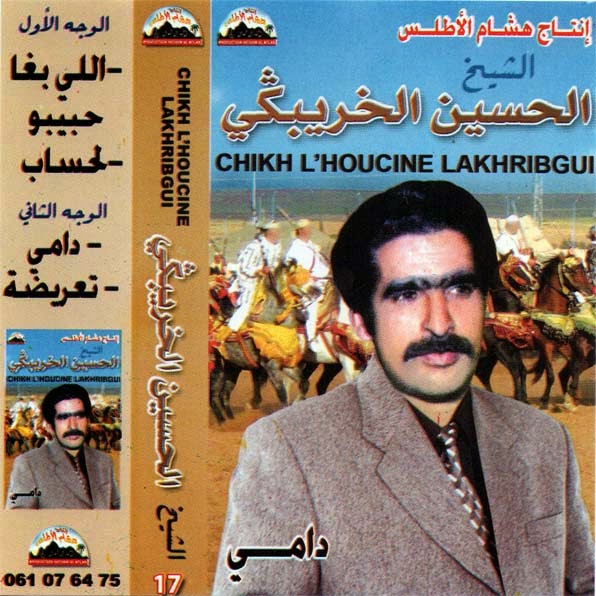
It's another vintage recording of Shikh El Houcine El Khouribgui, who has been featured here before, and it's on the great label Production Hicham El Atlas. Plucked new off the shelf in 2012 around Beni Mellal, it's definitely a reissue of an older recording. The tape begins by announcing "Istwanat Markikphone toukadime Shikh El Houcine el Khouribui" (Markikphone Records presents...). The great website settatbladi.org has this image of a cassette reissue of Shikh El Houcine on Markikphone (I assume it's a reissue because the j-card reads in Arabic "the late Shikh El Houcine...):
The centerpiece of the album is the opening piece "Dami", a long form âita with a great 10/8 rhythmic cycle. The j-card lists the titles "Lli Bgha Hbibou" and "Lehsab", but neither track 2 nor 3 sound like other versions of those songs that I know. I labeled track 2 "Nghadrou Kissane" because it shares lyrics with Bouchaib el Bidaoui's track of the same name, and I left track 3 as "Lli Bgha Hbibou", cause I hear the word habibi a lot. Whatever the correct titles may be, I hope you enjoy the old scratchy groove!
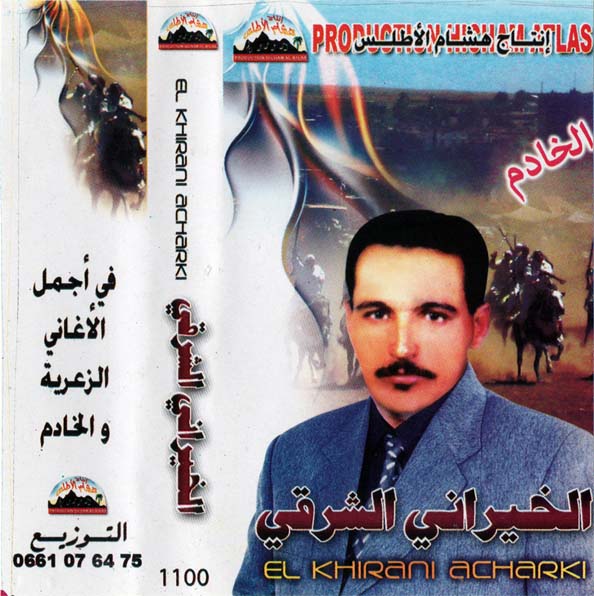
You want this tape! Long, sweaty tracks of âita zaêriya, just right for that we-can-do-this-all-night-long summer wedding vibe. The sound quality indicates a professional studio recording, but throughout the whole tape one can hear people having conversations, clapping along, ululating, encouraging the dancers and musicians, dancing on the qaâda perhaps? Maybe it's a good recording from a very rocking wedding? Whatever the source may be, it's a noisy, raucous, lively one that will do you right! Another winner from Production Hicham Atlas.
I don't know anything about the artist El Khirani Charki, though a few clips of his performances are available on YouTube. I picked up the cassette in 2012 in or around Beni Mellal.
By the way, I don't know what is the deal with the nutty taârija player in this video clip. I just saw him on Moroccan TV the other night, doing the same shtick. It's especially weird when, as here, sultry shikhat are vying for one's gaze. Perhaps he is the equivalent of the pickled ginger eaten with sushi to cleanse the (here, visual) palate, making one appreciate the shikhat even more...
El Khirani Charki - El Khadem (Hicham Atlas 1100)
01) El Khadem
I've referred to Âita with frequency in my posts, and with good reason. It's among the most important genres of Arab music in Morocco. It's well-loved in its own right and it serves as the basis for much of Moroccan chaâbi music. I wish I could give a better overall description of the genre and its variants. For those interested, I translated below a few paragraphs from Ahmed Aydoun's Musiques du Maroc to give some basic musical dimensions of âita and a few interesting tidbits of information. For a deeper analysis of the aesthetics and powerful association held between âita and regional identity, check out the work of ethnomusicologist Alessandra Ciucci.
Today's post features yet another cassette from the Hicham Atlas imprint, this time featuring a violist called Shikh al-Moutcho. I didn't find much info on him web-wise. Settatbladi.com lists an Ahmed Al Moucho, but most of the tunes with his name feature the ghaita oboe rather than the viola. (These tracks are worth checking out though - âita with ghaita is pretty unusual!)
The centerpiece of this tape (for me at least) is the 12 minute "Hsab Zaêri". I love pieces like this - short vocal couplets alternate with long passages of doing-it-to-death viola riffing, and are punctuated by syncopated accents on the bendir. In comments on a previous post, Hammer dissertated on âita zaêriya and described the practice called "Hisab Al-Za'ari" as a competition between singers.
(Hammer - hoping you may weigh in with some info on Shikh al-Moutcho - I notice that you mentioned his name in the aforementioned comments - any info is, as always, greatly appreciated!)
Unfortunately the shikhat singers featured on this recording are unidentified, and I can't tell how old these recordings may be. I picked up the tape in 2012 in Kasba Tadla or Beni Mellal. Hope you enjoy, and Happy Father's Day!
UPDATE: Forgot to mention - Track 2 "Bâd Menni" features the same melody as Najat Aâtabou's famous "Shouffi Ghirou" (as featured here). I wonder if it's a traditional melody that Najat borrowed or if this track borrows from Najat...
-----------------------
From Ahmed Aydoun's Musiques du Maroc, Casablanca: Editions EDDIF, 1992, pp. 108-109, my translation:
It is primarily in the plains bordering the Atlantic where al 'âita
is most appreciated. Specifically, the genre is practiced in the
regions of Shawiya, Dukkala and 'Abda, that is to say, in the
Casablanca-Safi axis. Al 'âita is also found in the plains of Z'ayer, in
Beni Mellal and in the Hawz, for which variants are named. The term
'âita is also used to refer the song of the Jbala, incorrectly referred
to by the name taqtüqa jabaliya. Finally we have found the term in the
hadra of the Hmadsha of Essaouira, where it refers simply to the
instrumental part that introduces the trance.
Two
different interpretations can be made of the word 'âita. According to
the first, it would be a derivation of the verb 'ayyat (to call, in
dialectical Arabic). According to the second, it would be a deformation
of ghayta (folk oboe). We prefer the first version since it is
effectively a call - nearly all of the 'âitas begin with the invocation
of Allah and the saints. The act of calling has several other
connotations - anticipating, searching, asking for inspiration.
Al
'âita takes different qualificative names by region; it is Marsawiya
along the coast, Za'riya, Mellaliya and Jabaliya. In addition to these
principal variants, there exists at Safi a special 'âita called Haçba,
its repertoire limited to several examples of the genre.
With
the exception of Za'riya, which is monorhythmic, all of the 'ayût
feature changes of rhythm, usually in three progressively faster
sections.
The 'ayüt are often sung by a group of mixed
men and women. In cases where the latter are absent, one of the men of
the group wears women's clothes and imitates women's voice and dance.
The 'âita of Wlad Hmar is a good example of this.
During
the second half of the 19th century the 'âita had its hours of glory
with the Qaîd 'Îsa ben 'Umâr al 'Abdi who was, it seems, a
connoisseur. His house attracted the best musicians and singers whose
performances were graciously rewarded.
According to
Mohamed Abu Hamid, the 'âita genre grew from its simplest form of
expression, al muqlâ' (the distich), to become over time an elaborate
composition best exemplified by the Marsawi variant.
The Marsawi is composed of two parts of contrasting rhythm and character.
Each part is comprised of strophes (qatibât) linked by cadences and
poetic transitions (hatta). The 'âita ends with a sadda, that is, a
final cadence.
The first part is slow and is called lafrâsh (literally: the bed, the bottom sheet). It begins with a
musical introduction that prepares the entry of singing. Often the
introduction is a taqsîm, then an exposition of the sung theme without
strict rhythm. The principal phrase of the song is repeated from start
to finish; in the second part, it undergoes only small changes.
The
fast-paced second section is called ghta (blanket). Here, the
rollicking rhythm drives the dance. The latter is regular, calculated -
for this reason it is called hsâb (literally: calculation). The
youngest of the chikhât performs before the audience sensual dances
(play of the belly and hips, undulating and quivering of the body,
swinging of the hair…), then the singing restarts with a dialogue
between the main chikha and the rest of the chikhat and musicians.
If I was lukewarm about the viola in my last post, I'm happy to post here some fabulous, scratchy viola from Shikh El Houcine el Khouribgui. Some good, old fashioned aita for ya, Khouriba-style. Another offering from the swell Hicham Atlas imprint.
This CD sort of does double duty - you've got some lady-driven call-response singalong tunes (which would probably sound just fine without the viola that plays along through the whole thing). And you've got some viola-driven chaabi tunes and riffs that give that desired wedding/party ambiance - in particular, track 6 which feature what sounds like someone doing rhythmic-percussive footsteps on a qaâda (the metal basin that dancers climb onto during weddings or performances, to let their feet sing).
Here's a pretty rocking qaâda clip (which spins off into silliness about halfway thru...)
But back to the CD. Personally, I prefer my call-response women's songs with percussion-only. But I understand the irresistable pull of the viola - the chaâbi ambiance-animator supreme, and it works alright here. What surprised me and worried me on my recent trip to Morocco, is that when hunting for tapes of the great âbidat errma genre in and around Beni Mellal, I was told by all tape sellers that nobody was recording it anymore with its traditional percussion-only ensemble - the only recordings I could find featured violas in the group. Stupid me, I was so disappointed that I didn't pick up any tapes of that. It would have been interesting (he says, donning his ethnomusicological hat) to compare older tapes of the genre with what's calling itself âbidat errma today. On my previous trip in 2006, the trad stuff had become quite popular, and there were loads of young men playing playing in âbidat errma groups in the Beni Mellal area. I've got some vintage âbidat errma I'll drop on ya one of these days. You've never heard a pair of scissors played so funky!!
By the way this CD and many tapes I got on this trip come from the production house Hicham Atlas. Their product lists no address - only a cell phone number. I'm guessing they're located around the greater Beni Mellal-Tadla-Khouribga-Fkih ben Salah area. Good stuff!