It's about time we got around to posting about La Tabaamrant! Fatima Tabaamrant (b. 1962) is a powerhouse singer, songwriter, and activist for Amazigh and women's rights. In addition to being a pivotal figure in Soussi music, she served as a representative in the Moroccan parliament from 2011-2016, where she became the first person to ever pose a question in the Amazigh language.
After a troubled childhood and early marriage, Tabaamrant turned to poetry and music as a mode of expression. (Her early life is dramatized in the 1994 film Tihiya, in which she stars.) She spent time working in the troupes of several different rwais (Rais Jami’ Al-Hamidi, Said Ashtouk, Moulay Mohamed Belfaqih, and Mohamed Demsiri) before ultimately striking out on her own in the early 1990s. She was not the first female artist to lead her own troupe in the field of Soussi amarg poetry and song: Rqiya Demsiriya and Fatima Tihihit were two notable predecessors. Tabaamrant, however, distinguished herself by not only singing and leading her own troupe but also composing her own poetry.
Her work has addressed many themes and issues over the years, primarily connected to and in support of Amazigh identity. These include: marginalization, Amazigh culture, land, language and traditions, women's rights, education and parenting, rural vs urban life, history and religion, love and marriage and contemporary topical issues. (She released a song in 1998 mourning Kabyle singer/songwriter Matoub Lounes, who was assassinated in Algeria that year.)
I picked up this cassette in 2012, I believe in Rabat. (Tabaamrant's YouTube channel dates it to 2000.) I don't speak Tachelhit, so I don't know what these songs are about. The main musical style here is a sort of tagroupit augmented with ahwach sounds. On first listen, I thought it was the typical tagroupit electric guitar plus banjo or bouzouki. On second listen, I think it's actually 2 electric guitars: one plucky twangy one and a second warm/fluid one. Additionally, all tracks feature drum accents and punctuations typical of ahwach performance, and the final track adds flutes and clapping to the mix for a big ahwach finale. For fans of quintuple meter (like me), the title track (Track 2) is 14 and a half minutes of fivey goodness!
Fatima Tabaamrant continues to produce new music consistently, incorporating different musical configurations as times change, but always anchored in her poetry and vocal delivery. Follow her on Instagram and/or Facebook, and subscribe to her YouTube channel, where she dropped this new track AN HOUR AGO:
Hawamich. "فاطمة تبعمرانت.. من طفولة قاسية إلى صوت للهوية الأمازيغية
[Fatima Tabaamarant.. From a cruel childhood to a voice for Amazigh
identity]". 2025-09-22. https://hawamich.info/10504/
Talmenssour, Abdelâali. "Rraysa Fatima Tabaâmrant: Figure emblématique de la chanson amazighe traditionnelle du Sud marocain", Moenia, 20 (2014), 215-230. https://hispadoc.es/servlet/articulo?codigo=7541628
This tape comes to us courtesy of Peter at the still active, still great มนต์รักเพลงไทย blog. The group is called Toudadine. I gather that the word toudadine is the female plural in Tachelhit for the Barbary sheep (ewes). The male plural for these sheep (rams) is oudaden, which is of course the name of a renowned Soussi group that originated the tagroupit style in the late 1970s/early 1980s.
We posted about Oudaden and tagroupithere back in 2015. Briefly, tagroupit originated in the 1980s as a sort of return to traditional Soussi rhythms and melodies as well as love songs. It was seen as a "return" in light of the 1970s innovations of the earlier, more eclectic and political tazenzart style that originated with the group Izenzaren. This 1980s return to traditional melodies by Soussi artists reminds me of the rise of new chaabi groups in 1980s Casablanca like Noujoum Bourgogne and Toulati el Farah who were also "returning" to traditional sources and lyrical themes in distinction to the 1970s proliferation of eclectic and political groups like Nass el Ghiwane.
This cassette by Toudadine is in a sort of pop-tagroupit style. It features the typical electric guitar and banjo, but 3 of the 4 tracks also feature a keyboard, and the rhythm sounds like programmed beats throughout. The group is fronted by what sounds like 2 female singers singing in unison, with a group of men as choral responders. The j-card flap reads:
أغاني متنوعة - كلمات وتلحين الحاج الحسين أمنتاك Various Songs – Lyrics and Composition by Lhaj Lhoucine Amentag
Lhoucine Amentag (not to be confused with Hmad Amentag) was a well-known singer and composer in the rwayes/amarg tradition. My ear thinks that the first song on this Toudadine tape may not be one of Amentag's: it seems to have more of a pop structure than the other 3 songs, and the lyrics keep coming back to the word "Toudadine", so I wonder if it might be an original song of the Toudadine group.
I didn't find any information about the group online. There are several video clips of a Toudadine group uploaded by Production Disco, but they are clearly a different group - the female vocals are in a different register, it seems about 20 years removed from the group in our cassette, and the songs are very poppy, despite the traditional banjo/guitar accompaniment. (The commenters on the video clips of this group are 50% complaints about their clothes and 50% defending them for having nice voices, despite their terrible clothes. E.g., here.)
Google identified one of the songs on this cassette as "Ahbib Nyan Zound Lkhatam", credited to a "Toudadine Amazigh". Perhaps LVEM rebranded the recordings with this name to avoid confusion with the other fashion-challenged Toudadine group 😅.
Speaking of Rais Lhoucine Amentag, you can find a swell cassette of his over at Moroccan Tapes and another one at TRAD & FOLK MUSIC ON 33RPM & TAPES. I used one of the tracks from the Moroccan Tapes cassette in a mix I recently produced for Radio Is A Foreign Country called "Buzz, Rattle & Scratch: Grainy Timbres of Moroccan Music". Check that out HERE - it's a buzzy, rattling, scratchy good time!
Toudadine تودادين La Voix El Maarif cassette 461 صَوت لامعَارف
Dig it! Here's a delightful cassette from singer and guitarist Haim Bobtol (billed on his Tichkaphone releases as Abitbol). You can read about Botbol's history and musical career in this old post at Jewish Magrib Jukebox. As far as I can tell, Botbol is still alive and nearly 90 years old here in 2026.
The opening tracks on each side of the album are of the fun, participatory chaâbi variety where a short phase is repeated by backup singers (and the audience) in response to the singer, who reels off line after short poetic line to keep the assembly engaged until he lets the violin take over to propel the dancing. The subsequent tracks on each side lean toward the Andalusian/classical end of the chaâbi spectrum in melody and texture.
If you've read my posts, you know I love the sound 1980swedding-type chaâbi groups with their raucous drum kits and strummy rhythm guitars. Botbol's style of orchestral chaâbi heard here emerges from an earlier generation. Many elements are the same: repertoire drawn from various Moroccan genres, violin driving the melody, several other instruments providing melodic and rhythmic support. But the sum of the parts feels different - somehow more urbane and more earthy at the same time.
A contemporary in this era and approach to chaâbi is Abdessadek Chekkara, whom we profiled here last year. Both he and Botbol are children of the 1930s, born into a musical families, raised learning elite traditions (Andalusian, mehlun), but also with interest in the broad swath of Moroccan musical styles. Both began recording in the vinyl era and continued into the cassette era.
You can hear a trace of this history in Botbol's vocal stylings - the vocal mawwal passages in the track "Lataâmal Âchir", where you can hear the ornamentation styles particular to Jewish Moroccan singers of classical genres.
The participatory chaâbi tracks feature some eclectic elements. In addition to darbuka, kamanja, female chorus and clapping, there is some kind of ghaita/oboe-sounding instrument on some of the instrumental breaks. Is it a keyboard? whatever it is, I love it. I'm also crazy about the harpsichord-sounding keyboard instrument - the same instrument can be heard on some Hajja Hamdaouia recordings of the period (late 60s? early 70s?). I wonder if there was a keyboardist in the Tichkaphone house band that added this instrument to the recordings of both artists. Finally, add Botbol's electric guitar deep down in the mix and you have a distinctive, very enjoyable track!
Hope you enjoy! I've got some more Botbol in the stash. But I'm working on a major Nass el Ghiwane post that you may see before I get back to Botbol.
Abitbol أبيطبول Tichkaphone TCK 523 تشكافون A1 Asbar الصبر A2 Lataâmal Âchir لا تعمل عشير B1 Rah Additiou راه الديتو B2 Rassoul Lhoub رسول الحبيب B3 Taârida
Âita, Moroccan deep Arabic folk song, doesn't need modernization - it's perfectly fine and powerful in its own right as performed by traditional ensembles. At the same time, it doesn't necessarily suffer when musicians put it into conversation with other genres and styles. Sure, this CAN be done in a simple way that doesn't add anything interesting and just waters down the hard-hitting time-tested acoustic textures of aita with modern instruments or vocal styles. In the best cases, though, something interesting emerges.
Last week I digitized a 1990's tape that Gary from Bodega Pop sent me by the group Toulati El Farah Lamnawar. It's a chaâbi album of the era but it's based in the âita repertoire, and pushes the right buttons for me. I also found out this week that the debut album of the group Aïta Mon Amour came out in January of this year. Their initial singles caught my attention last year with their clever settings of âita songs to modern electro beats and the powerful vocals of singer Widad Mjama.
Toulati El Farah Lamnawar
The cassette comes to us courtesy of Gary of Bodega Pop whose weekly program on WFMU's Give The Drummer Radio stream is eclectic, educational, and always entertaining.
The group Toulati el Farah Lamnawar [1] was led by the late producer, songwriter, and musician Abdeltif Lamnawar (1968-2022), who I believe is from Casablanca. I was not familiar with the group previously, but they seem to have produced a lot of music over the years in a number of formations. The presence of the name Lamnawar after Toulati el Farah suggest that this is Lamnawar's version of the group, which reached its initial successes as simply Toulati el Farah. You can find a couple of these early albums on the streaming platforms under the names "Dami" and "Ana Melit". I believe the initial formation of the group included Lamnawar as well as the vocalist Hassan Lougato. Later albums are attributed to "Orchestre Toulati el Farah" (Trio el Farah Orchestra). And I see some recordings and videoclips that mention the participation of the well known chaabi singer/violinist/arranger Mustapha Bourgogne. At any rate, as Lamnawar relates in this interview, the group formed around the idea of doing the old bendir-and-kamanja (violin) songs with drum set, guitar, and keyboard.
Followers of this blog know that I'm a sucker for electric guitar and drum set, so yes I did enjoy the early 1980s version of Toulati El Farah linked above. This cassette, however, dates from sometime in the 1990s, and chaâbi styles, like all popular music styles, can change substantially in a few years' time. How different is this? Well, it's smoother - seems like there is some drum programming that keeps the beat very steady, as opposed to the raucous drum set of the earlier recordings. However, the darbuka is high in the mix, keeping the music punchy and live. As a bass player, I tend to disdain the use of programmed keyboard bass, but I gotta say, this one here is pretty enjoyable - its syncopated runs provide some of the rhythmic variety that was previously provided by fills on the drum set. And the electric rhythm guitar is still there, buried a bit in the smooth mix, but prominent enough to provide that strummy goodness. Best of all, the 2 fine singers trade off verses, retaining the interactive excitement of shikhat groups. My assessment is of course a completely subjective one, based on my own personal tastes and experiences dancing to this sort of band years ago. For others, this may just sound old-fashioned, or may not work at all. But hey, you can be your own judge:
Toulati El Farah Lamnawar الثلاثي الفرح لمنور Rddou Ouarana Âacha ردو ورانا عاش Disco-Disc cassette ALBUM 19 ديسكو ديسك
[1] Depending on which words you want to translate and how, the group's name can be translated something like:
Lamnawar's Trio El Farah
Lamnawar's Trio of Joy
Lamnawar's Happiness Trio
Aïta Mon Amour
The group Aïta Mon Amour released their debut album Abda in January 2025. I'd been greatly anticipating the album after hearing the group's initial singles in 2024. The group is a powerhouse duo: Widad Mjama on vocals (and occasional drum pounding) and Khalil Epi on multiple instruments.
Like Toulati el Farah, the group was conceived as a vehicle for presenting the old songs in a new format. Here, the venue is not the chaâbi dance/wedding floor, but concert and festival stages, and the beats are contemporary and electronic. Normally I like my âita with a group of singers and musicians to provide that interactive texture that is such a vital part of this music. What Aïta Mon Amour lacks in that regard is made up by the power and expression of Widad's singing and the complex, suprising textures of Khalil's arrangements.
You can hear their album on all of the streaming platforms, but why not support the band and purchase a copy on Bandcamp.
How will these beats sound to ears 30 years from now? Who can say? But I have no doubt that the deep well of âita will still be a source of inspiriation for generations to come.
This tape comes to us from... well, down the street in El Cerrito, California, where I found and purchased it! This is a swell album from singer Fatima Tamrrakchit. The texture on every song is a bit different - there's always some combination of the typical Soussi amarg ensemble (rrbab fiddle, lotar lute or banjo) with additional instruments (electric guitar, a violin, maybe that was a sythn banjo, and some sort of bass instrument - it's a bit deep in the mix (which is fine), it could be a keyboard, or it might be a big Gnawa guinbri). The percussionists keep things lively and at times wild.
I found very little information about Fatima Tamrrakchit online. From what I gather from YouTube and TikTok comment, she died at a young age in April 1998.
There is another singer with the same name who is currently active but who should not be confused with the first Fatima Tamrrakchit.
Digital Mastering Note: I used the new "Mastering Assistant" that was released in the latest update of Logic Pro X. Part of the tool is an AI-driven analysis that can produce a custom EQ for whatever you're working on. Sort of freaks me out, but it's also kind of amazing. I used it here, and I think it sounds pretty good. You can find all of these tracks on YouTube, if you don't like this. (The YouTube clips are probably from a better source than my tape here anyway, but y'all come here for a bit of that analog patina, right?)
Hope you and your loved ones are well. Praying for a just peace.
Fatima Tamrrakchit فاطمة تمراكشيت تهراركتف Production Disco cassette PD47
A1 Takat Ah Igh Trgha Dora A2 Dounit Ra Tzri B1 Or Sarn Orrigh Lhob
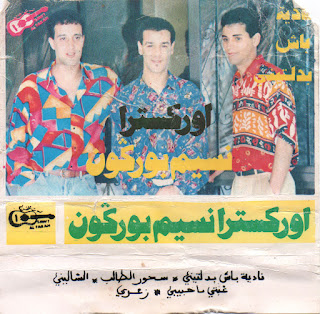
Here's some of that good early 90s chaâbi! The artist here is Orchestre Nassim Bourgogne - not to be confused with
the famous Noujoum Bourgogne/Mustapha Bourgogne, though one assumes
that they hail from the same neighborhood, namely Bourgogne in
Casablanca. The catchy catchy "Nadia Nadia" was a big hit in the summer of 1993, if my memory is correct.
I thought Nassim was the name of the singer, but in fact it's the name of the group - Nassim Bourgogne means "The Bourgogne Breeze". Facebook and YouTube are my only sources of information about the group. The Facebook page شعبيات شبابية مغربية identifies the 3 members of the group as Majid Meziane (singer), his brother Saïd Meziane (percussion) and Fakir Mohamed (viola). They appear to have gained some success in the 1980s and 90s.
Many audio and video clips of the group can be found on the YouTube channel TV HADJ BOUIDI, including this great extended clip from a 1994 concert.
The album we're sharing today has orchestration similar to that in the above live clip - there's a drum kit, an electric rhythm guitar and a keyboard. The guitar doesn't get to play much obbligato, other than the opening to "Nadia". I'd love to hear more of that, but I'm also happy to hear it play rhythm/chords, which I prefer so much more than hearing keyboard string or horn pads. And it does play some nice syncopated rhythmic figures during the âita piece that opens side B (audio clip below) - love it!
Orchestre Nassim Bourgogne اوركسترا نسيم بورگون Nadia Bache Bdeltini نادية باش بدلتيني Sawt El Farah cassette صوت الفرح c. 1993
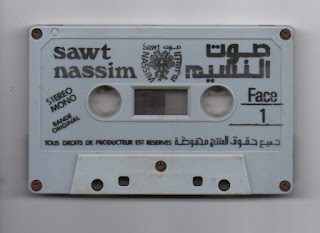
Well here's something old yet different - it's a tape of songs by lotar-master Rouicha, performed by a 1980s chaâbi orchestre - viola, drum kit, and darbuka, and driven by an electric guitar! I was just remarking a couple weeks ago how Middle Atlas lotar songs work so well in a chaâbi context and vice versa. Here is more evidence (apologies - the audio quality is not the best, but the grooves are so good!):
The vibe here ☝️ reminds me somewhat of the âita-based guitar-driven sound of Noujoum el Haouz. The drum kit is similarly propulsive, and the darbuka and viola pull the track toward the âita sound world. On another track 👇 however, the âita/chaâbi stylings fall away - there is no viola, the singing is in Tamazight, and the drum kit and darbuka switch from chaâbi propulsion to a laid-back Middle Atlas swing. This foreshadows a bit the flangey acoustic guitar-driven Middle Atlas grooves that Moulay Ahmed el Hassani would popularize a few years later.
Unfortunately, I have no idea who are the musicians on the cassette or from where they hail. The Sawt Nassim label was (is?) based in Casablanca, but that doesn't guarantee that the ensemble was based there. I hope someone in YouTube comments can identify the musicians!
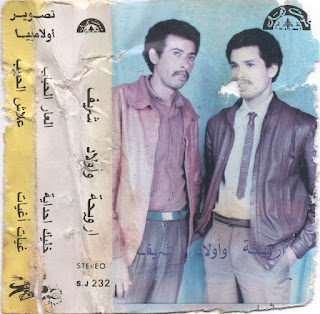
By the way, this cassette came to me from Essaouira (shukran T!) with the j-card pictured at right. I was looking forward to hearing it - the duo Arouiha and Oulad Cherif were featured in this old post over at Awesome Tapes From Africa. Was disappointed that the tape did not match the j-card. Luckily, the Sawt Nassim tape it housed is pretty great. Still - that leather tie!
The songs on side B of this album are both featured on Rouicha's fabulous album TCK790, still available here: https://moroccantapestash.blogspot.com/2011/06/mohammed-rouicha-afak-al-hwa-hda-liya.html. I couldn't identify the first track on side A, but the second track, 'Mani L3ahd Mani L3zazit' (featured in the YouTube clip above) can be found on YouTube in several versions, one of which is attributed to Rouicha. (There's no discographic information, but a YouTube commenter claims it was recorded by Rouicha in 1981). It clearly remains a well-known song, as one can find versions of it performed by many artists on YouTube.
Editing note: Side A and Side B of the tape both end with instrumental intros, and both sides begin with intros cut off. So I grafted the intro from the end of each side to the first track on the other side.
Pluck Yeah! 1980s Electric Guitar Chaâbi Orchestre Plays Rouicha Unknown Guitar-Driven Chaâbi Orchestre Sawt Nassim cassette
A1 Piste 01 A2 Mani L3ahd Mani L3zazit ماني العهد ماني العزازيث (video embedded above) B1 Toub Toub A Rasi توب توب اراس (audio embedded above) B2 Lawah a Lawah Ammi Lhubb Iâddeb لواه امي لواه الحب يعدب
Aaaah... a Moroccan wedding on a hot urban summer night about 30 years ago. The smell of mint tea and the amplified, saturated sounds of a big jawq/orchestra animating the crowd. After a bit of slow stately music (melhun or Andalus), the bride is paraded in, in all her glory, the ululations fly, the crowd rises, and the band launches into Lâaroussa Jat:
I picked up this cassette on my first trip to Morocco in 1992. It's your typical wedding chaâbi fare, but with an nice punch to it - the drum kit is propulsive, the electric guitar nice and twangy, and the bass and strings also pack a punch (unlike the smooth timbres that would become the norm a few years later). And Abdou el Filali's singing is appealing, energetic, and enthusiastic.
Filali was born and raised in Kenitra. His early musical career was spent with Ghiwane-style groups Layali el Ounss and L'Mghariyine. He later attended the conservatory in Kenitra, where he found his voice as a chaâbi singer. If the info I found online is correct [1], it was Filali who popularized the song Laâroussa Jat,
via the version on this cassette. The song subsequently became a wedding standard - that's a notable achievement for any
singer! [I'm pretty sure it was played at my wedding - I wonder whether
it's still in the repertoire for weddings today.]
Another rhythmic track from the album caught my ear. "Oh, they're singing in French", I thought... "Wait, did he just say 'passé composé'? Are they... conjugating verbs to a chaâbi beat?" Yep - here's what I got:
Poste. Téléphone. Télégraphe. P.T.T. Répétez
Poste. Téléphone. Télégraphe. P.T.T. Répétez
Le verbe 'chanter' en passé composé
J'ai chanté
Tu as chanté
Il a chanté
Nous avons chanté
Vous avez chanté
Ils ont chanté
Filali remains active today. You can find some recent videos at his YouTube channel. There are some old cassette covers and photos on his Facebook page. And Soundcloud has a rip of the song Lâaroussa from a tape of better quality than my copy. This version also contains the opening ululations and Slaaaaaa ou Slaaaaaaams that are cut off on mine.
Orchestre Abdou el Filali - اوركسترا عبدو الفياالي K (Kennedy) Music cassette 12 - موسيقة كنيدي early 1990s
1) Lâaroussa (لعروسة) 2) Hnia (هنية) Mali ou Mali (مالي و مالي) 3) Moulat Wa7ed (مولات واحد) 4) Telephone (التلفون) Al Wali Sidi Bennour (الوالي سيدي بنور) Jaya Min Eddouar (جاية من الدوار) 5) Ma Kayn Khir (ما كين خير)
Long drawn out medleys? Check. Âita melodies and structures? Check. Scratchy viola and punchy darbuka? Check. Drum kit, electric guitar and organ? Yes - right there!
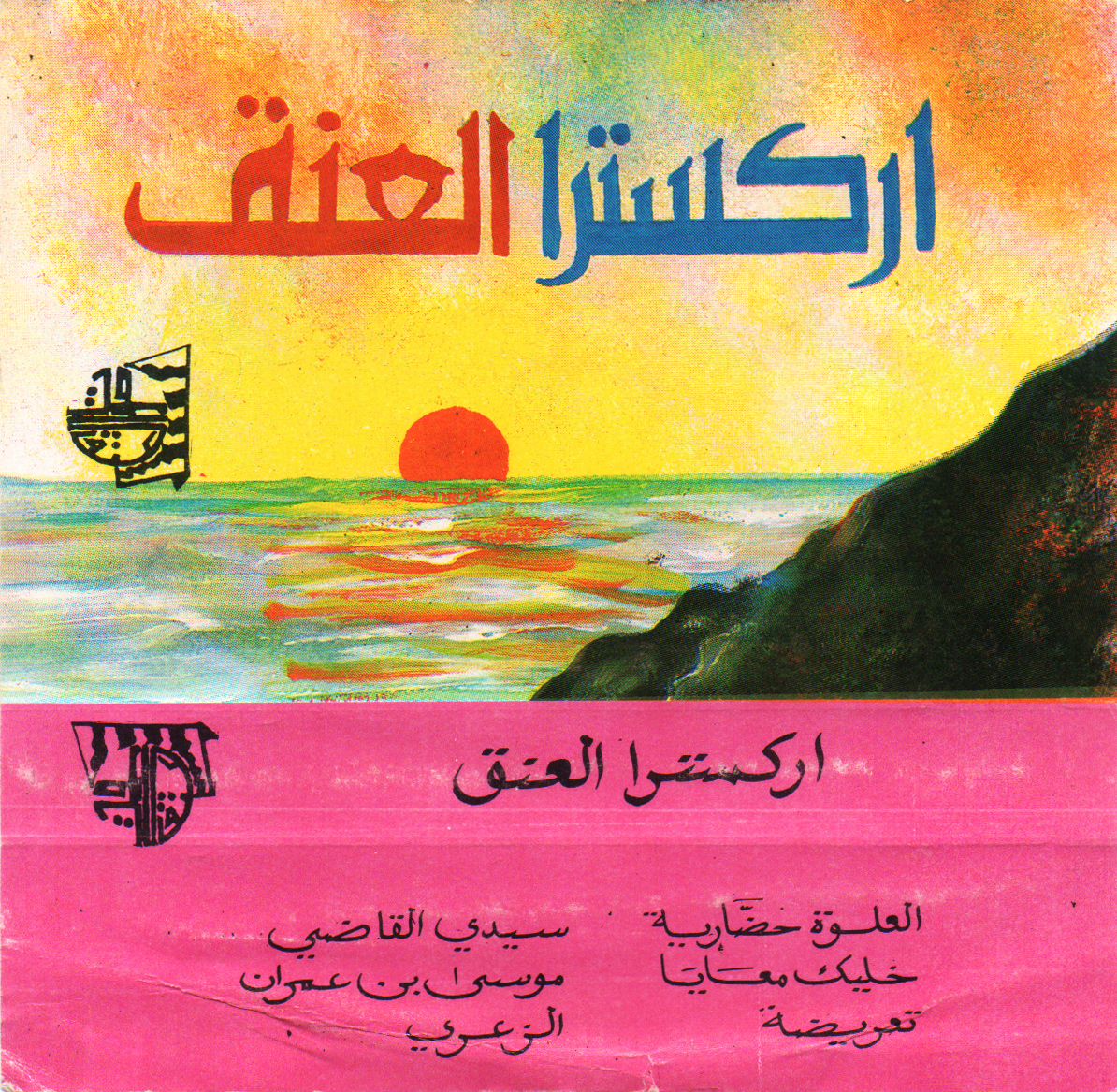
This swell tape comes from a little stash of tapes that fell into my lap a few months back. All without j-cards and most with only the name of the production house on the cassette shell. This one is from a company called Sawt el Ânq (انتاج صوت العنق). I'm guessing it's from Casablanca, but only because the singer gives a shout out to the soccer teams Raja and Wydad.
[blogger knows he's seen that logo before, goes digging around in the stash...]
Well - I knew I'd seen that Sawt el Ânq logo before on an orphaned j-card in the stash. (And a fantastic logo it is, too!) Went looking for it, hoping it would reveal the location of the production house. No luck there, but... the song titles were a match for this tape!! The tape must have bounced around among the Moroccan ladies in the Bay Area for 20 years and then landed back here in the stash where its j-card was waiting for it!
Also, my friend Jamal confirms that El Ânq is a neighborhood in Casablanca, so we're pretty sure this is a Casa production.
This is some vintage late 1980s chaâbi. Hope it hits your sweet spot too!
Orchestre el Ânq (اركسترا العنق) Sawt el Ânq (انتاج صوت العنق) cassette
1) Sid el Qadi سيدي لقاضي
2) Melki Ma Jiti
3) Zaeri - Musa ben 3amran الزعري - موسى بن عمران
4) Al 3aloua Hddariya العلوةحضارية
5) Khellik M3aya - Taârida خليك معايا - تعريضة
Salaams, good people! Sorry for the long dry spell. All's fine here at Moroccan Tape Stash, despite the generally befuddling times.
If you’ve visited Moroccan Tape Stash before, you know that your humble curator loves chaâbi tapes from the days of drum kits and electric guitars. How about we add some saxophone to that mix! Here’s a vintage gem from the stash - an early tape by Khalid Bennani, picked up on my first trip to Morocco in 1992.
According to his biography at Ournia, Bennani performs primarily for “private parties such as weddings and engagement ceremonies”. I have the greatest respect for a good wedding band - being able to satisfy folks old and young, from near and far, is not always easy. And if we’re talking about Moroccan weddings, that means having a fresh, diverse, and extensive repertoire that will give rhythm to a party for hours, often deep, deep into the night.
In addition to wedding work, Bennani continues to record prolifically and to give concerts outside of Morocco. (Apparently he performed some dates in Texas earlier this year!)
Bennani is based in Casablanca but is a native of Taza (between Fes and Oujda) and plays a Fessi repertoire, including melodies reminiscent of the Arab Andalusian and melhun repertoire, devotional strains from the Aïssaoua brotherhood, and tunes evoking the Jbala region of northwestern Morocco.
Fessi chaâbi is usually too smooth for my tastes. I prefer things more raucous, à la Casablanca or Marrakech style. This album, though, manages to achieve a texture that is somehow both smooth and raucous! Maybe it's those snare drum punctuations from the drum set along with the syncopated electric rhythm guitar, a darbuka prominent in the mix.
Enjoy!
Khalid Bennani خالد بناني
Oscariphone (اسكارفون) cassette 11
ca 1992
1) Lhwa Bia - Ma Ândi Zhar لهوى بيا - معندي زهر
2) Yom l-Miâd - A Latif يوم الميعاد - ألطيف
3) Ana f-Ârek - Daba Tendem Âliya انا فعارك - دابا تندم عليا
After the success of Nouveau 92, Najat Aâtabou did not return to the oud and bendir format of her earlier hits. Rather, she adopted various other instrumental combinations, moving eventually toward a more mainstream chaâbi sound.
I own copies of some of these cassettes (without j-cards), and have lost a few along the way. Also, some of these are available to stream or purchase online. So I'll mainly post here links to existing web resources and try to piece together her discography between Nouveau 92 and Attention Monsieur (2000).
Souaret (1993)
This album came out as a cassette on Edition Hassania in 1993. My copy went missing long ago, but I believe the j-card may have had this photo, which accompanies Amazon's version:
The production sounds similar to that of Nouveau 92, using the same funky synth bass on many tracks. I remember at the time being a bit disappointed with the album, feeling it was less hard-hitting than Nouveau 92, and contained no super-catchy single. Listening to it again now, though, it sounds like a breath of fresh air! It augments the unusual synth and viola texture of Nouveau 92 and fills it out with a more organic early-90s chaâbi orchestra: live strings, bendirs, full drum kit, and an occasional electric guitar. It's a more organic, orchestral overall sound. (Admittedly, I'm a sucker for the chaâbi sound of that era.)
And Najat's singing is spectacular. Those folks over at Edition Hassania really knew how to record her - whether accompanied by a simple oud-and-bendir ensemble or a full orchestra, her voice remains powerful and startling.
This is, I believe, the last album that Najat released on Edition Hassania. I used to have a copy of the cassette. Like the previous albums, this one is also driven by the viola. But the style is different here. Rather than a chanson moderne style of viola playing, hearkening to the smooth sounds of the modern Arab orchestra, here we have a straight-up dance-inducing chaâbi fiddle! The overall ensemble is more simple - bendirs, some oud and melodic keyboard here and there, and what sounds like a drum machine (hi-hat and some fills). Though a return to oud and bendir-s is nice, the chaâbi viola really dominates the mix and doesn't quite work for me. That being said, the tune "Baadou Lhih" is awesome and became part of her live repertoire.
The album's 6 tracks were remastered and released in the US as part of the Rounder compilation CD "Country Girls and City Women", which is out of print. It's worth finding a used copy of the CD - the booklet includes a nice essay, translations of all the song lyrics into English, and an interview with Najat. I can't find any streaming or download options for the album. Here's a YouTube playlist of the album's songs:
Sabara (1996)
I had a dub of this album, and I remember it being on label called something like "Safa Disque". (It wasn't the well-established Sonia Disque, with whom she would later record.) The leadoff track "Aatani Bedhar", also known as "Mali Ana Ma 3andi Zhar" was a smash hit - smooth chaâbi groups were covering it, and with its singalong chorus of "Wa-a-a-a-ayli", it was an instant classic, and one of Najat's biggest ever hits. I love it!
It was around this time that studio-produced chaabi in Morocco started to sound a bit too perfect and precise for my ears. Though rhythms were still driving and percussive, drum sets had given way to drum machines and programming, which could feel mechanical. Electric guitars for rhyhmic and chordal accompaniment were rarely found anymore, replaced by more versatile synthesizers, which could also add a variety of melodic textures. Even oud-s and violas began to sound more processed and perfect. I tend to like my chaâbi (and most music) a little on the sloppy side - I appreciate being able to hear the human interactions and imperfections.
That said, when all the elements come together in a studio production, it can be great, and that's the case throughout this album. The oud remains prominent in the mix, the real or synth strings (I can't always tell which) support without being overbearing, the rhythm section pops and crackles, the synth bass keeps things funky and in the pocket, and Najat and the backup choir sound great! A mega-post on the ARAB TUNES blog has this album, and many others by Najat!
Also, here'a YouTube playlist of the whole album:
Souvenir (1998)
According to this interview, Souvenir, like its predecessor Sabara, was produced by Najat's former husband Hassan Dikouk. It has a similar overall sound to Sabara, and Najat seems to have comfortably settled into a mainstream chaâbi setting. To my ears the sound is a little less punchy - a bit more emphasis on the viola and less on the oud, and the vocals seem more subdued. But when it works, like in "El Aati Houwa Allah" and "Daba Ytem El Nachat", it still kicks.
ARAB TUNES has this one as well, and here's the whole album on YouTube:
Et Oui Mon Ami, Parle Je T'écoute (1999)
My cassette copy of this (get it HERE) contains a track not available on streaming platforms - a spoken message from Najat to her public, presenting her new cassette, on which, she says, she has tried as always to move chaabi song forward, and that the most important measure of its success is "your entertainment, clapping, and pleasure".
I don't know what prompted the inclusion of this rather apologetic message. Perhaps her moves into mainstream chaabi were criticized by some sectors of the public. Or perhaps she was nervous about the leadoff track, which has a distinct Latin feel and a light programmed percussion track, straying further away from her roots than usual. (This was the era of Amr Diab's smash Egyptian hit "Habibi ya Nour el Ain". Unlike that track, though, Najat's does not include the soon-to-be-ubiquitous-in-Arabic-pop flamenco guitar.) On streaming versions of the album (like the YouTube playlist embedded below, or Amazon's version), there is a bonus track - a chill lounge remix of the title song, with light funk electric guitar and Middle Eastern strings replacing the punchy synth horns of the original.
Outside of the title track (which was not a big hit), the rest of the album features a pretty standard chaâbi texture, though a bit more sparse than the previous two albums. I couldn't quite put my ear on what was different at first. I heard a viola and a synth banjo, some restrained programmed rhythm with a live darbuka. There is a funky synth bass again, though it's very low in the mix as compared to the previous albums. The really key difference here, though is that there is NO BENDIR! Throughout all of her albums, whether based around the oud, the viola, or a full orchestra, the one constant is the presence of the buzzy bendir! On this one, though, the only buzzy timbre you can hear is the occasional taarija. The low percussive tones, are not buzzy booms, but clean synth bass drums. Which is a weird idea, but it sort of works for me.
The viola-centered sound of this album hearkens to 1995's Taqi Fia Allah, but with punchier rhythm and overall sound. Again, the chaabi viola isn't my favorite instrument to hear with Najat Aâtabou's voice, but this ain't bad.
---
I saw Najat Aâtabou do a concert in Casablanca in 1999, and the only songs she did from any of these 5 albums were "Mali Ana Ma 3andi Zhar", from Sabara and "Baadou Lhih" from Taqi Fia Allah. But although these albums may not be packed with hits, there's worthwhile material on all of them. My ear for Moroccan lyrics isn't developed enough to critically assess Najat's 1990s songs in comparison to the earlier hits that brought her to fame. A lot of the same themes seem to pop up - complaints about romantic relationships, trying to keep things cool with mom, patience, acceptance, and calling out hypocrites. Her turn toward a mainstream chaâbi sound strikes me as a way for her songs of support and solidarity to resonate with a broader community of Moroccan sisters. At any rate that's my interpretation for now. Am happy to hear other opinions.
Wishing a blessed Ramadan to you all. Thank you for continuing to visit, even though I seem to only post about Najat Aâtabou these days! I promise I'll get some other stuff cued up soon...
---
UPDATE: Here is another Najat album from the 90s that I didn't know about:
Here's some more of that Moulay Ahmed Elhassani for ya. Track 4 of this album was featured on the Moroccan Tape Stash episode of Bodega Pop Live a couple weeks back. If you didn't get a chance to listen then, you can still hear the program in the archives here. We had a rollicking good time, spinning 3 hours of choice cuts from this blog and beyond. Many thanks to Gary for coming up with the idea and making it happen!
The j-card of this tape reads "Variétés Amazighia" suggesting that it contains a collection of songs sung in Berber. However, on the left side you can see a black stamp that reads "Zman Tghayer", which is the opening track of the album. The songs are all sung in Arabic, driven by more of that slow-jammy flanged-out slinky guitar you know and love. There is a long paragraph of text on the front of the j-card, enjoining the public to purchase the artist's official tapes only in stores and on the imprint "Sawt El Hassani". I'm guessing there was some specific issue with tape piracy that prompted this message. One hopes that his albums sold on Amazon are properly licensed. Or, I wonder if there was some issue with this guy:
This cassette is attributed to a Moulay El Hassani, who happens to play the same sort of modified guitar as Moulay Ahmed El Hassani, and in the same style. Is this a shameless attempt at cashing in on the success of an older, established artist by adopting a name so similar that it's basically designed to confuse the consumer? The term "Moulay" is an honorific, translating roughly as "My Lord". So to me, this looks a bit questionable - as if some Hofner-bass playing musician not named "Sir Paul McCartney" decided to release an album of Beatlesque pop as "Sir McCartney". Then again, Moulay could actually be his name, so this could be totally legit.
Well, the proof is in the pudding, right? And this is a pretty groovy tape in its own right. Yes, Moulay's tracks have the same sort of flangey guitar, programmed Middle Atlas rhythms, and male-female antiphonal vocals as found on Moulay Ahmed's recordings. But Moulay's riffing has its own feel, it seems like he stretches out a little more in his instrumental breaks than does his namesake.
Enjoy both!
Moulay Ahmed el Hassani (مولاي احمد الحسني) - Al-zaman Tghayer (الزمان تغير) Sawt el Hassani (صوت الحسني) cassette, 2010
01 Zman Tghayer
02 Hamli Tqal
03 Ya Li Hjarni 04 3ayb 3lik Ya Labniya
05 Naker Walidik
06 Lokan Fik Lkhir
Get it all here. There's loads more of his earlier Fassiphone albums online at Ournia.
Moulay El Hassani - مولاي الحسني Afrah Fes Mondial (افراح فاس مونديال) cassette AF-07
1) Dessrouk a benti wmshaou - دسروك ابنتي وا مشاوا
2) Khellih ijerreb khellih - خليه يجرب خليه
3) Ya lkhayen 3ddebtini - يا لخاين عذبتيني
4) Kindir nferreqek wnti mmwi - كندير نفرقك و أنتي أمي
5) Kent n3aani min guelbi - كنت نعاني من گلبي
6) Lli galou lik ma idoumou lik - اللي گالوا ليك ما يدوموا ليك
Get it all here.
best guess personnel, clockwise from top center: Lahcen Bizenkad - lead vocal, bendir; Mohamed Abdelghani - guitar, vocal; Hassan Batch - tam tam, vocal; Boubker Ouchtain - bendir, vocal; Hamid Baih (Hamid Inerzaf) - banjo, vocal.
Today's tape comes to you courtesy of Mr Tear, curator of the Snap, Crackle & Pop blog and host of the The Junk Shop radio program. It's a good one, too - a vintage tape from the group Inerzaf (or Inrzaf). Thanks, Mr T!
Inerzaf ("Wedding Guests") came together in the early-to-mid-1980s in the area of Agadir. Like tagroupit contemporaries Oudaden and Ait Lâati, Inerzaf were inspired by the wave of 70s groups like Izenzaren, Archach and Ousman, but drew more heavily on Soussi Berber musical sources, such as the amarg/rwayes tradition. And like Oudaden and Ait Lâati, Inerzaf used the distinctive combination of electric guitar and banjo.
The most renowned version of the group seems to be the one including both composer/singer/bendir player Lahcen Bizenkad and banjoist Hamid Baih. A highlight of this line-up is Hamid's
virtuosic banjo playing, which is universally praised in online video comments. This version of the group was together from the mid/late 80s to around 1995. They are pictured on the j-card above and are featured in the live video embedded below:
All members of the group remained active after they split in the mid-1990s. Hamid and Lahcen both lead groups to this day, and the others have done so over the years as well. All of them use the name Inerzaf, and formations often feature more than one member of the earlier group (e.g., Inerzaf Hamid, Inerzaf Lahcen Bizenkad, Inerzaf Boubker, Inerzaf Brothers, Inerzaf Family...)
Inrzaf (انرزاف) Nassiriphone cassette NP183
A1) Ahinou Madrigh Zine - احنو مدويغ الزين - Iskert Lehouz Uwuday - إسكرت الحوز ؤوداي A2) Allah Allah Ijra Ghikad - الله الله إجرا غكاد
I recently inherited a box full of cassettes with no j-cards. The second cassette I popped in is an album by the AWESOME electric-guitar-drum-kit-and-shikhat group Noujoum al Houz, who were featured in one of the earliest posts on this blog, almost exactly five years ago!
The music of this group remains one of my favorite Moroccan sounds of all time. I've not heard another group doing quite what these folks did back in the late 80s/early 90s. The songs and singing are straight-up âita and women's chaâbi styles. The accompaniment just happens to replace the viola with an electric guitar and to move the bendir-taârija continuum of interlocking rhythms to a drum kit.
Having a guitar take the riffing melodic lead role (usually played by a viola or an oud) - is something I've not heard elsewhere inMoroccan chaâbi. Most electric guitars one hears in chaâbi (and one rarely hears them any more) are relegated to strumming rhythmic patterns and playing chords along with melodies that never used chords before (like in this old Orchestre Asri cassette, h/t Snap Crackle & Pop). This chordal support function in chaâbi was taken over by keyboards by the early 90s. One was more likely to hear melodic picking of electric guitars in Berber music (Moulay Ahmed Elhassani, Mohammed Amrrakchi), or in some of the Ghiwanesque folk revival groups (Oudaden, early Tagada).
As for the drum kit, well it does remain in chaâbi music, but it's never as in-your-face as you'll hear here. (And I mean "in-your-face" in a good way!) In most chaâbi music, the drum kit seems to play a supporting role in the overall texture of the ensemble. It doesn't drive the rhythm section, but rather provides support to the darbuka and bendirs (like dig this Daoudia live clip - you can barely hear the drum kit behind the bendirs, qarqabas, and darbuka, and it never does any fills.) But for a minute in the 80s and early 90s, the drum kit took a fantastic role in a few chaâbi recordings, stepping to the front of the mix, tumbling and accenting in a really exciting way. (In addition to these Noujoum el Haouz recordings, I'm thinking also of these bitchin' Mahmoud Guinia recordings and this excellentanonymous chaâbi tape.)
Today I'm offering a twofer. One is the newly-found cassette on the Kawakib label.
The second, let's call it a bonus album, is the actual tape that matches this j-card that I uploaded with my original post 5 years ago:
I never uploaded the actual tape that goes with this j-card because it is severely damaged. Over half of side A is barely audible due to some magnetic weirdness. Bits of side B suffer from this as well. Don't download this until you've heard the other tapes. If, like me, you can't get enough of them, you will happily sit through the magnetic weirdness in order to spend a few more minutes with this fantastic group.
I've been able to find no information online about the group or its leader, Lâyyadi Abdeljalil. I'm guessing they were a purely Marrakchi phenomenon, since both of the labels they appeared on, Sawt el Mounadi and al Kawakib, were based in Marrakech. Hope to find out more about them some day. In the meantime, enjoy!!
Noujoum el Haouz (نجوم الحوز) - Sawt el Kawakib cassette (ca. 1990)
1) Daouli Ghzali
2) A Moul L3aoud A Wlidi
3) Track 03 4) Sayh Ya Bu Derbala (see YouTube clip above)
5) Ayma Sabri Llah
6) Track 06
7) Suwwelu Moul Dar
Noujoum el Haouz (نجوم الحوز) - Tansiq ou Tanshit Lâyyadi Abdeljalil (تنسيق و تنشيط العيادي عبد الجليل) Sawt el Mounadi (صوت المنادي) cassette, ca. 1993
01) Dami
Alf Lila Ou Lila
Husa ya Husa
Waye Wa Houara
02) Ila Bghiti Temchi Ghir Sir
Ezzine oul Jamal
Lilwajed Lmra Zwina
This tape has major audio problems on side 1 (the first 13 minutes), and a few on side 2 as well. But the music is so good, I'm uploading the whole thing anyway.
The group Tagada arose in the 1970s alongside other Arabophone "folk revival" groups like Nass el Ghiwane, Jil Jilala, and Lemchaheb. When I first heard Tagada in the 1990s, they struck me as a bit apart from those groups. Where NG and JJ riffed on traditional songs and genres to create new and memorable original songs and styles, Tagada's repertoire sounded to me like straight-up folk material, delivered in a manner faithful to some kind of earlier, more rustic aesthetic.
Tagada's folk sources come primarily from the âita repertoire. Here's some early Tagada from the '70s. With the banjo (which they later abandoned), this recording has a very Ghiwani vibe, similar to Nass el Ghiwane's aita-based classic L-Hassada:
I haven't found much of this early Tagada available online. I would LOOOOVE to hear what THIS version of the group sounds like:
Oh joy, I found some - here's an amazing vintage 9 minute video clip, with electric guitar, even!
According to group member Dekhouche Ahmed Roudani, Tagada, like Nass el Ghiwane, came out of the theatre troupe of Tayeb Saddiki. Troupe members Omar Sayed, Boujemâa H'gour, and Larbi Batma split from Saddiki's group after the production of the play "Al Harraz" to form Nass el Ghiwane, while the future Tagada members remained with Saddiki's group for the next production, "Maqamat Badii Ezzaman al Hamadani" (1971).
In the Tagada I remember from the early 90s, the viola had eclipsed the banjo/guitar as the primary
melodic instrument in the ensemble. This amounted basically to a
stripped-down folk-chaâbi sound: viola and percussion (sometimes with a plucked banjo or oud) with âita-derived
call/response and group singing, without the modern sheen of keyboards
or guitars and without the sexy seduction of female shikhat singers.
Tagada usually performs dressed in jellaba robes. This is similar to what would be worn by traditional male folk or popular percussion ensembles like âbidat errma or tkitiqat
groups, and in contrast to both the 70s folk revival look (either with
groovy vests or the outlaw cowboy look of the album cover above) and thewell-dressed-chaâbi-orchestra-lead-singer-with-a-suit-and-tie
look. Despite their use of traditional dress and musical sources, one non-traditional practice does stand out - Mohamed Louz's unusual drum configurations: neither the double pair of tamtams (in the "Yahli" clip above) nor the conga/bongo combination (in the "Rgibaoua" clip) are traditional for Moroccan folk music - these appear to be Louz's own idiosyncratic configurations.
The only Tagada-related tape in my collection dates to 1995. I always thought it was by the regular Tagada group, but now that I'm taking a closer look at it, I see that it reads Majmo3at Louz Tagada (Ensemble Louz Tagada). The photo on the j-card features prominent photos of Louz (bottom right) and the violinist (bottom left) who were both previously with Tagada. According to Izza Genini in the film "Tambours Battant", Mohamed Louz split from Tagada in the early 1990s, though he reunited with them for a live session in the film:
Inasmuch as I can tell from YouTube videos, Louz's Tagada group and the regular Tagada group are both quite active still today. The regular Tagada had an insidiously catchy hit back in the late '90s or early 2000's with "Ach Kayn Ach Kayn", which remains a crowd-pleaser:
Here's a 2009 tape from guitarist/singer Moulay Ahmed Elhassani. An early tape of his was featured in one of the first posts on Moroccan Tape Stash. That tape featured singing in Tamazight. It seems that over the years he has produced more albums like this one, singing in Arabic rather than in Tamazight.
News out of Beni Mellal recently has been unpleasant, though some positive outcomes ultimately emerged. Let's enjoy some bluesy Mellali tunes and hope for safer, more tolerant and groovy times ahead.
Moulay Ahmed Elassani - لفنان مولاي أحمد الحسني Passeport Bla Chane - باسبور بلا شان Tasjilate Alhane Alhassani cassette BMDA 302.06 (2009)
1) Passeport Bla Chane - باسبور بلا شان 2) Qtlatha Leghbina - قتلاتها الغبینة 3) Raha Telget - راها طلقت 4) Taârida 5) Ach Dani Leblad Had Ennas - اشداني لبلاد الناس 6) Lguelb el M’alem - القلب مألم 7) Assbar Ikafih Llah - الصبار إكافيه الله