Showing posts with label Gnawa. Show all posts

Sunday, August 9, 2026

Mustapha Baqbou - Inna Muluk El Hwa Style (or perhaps Bahjawa Style)


Here's a very nice and interesting cassette from the recently departed, much missed Mustapha Baqbou, and it's unlike any other album of his I've heard.

Maalem Baqbou left us a fair number of recordings - Discogs currently lists 10 albums under his name in addition to his appearances on anthologies and compilations such as the seminal Gnawa Music of Marrakech - Night Spirit Masters. In addition to a series of albums for Edition Hassania (Discogs lists 5 of these, though I would not trust the listed release dates), Baqbou recorded a number of one-off albums for other Moroccan cassette labels. We shared one of these, a fantastic release on Sawt al Haouz, several years ago. Today's tape is on the Fassiphone imprint (out of Fes, of course). It's a very enjoyable cassette, though I have a lot of questions:

  • The ensemble on this cassette is that of the standard Ghiwani-style group: guinbri (bass lute), banjo (or perhaps bouzouk or other plucked steel stringed instrument), bendir buzzy frame drum, and tbilat (pair of small kettle drums). Normally this sort of group would record under the name of a group, not that of a single musician. 
  • The two tracks on side B are straight versions of songs from the Gnawa ritual repertoire, and the lead vocalist on these tracks does sound like Baqbou. The tracks on side A, on the other hand, are in a more Ghiwani vein, or better, in a Muluk el Hwa vein. They are very much centered on the guinbri and use Gnawa or Gnawa-styled melodies, but with additional or alternate lyrics. 
  • On first listen, I wondered whether this was actually a Baqbou album, as I did not hear his voice right away. On second listen, I did recognize his voice - he's not the vocal soloist on the first track, but I do hear him on the other three tracks. Not sure why I didn't recognize him at first - perhaps the recording is from early in his career, or perhaps the playback speed on my edition of the tape is faster than the original recording, or perhaps I'm just thick-headed.
  • On track A1 "Al Hal", the solo singer does not sound to me like Baqbou, though Baqbou may be one of the choral responders. This track reminds me of Muluk el Hwa in its overall groove and production style.
  • Track A2 "Menni Mennek" features a recited declamation at the beginning, like what is heard at the start of many Nass el Ghiwane or Jil Jilala tracks. This recitation is definitely NOT Baqbou, and the supporting banjo accompaniment is in a different key from that of the rest of the song. I'm guessing it was part of a separate recording of the song. The main body of the track sounds to me like Baqbou, possibly double-tracking vocals in unison in the group passages, and in call-and-response with himself in the second half of the song. Either that, or his musical collaborator sings very much like him.
  • In the second half of "Menni Mennek", the melody and rhythm switch to that of the Gnawa song "Fofo Denba". Instead of singing the traditional refrain Fofo denba, Fofo denba ya Sidi, Baqbou here sings: Wa ya denya, hadi denya ya Sidi "Oh life, this is life". I am reminded of a track by Paco Abderrahmane "Ma Fik Khayr Ya Denya", which similarly uses "Fofo Denba" as the basis for the second half of the song. Paco sings Had denya, hara ou marra ya Sidi "This life is hot and bitter". We shared that album in the early days of Moroccan Tape Stash, and I have always attributed the use of lyrics about denya to this recording of Paco's. But since I don't know the dates of either the Paco cassette or the Baqbou cassette, it's possible that the substitution could originally be Baqbou's, or perhaps it was something floating around among Gnawa musicians that both of them brought to the studio independently.
  • I wonder when this was recorded and released, and how it relates to Baqbou's work with other Ghiwani-style group formations. Biographical sketches of Mustapha Baqbou mention that he was a member of a Ghiwani-style group in the Netherlands in the mid-1970s called Tiq Maya, but I've found no audio clips of this group. His tenure with Jil Jilala ran from approximately 1985 through the late '90s or early 2000s.
  • The artwork style of the j-card, with the psychedelic purple background looks to me like a release from the late 1990s or later, but I would date the photo of Mustapha and the sound of the recording to the 1980s. So I wonder if this is a reissue of a cassette that originally had different artwork.
  • OH WAIT, I just re-stumbled across a pair of YouTube clips on the legendary Cafe Matich channel that purport to be of Mustapha Bakbou with Groupe Bahjawa in either 1975 or 1980. Both of these tracks are on the Fassiphone album I'm sharing today! The clips feature this enticing photograph of Baqbou and Bahjawa: 
  • I have been sort of obsessed with the Marrakchi group Bahjawa for some time. I will eventually write something about them. There's not too much information about them online, but the longer I wait to write about them, more information and audio continues to trickle onto the internet, so hopefully I will piece together some audio and coherent information about this interesting group for you one of these days.
  • At any rate, perhaps one question about this Fassiphone cassette is solved, and the group accompanying Mustapha Baqbou here is Groupe Bahjawa. I am in no way certain that this is the case - Cafe Matich could be wrong in attributing these recordings to Baqbou with Bahjawa. And the question remains why would this be released under Mustapha's name and not under Bahjawa's name.

I should have some more Baqbou for you in the not-too-distant future. Hope you enjoy this one for now!

Mustapha Baqbou مصطفى باقبو
Fassiphone cassette فاسيفون

A1 Al Hal الحال
A2 Menni Mennek مني منك
B1 Lâribi العربي
B2 Turku Lila ترك وليلة

FLAC | 320

Tuesday, June 30, 2026

Mâalem Mohamed Daoui - Gnawa Variétés From Meknes - Track 2 Destroyed Me


Here's a nice old-school Gnawa cassette from Mâalem Mohamed Daoui. During my research days (late 1990s - early 2000s), Daoui was the most well known Gnawa mâalem from Meknes. I believe he was the primary interlocutor for the German researcher Frank Welte, whose Der Gnawa-Kult: Trancespiele, Geisterbeschwörung und Besessenheit in Marokko (1990) was one of the first books on Gnawa ritual and repertoire. 

The cassette contains 3 tracks - the first is a 25-minute non-stop suite of songs from various sections of the Gnawa lila ceremony (black, blue, and red songs). This track crosses sides 1 and 2 of the cassette, but I was able to edit them together relatively seamlessly. 

The track that destroyed me was the second track. I made the mistake of transferring this tape when I was trying to do work for my day job. "Moulay Abdellah Ben Lhoucine" came out of the speakers and within about a minute my hair was down and I was stamping the floor with my bare feet and banging my hands on my desk/workstation. (Good thing I am working remotely these days...) The singing unfolds at its own pace, going on as long as it needs to, to give a listener (trancer) the lines of text that invoke the ambience of wali (saint), while the guinbri marks time, provocatively, underneath, and the choral responders keep the energy high and provacative. On the ritual floor, singing would continue until the mâalem judges that trancers are competently riding the groove and are ready to interact directly with the guinbi. His manipulation of riffs responds to (or provokes) the movements of whatever trancing body is directly in front of him, moving in dialogue or in concert with his guinbri. In this state of heightened musical awareness, trancers are keenly aware of the slightest variations of phrase, accent, and volume level. The job of the mâalem is to give the trancer the musical support to express in movement whatever needs to expressed. This track, better than most Gnawa tracks you will hear, gives a sense of how that conversation unfolds - though of course you are only hearing one side of it.

Daoui الضاوي
Variétés Marocaines Gnaoui منوعات ڭناوية

Sawt Isamailia cassette 015 صوت الإسماعلية


A1-B1 Berkilia - Fofo Denba - Lgnaoui Baba Mimoun - Samaoui - Marhaba Sidi Komwi
B2 Moulay Abdellah Ben Lhoucine - Moulay Brahim
B3 Mekkaoui Habib Allah - Âmmar Douwaya Abdellah

FLAC | 320 

Monday, May 4, 2026

North African Tapes Roundup (Music Blogs is Dead - The Blogs Abides!)

It's 2026 and the heyday of the music blog recedes into the rearview mirror of our music consumption patterns along with the era of the cassette tape itself. However, there's still plenty of North African musical goodness being shared online via the form of the anachronistic blog and its various successors. 

Here's some recent shares that might pique your interest:

GET THESE BEFORE THEY DISAPPEAR - THE BIG 4 MOROCCAN TRANCE TRADITIONS AT HIVE MIND

Marc at Hive Mind has been sharing some great cassette audio at "Name Your Own Price" on his Bandcamp page. These generally disappear after 1 month, but he's currently made all four them available again for a limited time. So get over there and pick up some choice Hamadcha, Gnawa, Jilala, and Aissaoua sounds. (And chip in a few dirhams for the good causes he supports if you're able to do so.) 

(And most of Marc's shares are still available at his old Snap, Crackle & Pop blog.)

SWEET ANADALUSIAN SOUNDS FROM CONSTANTINE AT MUSIC REPUBLIC 

MusicRepublic - World Traditional Music from LPs and Cassettes continues to share rare and high quality audio from world of vinyl. He recently shared a lovely album from the Algerian artist Mohamed Tahar Fergani. 

RAI VARIETIES AT K7MATIK 

Reda at K7MATIC continues to share loads of Algerian cassette audio, primarily but not exclusively rai music, this unusual cassette caught my ear recently - stripped down rai from singer Cheikha Houaria, but replacing the typical gasba flute accompaniment with a ghaita oboe provided by an Aissawa ensemble.

KHADIJA ATLAS ANTHOLOGY AT ARAB TUNES

Lazyproduction continues to compile anthologies and mixtapes from across the Arab (and Amazigh) music world at the Arab Tunes blog. A recent highlight is a compilation of the Zayane singer Khadija Atlas, featuring recordings under her name as well as her appearances on recordings of other artists such as Rouicha, Abdelaziz Ahouzar, and Mustapha Oumguil.

KHADIJA EL BIDAWIYA AT WALLAHI LE ZEIN!

A welcome recent development is Matthew's return to posting at Wallahi Le Zein! He recently reupped a compilation of the late âita marsaouia singer Khadija el Bidaouia, and the post includes excerpts from a 2011 interview he did with her. 

NORTH AFRICAN VINYL PROGRAMS AT BODEGA POP

No, not the old Bodega Pop blog, but the Bodega Pop radio program at WFMU's Give The Drummer Radio stream every Wednesday from 7-10 PM Eastern Time. Gary continues to confound expectations with his broad knowledge and musical omnivorosity for 3 hours every week. These programs live forever on the WFMU website, so you can enjoy them anytime you like. Many of his 2026 shows are devoted to vinyl from specific countries. In the North African vein, you can listen to entire programs devoted to music on vinyl from Morocco, Egypt, Algeria, and most recently Tunisia

And you should definitely check out the fab compilation he put together for Sublime Frequencies that came out last year, Born in the City of Tanta - Lower Egyptian Urban Folklore and Bedouin Shaabi from Libya's Bourini Records 1968-75

THEMATIC MIXES AT RADIO IS A FOREIGN COUNTRY

Lastly, there are some great North African mixes among the many streamable mixes at Radio Is A Foreign Country. Most recent North African offering was a great audio montage of recordings from Radio Mauritanie put together by Matthew Lavoie of Wallahi Le Zein! Keep an eye on Radio Is A Foreign Country for a Moroccan mix by yours truly, dropping very soon! 😉


Thursday, April 2, 2026

Get It While You Can - Vintage Moroccan Cassette Audio at Hive Mind

If you aren't already following Hive Mind Records, clicky over to Bandcamp, Instagram, or Facebook and get on that list. In addition to fantastic new music releases, Marc has been doing limited releases of some great audio from vintage Moroccan cassettes. 

Out today (and for one month only) is this killer album from Maalem Abderrazak al Moustakim, who I believe is from Rabat or thereabouts. The album includes an unhurried 17-minute suite of songs related to Sidi Mimoun L-Gnawi. The sequence follows the Rabat tradition, leading from L-Gnawi eventually into Mberkiriya and Fofo Denba, but with some additional melodies along the way. It's wonderful stuff. 

Make sure you get it quick - the public link will disappear after one month. Pay what you like - the proceeds always go to good and timely causes. And get on the mailing list so you find out when he offers something old and new!

Sunday, March 22, 2026

Nass El Ghiwane 2.0 - Falastiniyat

This post looks at the short but seminal period of Nass el Ghiwane 2.0, from the time Abderrahmane Paco replaces Moulay Abdelaziz Tahiri until the untimely death of Boujemiî Hgour in October 1974.  

Nass el Ghiwane 2.0: Exit Tahiri, Enter Paco

At some point in 1973 or early '74, Moulay Abdelaziz Tahiri left Nass el Ghiwane. Larbi Batma wrote in his memoir ar-Rahil [1] that Tahiri's leaving was a function of interpersonal matters related to an unnamed person from Marrakech, not a function of any musical or creative differences.

Although the narrative of Nass el Ghiwane's formative days centers on the creative duo of Boujemiî and Batma, Tahiri's creative contribution to NG 1.0 should not be discounted. In addition to being musically proficient on various instruments and fluent in various styles, he was absolutely committed to the project of creating a new type of modern Moroccan song anchored in traditional forms. Batma notes that Tahiri contributed to the group's songwriting in those early days. Memorably, his solo guinbri opens the Disque D'or album's opening track "El Madi Fate (The Past is Gone)", and he sings the vocal lead in the song's opening verses. 

Despite Tahiri's early departure from the group, the Ghiwanis would find a more than competent replacement in Abderrahmane Kirouch "Paco". Paco would come to be one of the primary creative drivers of the group from that time forward, adding substantially to the group's already rich poetic and musical tapestry.

Like Tahiri, Paco was not native to Casablanca. Tahiri came from Marrakech and Paco came from Essaouira. Also, like Tahiri and the other Ghiwanis, Paco had some experience in unconventional theatre, but of a very different type. In the summer of 1969, the experimental American theatre troupe The Living Theatre took up residence in Essaouira, which was at that time a renowned destination for hippie and other anti-establishment seekers. Jimi Hendrix visited Essaouira that summer, and Paco claims to have performed a lila ceremony that Hendrix attended there [2]. Critically for his artistic itinerary, Paco participated with The Living Theatre in a local production in Essaouira wherein he played the guinbri and sang wordless melodies [3]. This is likely the origin of the "sonorous Gnaoua chant from Morocco" that runs throughout The Living Theatre's production "Seven Meditations on Political Sado-Masochism". 

Paco's experience with Living Theatre and their deconstruction of foregoing theatrical conventions must have resonated with the other Ghiwanis' experience with Tayeb Saddiki's troupe - i.e., openness to the idea that music and performance could be deployed in the service of transformative experiences beyond the confines of the proscenium stage. And of course Paco also had practical experience of these transformative possibilities through Gnawa musical-ritual practice.

Before Paco joined Nass el Ghiwane, however, he spent time as a member of Morocco's other top group working in the new style. The Marrakech-based group Jil Jilala wanted to add a guinbri player to their ranks. Members went looking for Baqbou in Marrakech but were told he had gone to Essaouira. They set off for Essaouira and were unable to find Baqbou, but someone pointed them in the direction of Paco, who liked the idea and joined the group.

From what I can surmise from the online resources, Paco is featured on two pairs of 7-inch singles released by Jil Jilala, both containing the same songs in different versions, for the Atlassiphone and Casaphone labels. YouTube user Ismael Abo Salma (well worth following) has put together an excellent chronological playlist of Jil Jilala's recordings, and he dates these singles to 1972, making them the earliest of the group's recordings. He lists the Atlassiphone singles as being the initial recordings, and the Casaphone singles being subsequent re-recordings of the same songs:

  • Jilala جيلالة (Atlassiphone ATL 555) (Discogs, YouTube)
  • Klam Lmrassah الكلام المرصع / Ha Lâar A Bouya  ها العار أبويا (Atlassiphone ATL 556) (Discogs)
  • Jilala جيلالة (Casaphone CSP 5084) (Discogs , YouTube - I think this is the Casaphone recording - you can clearly hear Paco's solo voice and guinbri at the beginning of this track, and the image is from the back of the Casaphone sleeve)
  • Klam Lmrassah الكلام المرصع / Ha Lâar A Bouya  ها العار أبويا (Casaphone ???) (YouTube)

Despite Paco's participation in these early successes of the group, it was apparently not an ideal musical fit as far as Paco was concerned. The story goes that he was in a recording session with the group and got into an argument about the rhythm of the song being recorded. Frustrated, he walked out and never returned [4]. Fortuitously, this coincided with Tahiri's departure from Nass el Ghiwane, and soon thereafter Paco joined the Ghiwanis.

Nass el Ghiwane 2.0: Recordings - Falastiniyat

The recorded output of Nass el Ghiwane 2.0 while they were together consists of 3 singles comprising a total of 4 songs, 3 of which were included on their second LP. Each of the three singles features the word "فلسطينيات (Falastiniyat)" in the top right of the sleeve. I don't detect any explicit references to Palestine in the lyrics of these songs, so I'm not sure what is the significance of the moniker "Falastiniyat" here.

  • Song: Ghir Khoudouni (Hammouda)  غير خذوني (حمودة)
  • Polydor 2225036
  • Date: assuming 1974
  • Appears on 2nd album 
  • Discogs link
  • YouTube link 
  • Song: Ya Sah  يا صاح
  • Polydor 22 25041
  • Date: ℗ © 1974
  • non-LP
  • Discogs link
  • YouTube link 
  • Songs:  
    • Lahmami لهمامي
    • Mezzine M'Dihek مزين أمديحك
  • Polydor 2225045
  • Date: ℗ © 1974
  • Appear on 2nd album 
  • Discogs link
  • YouTube link 
  • LP contains the 1st and 3rd single above, plus the final 2 songs recorded by Nass el Ghiwane 1.0 (Youm Malkak and Al Hassada)
  • Polydor 2944008
  • Date: ℗ © 1974
  • Discogs link
  • YouTube link 

Along with his powerful singing voice and muscular guinbri playing, Paco brought to the Ghiwane his experiences with both the ritualistic performance art theater aesthetic of the Living Theatre and the ritual mise-en-scène of the Gnawa lila ceremony, where music is the element that structures time. Adding this powerful force brought the group's already rich compositional and performance mix to a new level, making good on the idea of New Dervich.

Although the recorded output of this lineup is small, it lays the course of the group for the next 20 years with the addition of the Gnawa element. Specifically here, the songs "Lahmami" and "Ghir Khoudouni" incorporate melodies, structures, and symbolism from the Gnawa ritual repertoire.

"Lahmami", which kicks off the 2nd LP, contains a whole opening section that the group seems to have dropped in future re-recordings and performances of the song ("La la la la lal ya oueddi lal"). The familiar, energetic Lahmami section of the track takes much of its melody and structure from the Gnawa song "Baba Laghami" [5]. Nass el Ghiwane transform it from a sort of saint's invocation song to something secular and quotidian, with lyrics evoking rural beauty as well as the imperative of departure and the impermanence of life, yet retaining the driving urgency of Gnawa ritual musical structures.

There is so much going on in "Ghir Khoudouni" that I'm planning to devote a separate post to a musical analysis of the song. Suffice it to say here that to this day (2026) I know of no song that has so sophisticatedly, sympathetically, and meaningfully transformed musical material from Gnawa ritual in a way that approaches the rich web of signification that drives Gnawa ritual practice.

A couple of additional subjective takes on the 2nd Nass el Ghiwane LP: 
  • The Nass el Ghiwane 1.0 songs included on this LP are remarkable. Youm Malkak (aka Ah Ya Ouine) sounds like nothing else recorded by the group and really shows off for the first time the haunting quality Omar Sayed could bring to a plaintive melody. Al Hassada brings the rural influence to the forefront. The celebratory short call/response phrases that structure the song, the driving rhythmic punctuations, and the ecstatic singing make this one of the most joyful tracks the group ever recorded.
  • Side 2 of the LP juxtaposes the celebratory Al Hassada with the existential despair and defiant hope of Ghir Khoudouni. Boujemiî's unexpected death before or shortly after the release of this LP makes this juxtaposition all the more devastating and heartbreaking. 

Please enjoy the Ya Sah single and the 2nd LP, remastered from my vinyl rips.


Nass el Ghiwane ناس الغيوان
Ya Sah 7" يا صاح

Polydor 2.225.041

1974

01 Ya Sah يا صاح 

Nass el Ghiwane ناس الغيوان
Polydor LP 2.944 008

1974

A1 Lahmami لهمامي
A2 Mazine M'Dihek مزين امديحك
A3 Youm Malkak يوم ملقاك
B1 El Hassada الحصادة
B2 Ghir Khoudouni غير خدوني 

FLAC | 320 

NOTES/SOURCES CITED: 

[1] Larbi Batma. Ar-Rahil: Sira Dhatiya. Casablanca: Manshurat al-Rabita, 1995. p. 168.

[2] Abderrahmane Paco, interviewed in Abderrahmane Kirouj (Paco), episode of Nostalgia, dir: Rachid Nini, 2003

[3] Hassan Habibi, interviewed in Abderrahmane Paco, episode of Fi Adhakihra, dir: Imane Tadouat, Jahan Inouaoui.

[4] Larbi Riad, interviewed in Abderrahmane Paco, episode of Fi Adhakihra, dir: Imane Tadouat, Jahan Inouaoui.

[5] L-Ghmami is one of the cohort of mluk entities known as the Bawwab that includes Sidi Mimoun the Gnawi, Lalla Mimouna, L-Ghmami, Sidi Mimoun Ganga, Baba Siyaf, etc. We've shared a version of this song as recorded by the late great maalem Hmida Boussou (blogpost, youtube). Also, here's a weird version by Mahmoud Guinia with synth drum and electric guitar.

Wednesday, January 7, 2026

Radio Annajah G'nawa Succès 94 - More Popstalgic Enjoyment

Time keeps on slippin' slippin' slippin' into the future... and the cassette era recedes further and further back in the rear view mirror. For our first post of 2026, we're going back to 1994 for some early electrified Gnawa music. And when I say electrified, I mean one dude with a keyboard!

1995 me picked up this tape probably in Marrakech and, played it maybe once or twice, said "meh", and set it down to languish in the Stash until 2026. 1995 me was more interested in either straight-up Gnawa recordings (you know, just the guinbri and qarqabas) or in hipper fusion things like Hassan Hakmoun's first 2 albums (Gift of the Gnawa and Zahar), the Gnawa rock of Houssaine Kili, or the wild Mahmoud Guinia + drum kit tapes (which I now believe NOT to be Mahmoud Guinia, at least on vocals). 1995 me was not interested in a Gnawa group accompanied by a keyboardist playing sax, flute, marimba, organ, and straight-up synth sounds along with a drum kit. 

While 2026 me still prefers electric guitars to keyboards in chaâbi ensembles, I have developed occasional warm feelings for the sounds of the North African electric keyboard (especially those of the 1980s Algerian raï variety). And whereas a standard wedding band drum kit was nothing special to 1995 me, 2026 me waxes nostalgic at the sound of a prominent and raucous drum kit, and for the days (nights, really) before production values got so smooth. Its sound brings a time-traveling grin to my face and an old school derdeg to my feet and hips.

This is all a prelude to saying that 2026 me is rather enjoying the "meh" tape that 1995 me dismissively filed away so long ago. 

Sure, it's an anonymous studio creation meant to capitalize on the growing popularity of Gnawa music, crediting no particular musicians and using stock images of Gnawa from postcards for the cover. But as I spieled recently, pop textures of yesteryear age differently for different ears. For me, the keyboards here are never awful, sometimes retro-delightful, and the drum kit is always in the pocket, sometimes just grooving steadily with the qarqabas, sometimes pushing things forward with accents, punctuations, or backbeats. 

So you may dig this or you may not. For mid-90s Gnawa-and-keyboards cassettes, you may prefer the cassettes released by the duo Saha Koyo, but they don't float my popstalgic boat like this Radio Annajah cassette, and I don't find them interesting as fusion items. But ask me again in a few years - perhaps my ears' viewpont will have changed!

Discographic note: The songs listed on the j-card flap appear in a different order on the cassette. Also, I believe Side 2 is actually the beginning of the album. Side 1 fades in mid-song, and side 2 fades out mid-song. These two songs typically run together in performance, so I have edited them together into one long track. The edit is not seamless - there appears to be some missing music - but the tempo and the key are the same, so the edit is pretty smooth. Side 2 does not fade in but rather starts with a guinbri and keyboard unmetered intro section, so it feels much more like the beginning of an album. So I've tagged track B1 as the first song of the album and the edit of B2-A1 as the second song.

G'nawa ڭناوة
Succes 94 مفاجأة

Radio Annajah cassette RN 136 راديو النجاح

1994

B1 Taj Lâin A Ya Habib Allah تاج لعناية حبيب الله
B2 Nebda Bennbi Wensbeq Allah Feklami نبدا بالنبي ونسبق الله فكلامي
A1 Ach Qdaw Ila Berhou Biya آش قضاو إلى برحوا بيا
A2 A Moulati Fatma أمولاتي فاطمة
      Lâafou Ya Moulana العفو يا مولانا
A3 Hamouda Baba Hamouda حمودة بابا حمودة

Production and Distribution انتاج و توزيع
Radio Annajah راديو النجاح

 FLAC | 320

Tuesday, December 30, 2025

Mustapha Baqbou - Negcha: Dancing Together Out Of Our Constrictions

Here's another great cassette by Mustapha Baqbou: a nicely recorded effort with Maalem Mustapha accompanied by what sounds like 4 singers who also provide percussive accompaniment in the form of the tapping of cassette tapes and a couple jingly percussion instruments - possibly the sersara (shaker plate with jingles) that normally sits atop the neck of the guinbri . The jingles are not to my taste - perhaps they were meant to be a more gentle accompaniment than the crazy-making sound of the qarqaba iron clackers. However, they feel sloppier than qarqabas because one cannot control the jangle of the jingles after the plate is struck. Qarqabas or cassette tapes, on the other hand, give a very controlled sound with a very quick decay after they are struck.

Despite the jingle jangle issue, the tape is very enjoyable. The guinbri and the vocals are strong, and the album includes almost the entirety of the Negcha suite (minus a couple of fadeouts). As always Mustapha gives a master class in how to manipulate one or two simple guinbri phrases into endless, compelling variations.

Negcha is the second of the two Fraja (entertainment) suites that open the Gnawa lila ceremony. I adore the Negcha, and I find it the most joyful part of the lila. The Gnawa dancers move counter-clockwise in circle formation, facing inwards toward each other. Although Negcha song texts lament the Gnawa of old who have passed on and recall the slave experiences of the Gnawa forbears, the rotating Negcha dancers celebrate life together in the present moment. Dancers lock eyes with each other across the circle and coordinate their spins, crouches, and leaps. Older musicians in attendance join the circle to share the moment. Most movement in the lila is that of an individual body (dancer or trancer) coordinating/dialoguing with the phrases of the guinbri. In the Negcha, it's a collective endeavor, it's about the group. 

Thanks for continuing to stop by Moroccan Tape Stash after all these years. Here's wishing you all the best in 2026. May we find a chance to joyfully dance our way out of our constrictions.

Mustapha Bakbou مصطفى باقبو
Edition Hassania cassette EH1598

1995

Side A: Negcha (Oye Waye) - Lalla Fatima - Tanglamo - Chabakro - Bukiriri
Side B: Mbirika - Allah Ya Buderbala - Rebbi Moulay - Hada Waâdo Meskin - Zid El Mal - Yomala| 

FLAC | 320

Discographic notes:

  • My copy of the cassette contains a faint clicking that runs through the entire tape. You can only hear it in the fadeouts or introductions. Other pressings of the album seem not to include this - you can hear a clean copy at Cafe Matich's YouTube (Side A | Side B). I think you will like my version, though. As usual, I have used Logic's Mastering Assistant tool to tease out a more dynamic sound from the cassette.
  • Cafe Matich dates this to 1985, but I think that date is incorrect. The catalog number EH1598 is very close to Najat Aatabou's EH1595, which is undoubtedly from 1995. I'm pretty sure the Baqbou album dates to 1995 as well.

Tuesday, November 18, 2025

Mustapha Baqbou - Moroccan Tape Stash Remix

Still hard to believe that Mustapha Baqbou is gone. The great guinbri player from Marrakech passed away in September, as we commemorated in a previous post. I checked the stash to see if I any additional recordings of his that I could share. I found a copy of a cassette of his that has appeared online before: many years ago at the defunct Murky Recesses blog, and recently in a YouTube complete album upload: 

The album is very good and well recorded, but there is a lot of tape hiss on the recording, especially on side B (at least this edition of it - my copy is the same edition as the embedded YouTube video above). I was able to roll back a fair amount of the hiss using Audacity. My audio software (Logic) recently rolled out a new stem splitter feature that can identify voices and some instruments in a recording and separate them into tracks. So I thought I'd try my hand at a remix - eq'ed the vocal and the guinbri, added a tiny bit more stereo separation between them and a little reverb (between the noise reduction and the stem separation, the sound had become very dry). Finally, I used the mastering tool to algorithmically improve the overall sound, and I'm pretty happy with the results! Hope you enjoy it too!

Mustapha Baqbou مصطفى باقبو
EH1271 (2025 Moroccan Tape Stash Remix)

A1 Baniya - Sidi Hammou
A2 Chalaba Titara - Mimouna
B1 Berrma Nana Soutanbi - Aicha Lagnawiya
B2 Hamdouchia
B3 Jilali Boualam (fadeout)

FLAC | 320

Saturday, September 13, 2025

Goodbye Mustapha Baqbou

I was very sad to hear this week that the Gnawa master Mustapha Baqbou passed away on September 8. I've sung his praises over the years here at Moroccan Tape Stash both for his sublime guinbri playing within the Gnawa tradition and for his work with the group Jil Jilala from around 1985 to 1994.

Sharing here a very nice cassette of his. Two long tracks. Baqbou on guinbri and vocals, accompanied by two musicians singing choral responses and playing what sounds like a tambourine (jingly cymbals) and a cassette tape (being tapped like a pair of qarqabas - this is what we used to do late at night in Marrakech when we wanted to play some music without being too loud). The songs are from the Black suites that come toward the end of the Gnawa lila ceremony. 

I particularly love the second track (which starts with "Boussou") - these songs are from the very end of the Black suites, and I've always found them to be particularly moving. Mustapha's playing here is just fantastic: check the guinbri intro and outro to "Allal ya Allal". What he can do when strumming just the same note over the course of 4 beats is earth-shattering (dynamics, syncopation, rhythmic variation, GROOVE).

RIP Mâalem - إِنَّا لِلَّٰهِ وَإِنَّا إِلَيْهِ رَاجِعُونَ

Bakbou
منوعات أݣناوية

Editions Hassania cassette EH 2025 حسنية

01 Mnuât Gnawiya (this track takes up all of side A and the first 4-1/2 minutes of side B). contains the songs: Berkiliya - Allah Yarki Mabana - Sidi Bouganga - Allah ya Rebbi ya Moulay - Belaiji - Shaba Kouriya - Kubaily Mama - Mamaryo
02 Mnuât Gnawiya. contains the songs: Boussou - Salaam Âla Mohamed Sidi - Allal ya Allal - Fulani 

FLAC | 320

Saturday, June 14, 2025

Noujoum Eddiwane Quartet - live on KPFA

Something different this week. This is a recording of four members of the Algerian group Noujoum Eddiwane who spent a couple months in the San Francisco area (the East Bay - Richmond, specifically) in the summer of 1997. In addition to a handful of live performances, they performed this short set on KPFA radio's "Majoun Traveler" - a program that aired Mondays at midnight (technically Tuesday mornings) and was hosted by the dearly missed DJ Cheb i Sabbah. 

Noujoum Eddiwane (The Stars of Diwane) hail from Sidi Bel Abbès. They are formed as a cultural association dedicated to the preservation of diwane. The Algerian diwane ritual/musical tradition is analogous to that of the Moroccan Gnawa. The instruments are the same (guinbri and qarqaba), nightlong ceremonies invoke a sequence of suites dedicated to different groups of saints and spirits, and the traditions are understood to have roots in sub-Saharan African cultural groups. Some songs of each repertoire are clearly related to each other; others are unique to regional repertoires. The term diwane is short for Diwane de Sidi Bilal, a reference to Bilal, a companion of Prophet Muhammad, whom both traditions hold in reverence as a spiritual forbear.

In California in the 1990s, we were able to hear Moroccan Gnawa music via CDs and the occasional touring group (Hassan Hakmoun came from New York sometimes, and even Hmida Boussou performed once in Berkeley.) But there was no absolutely no information about diwane and no way to hear this music (other than a single OCORA album), so it was an unexpected pleasure to have Noujoum Eddiwane spend some time in our area to give us a taste of this deep tradition. 

In the ensuing years, YouTube has made it easy to search, click, hear and see diwane musicians. (Dig this channel!) And some outstanding scholarly work has been done on diwane - Dr. Tamara Turner has published several articles and book chapters, and her book will be coming out next year! Yet high-quality audio recordings remain few. This one is a bit rough (live radio broadcast), but the energy and music are great. Hope you enjoy.

Noujoum Eddiwane
"The Majoun Traveler" KPFA 94.1 FM, Berkeley, CA, USA

August 19, 1997

1. DJ Cheb i Sabbah intro
2. Salaamu Alaykum intro
3. Lâfu ya Mulana (Salaamu Alaykum)
4. Ya Bulali Ba Dawi
5. Wayna Zuru ya Kama
6. DJ Cheb i Sabbah outro

Youssef Mazouzi - goumbri, solo vocal
Ada Belamri - derbuka
Abdellah Benhada - karkabu, vocal
Mustafa Elbordji - karkabu, vocal 

FLAC | 320

Wednesday, April 9, 2025

Radio Khiyaban - Streets of Marrakesh: Field Recordings From Morocco

I stumbled across this on Discogs - street recordings from Marrakech in 2018, released by Radio Khiyaban out of the Netherlands. Sounds from walking and hanging around Marrakech, primarily at the Djemaa el Fna plaza. There's plenty of music here, including some spirited tracks from an "Electric Banjo Band", including the old Houcine Slaoui standard "Alala Yelali" and the Nass el Ghiwane standard "Allah ya Moulana", 70 and 45 years old respectively (in 2018) and still pleasing the assembled crowds! Also some nighttime Gnawa sit-down musicking with guinbri and full group. 

If you've spent any time strolling around the Djemaa el Fna, or even if not, you may enjoy this. A physical cassette edition was released but is sold out. However, the album is free to download via Bandcamp.

Tuesday, February 25, 2025

Muluk el Hwa - Kasbah (1992)

Kasbah is the third of the three albums released in Spain by Marrakchi folk ensemble Muluk el Hwa. Recorded in 1991 and released in 1992, the excellent album shows some personnel and stylistic changes from the previous album, but many continuities as well.

Remaining in the group for this album are guinbri player Hassan Larfaoui and percussionist Sidi Mohamed Sahal as well as the artistic director of the group, Abderrahim Elaadili. On the previous album Cançons De Jmà-El-Fnà, Elaadili is not credited with singing or playing an instrument, only with "Dirección", and as lyricist and arranger on some songs. On this album, Elaadili adds percussion, vocals, and the cover illustration to his credits.

The departure of Abderrahim Ben Bich and Abdeljalil Koddsi removed two of the group's composers and arrangers. Filling the gap in a big way on this album is Abdeljalil Belkabir. Belkabir was a member of the group Tagada from 1973 to 1977 [1], and he provides arrangement and musical composition on 5 of the album's 7 songs. He also provides banjo, oud, and vocals to the session. Other new members add flute, oud, and violin, broadening the group's musical textures while retaining its acoustic character.

The result is another excellent mix of traditional songs and original compositions. The fine original songs "Soubanak" and "Hadafna" would appear again later on Nass Marrakech's 2000 debut album Sabil 'A 'Salaam as "Allah" and "Salaam Aleikum" (with different composer credits as well 🤔). And the folk sources include Gnawa, Sahrawi (a remake/rearrangement of "Tafla Zina"), and Hawara of Agadir (the energetic "Sidi Hbibi"). The expanded instrumental palette allows for different pairings of melodic instruments on different songs - the version of the Gnawa song "Hammadi", for example, uses violin and flute, giving it an almost Irish flavor. I hope you enjoy the album!


Muluk el Hwa املوك لهوا
Kasbah
قصبة
Di-fusió Mediterrània LP DMM-41
1992

A1 Banguey بانڭري
A2 Tafla Zina الطفلة زينة
A3 Essayeh السايح
B1 Hammadi حمادي
B2 Sidi Hbibi سيدي احبيبي
B3 Soubanak سبعانك
B4 Hadafna هدفنا

320 | FLAC

[1] according to a post on the Tagada Officiel Facebook page

Saturday, February 15, 2025

Muluk el Hwa - Cançons de Jmà-el-Fnà

Marrakchi folk/Gnawa/Ghiwani ensemble Muluk el Hwa not only released a number of albums on cassette in Morocco, but also released 3 albums in Spain. According to a 1988 article in El País (1), the group came to Spain thanks to author Juan Goytisolo, "who met them by chance in the barbershop run by one of the members of the quintet."

Their first Spanish release was the 1985 album Xarq al-Andalus, a collaboration with Valencian folk revival group Al Tall. It is the only Muluk el Hwa album available on streaming platforms

Xarq al-Andalus is an interesting project - translations into Catalan of Arabic poetry from the region of Valencia from the 11th to 13th centuries, set to music by Al Tall with some musical support from Muluk el Hwa. Using Muluk el Hwa for the project is an unusual choice. The obvious or easy choice might have been to collaborate with an Arab-Andalusian group from North Africa, but Al Tall preferred a different trans-regional Mediterranean mix.

Muluk el Hwa's contribution to the album is rather limited. The track embedded above, "La Tirana", is the only one to feature prominent vocals from the group, and the only one to list Muluk el Hwa as a composer/arranger (at least on my CD copy).

Their other two Spanish albums, including 1986's Cançons de Jmà-el-Fnà present them doing what they do best: mixing up Gnawa tunes, Marrakchi and Sahraoui folk and popular pieces, and original compositions. As usual, they take the Ghiwani model of a folk ensemble: the guinbri, a plucked string instrument (here I belive it's some sort of mandol), and several drums, and augment it by adding qarqabas and sfiqa (interlocking clapping) to the mix, accenting that Marrakchi feeling. Cançons is a lovely album. Its varied musical textures engage the ears of listeners who may not understand the Arabic lyrics. 

Of note is track B1, "Ghziel Miel". Like "Tafla Zina" (featured in a post last week), this is another song that Muluk el Hwa credits to a Saharan folk origin. Led Zeppelin fans may recognize it as the basis for the tune "Wah Wah" that was featured on the Jimmy Page & Robert Plant album No Quarter and the related Unledded live video. It's one of two songs that Page & Plant recorded in Marrakech. Hassan Larfaoui "Baska" of Muluk el Hwa can be seen playing bendir in the video:

Cançons is out of print and unavailable via streaming platforms. Happy to share it here - hope you enjoy!

Muluk el Hwa
Cançons de Jmà-el-Fnà أغاني جامع الفناء

Di-fusió Mediterrània LP, 1986

A1 Ued الواد
A2 Taleb Hanaya طالب هنايا
A3 Aununa Rijal Elah عاويونا رجال الله
A4 Anti Arfa Elebia انت عارفة اللي بيا

B1 Ghziel Miel الغزيل ميل
B2 La Ilaha Ila Alah لا إلاه إلا الله
B3 Jhar Medlam جحر مظلام
B4 Mizem De Marraquech ميزان مراكشي

FLAC | 320


(1) Luis Hidalgo, "El grupo Muluk el Hwa cree que el éxito de la música africana se debe a su vitalismo". El País, February 16, 1988. Accessed at https://web.archive.org/web/20160604000234/https://elpais.com/diario/1988/02/16/cultura/571964407_850215.html


Thursday, February 13, 2025

Muluk el Hwa - All Gnawa Album (upgrade)


A friend and neighbor of the Stash has shared with us an undistorted version of this Muluk el Hwa album. Many years ago I shared here a copy whose head and tail end are marred (or enhanced) by an amazing bit of distortion that provides a unique sci-fi cyborg-Gnawa vibe. Despite the charm of that copy, I expect many of you will be pleased to have a distortion-free upgrade.

Unlike the tape I shared earlier this week, this Mluk el Hwa album consists purely of songs from the Gnawa ritual repertoire, primarily from the opening Fraja sections of the lila ceremony. Group member Hassan Larfaoui ("Baska" ) grew up in a family of Gnawa musicians in the ritual tradition, so he brings that tagnawit feeling to the session. The rest of the group add qaraba and clapping and on some tracks add the banjo and hand drums, giving that Ghiwani edge to the proceedings.

Discographic note: My copy of this album was published on Sakhi Disque. Today's copy was released on an imprint called Sawt el Hassania (not to be confused with the Edition Hassania that released the classic early albums of Najat Aatabou). The tracks on side 1 of my tape appear on side 2 of this copy, and vice versa. Track titles below are taken from the j-card of the Sakhi Disque cassette.

Muluk Lahwa ملوك لهوى
Sawt Hassania cassette صوت حسنية

A1 Allah Allah Moulana الله الله مولانا
A2 Ahayo آه أيو
A3 Baniya بنيا
B1 Âli علي
B2 Laghmami لغمامي
B3 Zid el Mal زيد المال

256

Monday, February 10, 2025

More from Mluk el Hwa

Here's another cassette from the Marrakchi folk group Muluk el Hwa. I've sung their praises previously here and shared a compellingly corrupted tape of theirs here. Today's tape I digitized a long time ago but never shared it. I think it was because this j-card doesn't belong to the cassette with which it came. None of the listed song titles match what's heard on the tape, and somebody used a ballpoint pen to scribble out the catalog number 299.

The cassette certainly contains music by Muluk el Hwa, and it was issued by Sakhi Disque, the Casablanca-based label that released the other two tapes of theirs that I own. Unlike those two tapes, which contain almost exclusively Gnawa songs, this cassette contains no Gnawa songs (unless you count instrumental track that ends each side of the tape).

The songs on side 1 are traditional tunes. The opening track "Tafla Zina" has been widely recorded by Gnawa-affiliated folks, usually under the name of "Hasna ya Laila" or something similar. It has a feeling similar to the Soussiya songs that Gnawa perform at the end of lila ceremonies - the same melodic and rhythmic feel, lyrics of a popular nature, simple and catchy catchy catchy. I first remember hearing the song on a Mahmoud Guinia tape in a lovely solo vocal and guinbri version. Muluk el Hwa's recording is roughly as old as Mahmoud's, so the song has been circulating in Gnawa circles since at least the 1980s. Muluk el Hwa attributed the song to a Saharan origin. Their version seems to have different lyrics than what you hear in the many many versions of this song that you can find online.

Tracks 2 and 3 sound like traditional pilgrimage songs, though I'm not sure which saint is the destination of the pilgrimages in question. The Bahr el Ghiwane YouTube channel has shared a lyric video for these tracks. The songs on side 2 sound like original compositions, in the vein of classic Nass el Ghiwane and fellow Marrakchis Jil Jilala.

I must admit that Mluk el Hwa are more complex than I'd first characterized them. I'd originally thought of them as doing primarily Gnawa songs with a Ghiwane-type ensemble. But really they drew on a broader range of traditional material and they composed more original material than I'd realized.

Hope you enjoy - I'll have some more Muluk el Hwa posts soon!

Muluk el Hwa ملوك الهوى
SAKHI DISQUES cassette S.L. ??? الساخ ديستك

A1 Tafla Zina
A2 Ghir Joudouni Berdakoum
A3 Dar Nnbi A Dar Aljoud
A4 instrumental (ouled bambara)
B1 Ayayay Lemluk Lahwa
B2 Chi Rwa Min Safi, Chi Rwa Min Leghdira
B3 instrumental (ouled bambara)

FLAC | 320

Tuesday, October 29, 2024

Stambeli - Sidi Mansour - also catch me live on Bodega Pop!

Hi Folks - A Tunisian detour before we get back to some more Moroccan material. 

I've been obsessing over the song "Sidi Mansour" for a while. To hear me spiel about the song, its global spread, its many cover versions, thefts, and transformations, join me on Gary Sullivan's great Bodega Pop radio program on WFMU's Give The Drummer Radio for The Sidi Mansourgency. You can catch the 3-hour extravaganza live on October 30 from 4PM to 7PM New York time, or anytime thereafter in the archives.

The catchy catchy pop smash by Saber Rebai was what first caught my attention about 20 years ago. Back then, I wondered whether it might actually be a Tunisian Stambeli tune - it had the simple call/response structure and invocation of a wali saint as found in Moroccan Gnawa songs, which are similar and sometime cognate to Stambeli songs. And Saber Rebai's video clip for the song features young ladies dancing around with qraqeb

Long story short... It's not a Stambeli song, but the Stambeli do have a song dedicated to the wali Sidi Mansour. In light of the dearth of commercial recordings of Stambeli, it is remarkable that there exists a 45 RPM record of Stambeli musicians performing their "Sidi Mansour" song, which Discogs dates to 1961! And it's a delightful recording.

To heard about the origins of the other Sidi Mansour song, you'll have to tune into the program, unless I do a write-up at some point. For now, enjoy this wonderful Stambeli recording. 

Stambeli سطنبالي
Ennagham S.T.D. 032 (7") النغم
1961?

01) Cerki N'ghari سركي نغاري
02) Sidi Mansour سيدي منصور

FLAC | 320

Saturday, February 3, 2024

People Doing Whatever and Calling It Gnawa, Part One

When "Gnawa" is on the package, you never know what you'll find inside.

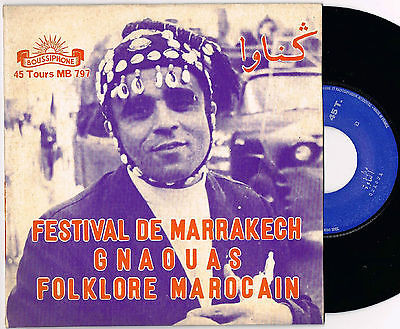
I recently obtained this 45 rpm 7" record. It likely dates from the early 1970s. Sure, it looks like it would contain a recording of a Gnawa group from a performance at the storied Festival des Arts Populaires (commonly known as the Folklore festival). Gnawa groups perform regularly at this Marrakech festival, including the Ismkhan - Amazigh-speaking Gnawa groups, always clad in white foqia robes, like the group pictured on the sleeve of this record.

Like these guys:

Sure, that would be logical. But who is this, and why is he on the back of the sleeve?

Saddik Jaghalef? Who is this man? Why is he pictured in dapper fashion with cuff links, bow tie, and cigarette? One assumes he's not part of the Gnawa troupe. Is he on the flip side of the record? Gnawa on side A and Saddik on side B? Why does the front list catalog number MB 797 while the back lists MB 798? Maybe the labels on the record will clarify?

Side A reads  اڭناوة - أهازيج مغربية which translates as Gnawa - Moroccan Songs. Side B reads just أڭناوة Gnaoua. And both sides show catalog number MB 797, so maybe this is simply the Gnawa folkloric troupe from the festival and this Saddik Jaghalef is on another disc MB 798. Let's take a listen...

The opening announcement says Istouanat Boussiphone, Jghalef Sddik - that's the name of the record label, Edition Boussiphone, and the vocalist's name, Jghalef Saddik. A group of people shout out something unintelligible, and what follows is possibly the worst excuse for a Gnawa record I've ever heard. 

There's one qarqaba player and one person playing a tbel barrel drum. And there's a call and response vocal between Saddik and a mixed-gender group of vocalists. Saddik sings all the lyrics on the same pitch, and the group responds on the same pitch, when they even sing in pitch. When the "singing" stops and the drums keep going, the vocalists become audience members cheering on the action. At some moments the qarqaba and drum accent a note, then rest for a couple of beats as if they were responding to the movements of Gnawa dancers.

This is a fake Gnawa record. That is, it is a recording of people pretending to be Gnawa musicians pretending to perform in front of an audience at the Folklore Festival in Marrakech. The "song" features a couple of lyrics that can be found in Gnawa songs: Lalla takul lhayma/Sidi yakul chhayma comes from "Khali Mbara Meskin", and the choral reply "a bam bam bara" comes from the song "Sudani Minitara"

Sudani Minitara might be the perfect song for a fake Gnawa record - it features arguably the most exotic aspect of Gnawa lyrics - the fact that some words are the remnants of non-Arabic languages spoken by the sub-Saharan forbears of the Gnawa. Jghalef Saddik doesn't sing the main lyrics one typically hears in Sudani Minitara, but it doesn't matter much, since most people who hear the song receive its lyrics as nonsense. "A Bam Bam Bara" does make an easy singalong for crowd participation:

By the second song of this 4-track EP, all Gnawa pretenses have been dropped, and we are simply listening to a novelty record. "Dyal Ba" sounds like something a Marrakchi tkitikate group might sing if they only had one tbel, one pair of qarqabas, and nobody knew any real songs so they just started saying the googly things that adult humans say to babies. And by side B we've moved on to pseudo-Latin Dance singalongs Baila La Bamba and Cha Cha Cha Malika. The group is singing actual pitched notes now, but it doesn't really improve the vibe. Saddik does throw a "Sudani" or "Gnawi" into the lyric here and there, but it's still just nonsense. By the end of side B he is singing a romantic melody in Arabic, French and English: Ya Habibi, Mon Amour, Ya Habibi, I Love You...

This was still early days in the endeavor of recording sounds onto physical media and calling them Gnawa, and apparently you could get away with releasing something like this and calling it Gnawa. What was Boussiphone thinking when they put this out? What was the intended audience for the record, and would this have satisfied their expectations? A clue may be the fact that it is marketed as a recording from the Folklore "Fistival". I don't know the exact date of this record's release, but I would place it sometime in the early-to-mid-1970s. According to the website of the Festival des Arts Populaires, Gnawa groups only began performing at the Festival in 1974. So perhaps this record is trying to capitalize on that recent addition.

[Aside - it blows me away that Gnawa groups were not featured in the Folklore Fest before 1974. By that year, Nass el Ghiwane and Jil Jilala had raised awareness about the cultural value of Gnawa music by incorporating the sintir and Gnawa melodies into their highly popular music. I wonder whether Gnawa's entry into the Folklore Festival was a response to this popular reevaluation!]

I could find no mention of Jaghalef Saddik anywhere online, outside of these 2 EPs on Boussiphone. According to what has been catalogued at Discogs, two discs were released with the same sleeve: MB 797 and MB 798. So if you seek more from this recording session, there's more to be had. Also, there is an alternate sleeve shown on Discogs - it looks like Saddik wearing some sort of Gnawi headgear, yet also sporting a turtleneck sweater.

By the way, the photo of the Gnawa group on the sleeve appears to be from the 1940s, according to the Maison de la Photographie de Marrakech.

This blogpost is Part One - I have at least one other example to share of a recording that purports to be of Gnawa but which is also a fake recording. I'll get around to it eventually. Don't worry, there's more actual good music coming too.

 😂

Saddik Jaghalef
Gnaouas ڭناوا
Fistival De Marrakech - Folklore Marocain

Boussiphone MB 797
45 RPM, 7"

Side A label reads:
اڭناوة
أهازيج مغربية

Side B label reads:
أڭناوة
Gnaoua

From listening, here is my breakdown of tracks:

announcement : "Istouanate Boussiphone,  Jghalef Sdik"
A1) Bam Bam Bara
A2) Dyal Ba

announcement: "La Bamba!"
B1) Baila La Bamba
B2) Cha Cha Cha Malika

FLAC | 320