Showing posts with label Casablanca. Show all posts

Saturday, February 14, 2026

Nass el Ghiwane 1.0: Origins and Recordings

Nass el Ghiwane - the game changers. Bursting onto the Moroccan musical scene in 1972 out of the slums of Hay Mohammadi in Casablanca, they changed what was possible in modern Moroccan music. Drawing musical and lyrical inspiration from the deep roots of Moroccan art, folk, and religious traditions, Nass el Ghiwane composed and performed new songs that felt traditionally Moroccan but spoke to modern experiences and discontents. It is said that hundreds, perhaps thousands of musical groups were launched across North Africa in their wake by young people who found the Ghiwanian expressive mode potent, timely, and accessible.

I've shared a bit of Nass el Ghiwane's music on this blog, but not a whole lot. I have written about them quite a bit here over the years, often when sharing or discussing the music of other artists. This post is intended as the first of several posts focusing directly on the group and some of the many recordings they released on vinyl and tape from 1972 to the present. This is my attempt to sketch some of the early history of the group leading up to the first recordings of the group for the Polydor label. I'll call the quintet featured on those recordings Nass el Ghiwane 1.0. And I'm delighted to share here my vinyl rip and remaster of their first LP. I think it sounds better than any of the digital versions I've heard streaming around out there on the webs and tubes.

Nass el Ghiwane 1.0: Origins 

According to Larbi Batma's memoir Ar-Rahil [1], the initial core of the group was the trio of Batma, Boujmiî Hgour, and Omar Sayed. The three had participated first in neighborhood amateur theater groups and later as actors and singers in Tayyeb Saddiki's professional troupe. Filmmaker Ahmed Maanouni (director of the Nass el Ghiwane documentary film "Trances") says that Saddiki had a grant from a trade union to produce plays using young actors from the poor neighborhoods of Casablanca [2]. By the time the young Ghiwanis were working with Saddiki, he had established a new style of Moroccan theatre that drew themes and inspiration from old literary and oral sources like melhoun poetry and the Sufi poetry of Sidi Abderrahmane al Majdoub. This new theatre movement also drew inspiration from folk performance aesthetics, specifically the halqa circles that form around street performers in places like Djemaa el Fna plaza in Marrakech, interactive circles in which the audience is as much a part of the performance as the performers. The plays were not, however, simple recreations of archaic or folk forms, but dynamic vehicles using deeply held cultural resonances to create new and modern experiences in a new postcolonial era.

Boujmiî Hgour, then Larbi Batma, singing vocal solos in the play "Al Harraz":

Omar Sayed and Boujmiî Hgour singing a duet in the play "Al Harraz":

During their tenure with Saddiki's troupe, Batma and Boujmiî began writing their own original songs and the trio began performing these as a short opening act before the start of the plays. Like Saddiki's plays, these songs drew on archaic, folk, and religious song styles, forms, and lyrics, and wove into them themes that spoke to the lives of their contemporaries. Adding to this tapestry of sources is the fact that the group's neighborhood, Hay Mohammadi, was home to migrants from every corner of Morocco. Omar Sayed has characterized the neighborhood as Morocco in miniature [3]. Thus while he and the other group members from the neighborhood grew up in close proximity, they were raised with linguistic and musical vernaculars from very different regions: Batma from Chaouia, Boujmiî from Tata, and Omar from Aït Baha in the Souss [4].

In addition to their warmup spot at the Theatre Municipale, the trio began performing their songs in cafes and other venues. Eventually they were able to record a performance for broadcast on Moroccan TV, where they made quite a splash, being absolutely different from anything seen before them. 

The group's lineup was shifting around in these early days. Allal Yaâla was known to them from their neighborhood as a top-notch musician and music teacher with an encyclopedic knowledge of Moroccan styles as well as a quick learner of songs. Allal accompanied the group on oud for its initial TV appearance, but he did not join them permanently at that time [5]. The earliest photos of the group show the founding trio along with musician Mahmoud Saadi (also an early member of Jil Jilala) playing the bouzouki and Moulay Abdelaziz Tahiri playing the sintir (the Gnawa guinbri). 

Nass el Ghiwane 0.9
L-R: Omar Sayed, Larbi Batma, Moulay Abdelaziz Tahiri, Mahmoud Saadi, Boujmiî Hgour

Unlike the rest of the group, Tahiri, whom we've profiled here before, hailed from Marrakech. He did two years of study at the prestigious Conservatoire National de Musique, de Danse, et d'Art Dramatique in Rabat, after which he returned to Marrakech and worked with several local theatre troupes [6]. 

I believe Tahiri relocated to Casablanca due to his Marrakech theatre work. He had played the role of Mahmoud in the Wafa troupe's production of Abdeslam Chraibi's "Al Harraz". That play was later produced in Casablanca by Tayeb Saddiki (see video embedded above). I read somewhere that Tahiri helped Saddiki's troupe with the melhun vocal styles used in the production. It was here that the Ghiwane group got to know Tahiri and appreciate his talents.

By sometime in 1972, Mahmoud Saadi had left the group [7] and they reached out to Allal Yaâla to join. The addition of Tahiri and Allal increased the group's scope exponentially on the strength of the stringed instruments they could bring to the songs as well as percussion and vocals. Both musicians were steeped in the melhun tradition and various other styles. It is this quintet that we hear on the group's first recordings, pictured here on the back of their first album:

Nass el Ghiwane 1.0

Left to right: 
Allal Yaala - banjo (snitra), vocals
Omar Sayed - percussion, vocals
Larbi Batma - percussion, vocals
Moulay Abdelaziz Tahiri - sintir, percussion, vocals
Boujmiî Hgour (aka Boujemaa Ibrahim) - percussion, vocals

Nass el Ghiwane 1.0: Recordings 

Nass el Ghiwane 1.0 existed from 1971 or '72 to 1973 or early '74. As far as I can tell from the world wide web in 2026, they released five 7-inch singles and one 12-inch LP during 1972 and 1973. Two songs from the 1973 singles also appear on the second Nass el Ghiwane album in 1974. By the time that album was released, Tahiri had left the group and Abderrahmane Paco had joined to begin the brief era of Nass el Ghiwane 2.0. 

Here is a detail of the releases by NG 1.0 while they were together:

NOTE 3/22/2026: I subsequently found some errors in the discography below. For details, see here.

  • Song: Sinya الصينية
  • Polydor 2225008
  • Date: assuming 1972
  • Appears on 1st album 
  • Discogs link 
  • Songs: 
    • Ya Bani Al Insane يا بني الإنسان 
    • Al Madi Fate الماضي فات
  • Polydor 2225010
  • Date: ℗ 1972
  • Appear on 1st album 
  • Discogs link 
  • Songs:  
    • Fin Ghadi Bya Khouya (live) فين غادي بى خويا
    • Wach Hna Houma Hna (live) واش احنا هما احنا
  • Polydor 2225014
  • Date: assuming 1972
  • Record sleeve reads في سهرة عمومية, indicating that it is a live recording: https://www.youtube.com/watch?v=iRYgimz7pkA
  • Non-LP (The songs appear on the 1st album in studio versions)
  • Discogs link 
  • LP including heretofore unreleased songs:
    • Dane Dany (Allah Ya Moulana) أدَانْ دَاني - الله يَا مُولانَادة
    • Yamna (Joudi Berdak) جودي برضاك
    • Fin Ghadi Bya Khouya (studio version) فين غادي بي خويا
    • Wach Hna Houma Hna (studio version) واش احنا هما احنا
  • Polydor 2.944.007
  • Date: ℗ © 1973
  • Discogs link 
  • Song: [Ah Ya Ouine] Youm Malqaq آه يا وين اوين - يوم ملقاك
  • Polydor 2225021
  • Date: assuming 1973
  • Appears on 2nd album 
  • Discogs link 
  • Songs:
    • Al Hassada  الحصادة
    • Joudi Berdak  جودي برضاك
  • Polydor 2225023
  • Date: ℗ © 1973
  • Al Hassada appears on 2nd album, Joudi Berdak (aka "Yamna") appeared previously on 1st album.
  • Discogs link 

Some concert recordings of Nass el Ghiwane 1.0 were released commercially in the 1980s. I have not included them in this list, but I am planning to devote a blogpost to them sometime this year.

Disque D'or: A spurious album title, but golden nonetheless

The album cover for the first Nass el Ghiwane LP reads prominently "Disque D'or 1973". In his memoir, Larbi Batma writes that this gold record award was announced by the record company Phillips (I think he means Polydor) but the group never saw or received an actual prize. He eventually asked someone about it and was told that the record company just wrote Gold Record on the album for publicity [8]. Despite this unawarded award, the record will always be gold in my book. It's a collection of groundbreaking, classic songs with inventive arrangements, sung passionately and with an urgency that leaps off the record over 50 years later. Here are a few of my subjective takes and random thoughts:

  • El Madi Fate (The Past is Gone) - leading off the album with a bold, anti-nostalgic declaration of a new (cultural) moment. 
  • As Siniya (The Tea Tray), the group's first single and probably their most well-loved song, a complaint sung to a tea tray, the tea tray being the physical artifact around which a ritual of sociality and belonging is enacted - the preparing and sharing of tea. A complaint about the state of the singer's tea glass among other glasses on the tray. Language evocative - unspecific about what has brought on this condition, but universally resonant in Morocco by virtue of its imagery. And with a rousing refrain declaring departure and that "bahr al ghiwane ma dkhaltu bil3ani بَحْرَ الْغِيوَانْ مَا دْخْلْتُ بَلْعَانِي" - the ocean of Ghiwane - I didn't enter it intentionally. The cryptic term "Ghiwane" which of course became synonymous with the group itself - Nass el Ghiwane = People of Ghiwane - something to do with song, something archaic, something that one does not simply walk into by design but that one falls into. The references to trance were here from the very beginning of the group, even before the Gnawi Abderrahmane Paco joined them. (See also the name of the group in English on their first 2 singles: New Dervish.) 
  • Allah ya Moulana - cooling down with a heartfelt supplication to God and the Prophet ﷺ in the form of a legitimate earworm, complete with an unforgettable wordless singalong wo-wo-wo melody before the Dan-Dani part of the song. 
  • Side two expands the discourse to more philosophical and ethical matters, leading off with Ya Bani Al Insane (Oh Children of Man) - my condition, my promise, today pushes me, I want to pose a question and say it in the tongue of Ghiwane, Oh Children of Man, why are we enemies?
  • An ecstatic, quick paean to love and beauty in Yamna/Joudi Berdak with terrific long held high vocal notes from Omar while Allal goes wild on the banjo. 
  • Then finishing up with two more philosophical questions: Fin Ghadi Bya Khouya (Where are you taking me, brother) on individual connection and blame in a time of social and cultural rupture - with an eerie ethereal vocal harmony placed a fourth above the main melodic line, and Wach Hna Houma Hna (Are We Still Us?) on the existential effect of greed and inequity on society and humanity as a whole.

I'm so happy to be able to share this good sounding vinyl rip. My copy of the LP is far from the cleanest in the world, but the recent addition of stem splitter capabilities to Logic Pro X allowed me to isolate vocals on one track while the pops and clicks got shunted onto another track, which I could then mute during the a capella passages. TLDR - it sounds really clean where it counts the most. And it sounds better than any streaming digital version I've heard. 

I am of course conflicted about the use of AI tools in this work and in general. They are resource-hungry, and as much as we are being told we will not lose jobs, we will definitely lose jobs, which is terrifying in a society where existing rips and tears in our social safety nets are being widened in order to make oligarchs imperial again. I hope my limited use of these tools to restore a work of beauty does not exacerbate the situation. I'm sure a professional could do a better job at this than I have done, but until that happens, please enjoy this new version of this historic LP. 

Nass el Ghiwane ناس الغيوان
Disque D'or 1973 نال اسطوانة الذهب السنة

Polydor 2.944.007
1973

A1 El Madi Fate الماضي فات
A2 As Siniya الصّينية
A3 Dane Dany (Allah Ya Moulana) أدَانْ دَاني - الله يَا مُولانَا
B1 Ya Bani El Insane وايّى يابني الإنسان
B2 Yamna جودي برضاك
B3 Fin Ghadi Bya Khouya فين غادي بي خويا
B4 Wach Hna Houma Hna واش احنا هما احنا

FLAC | 320

NOTES/SOURCES CITED: 

[1] Larbi Batma. Ar-Rahil. This book has not been translated from Arabic, but there is a monograph in English that examines the work in depth: Lhoussain Simour's 2016 book Larbi Batma, Nass el-Ghiwane and Postcolonial Music in Morocco. To date, this is probably the best source in English about Nass el Ghiwane, but keep your eyes open for the results of research in progress by Alessandra Ciucci.

[2] Ahmed El Maanouni. “Transes”: The Resonance of Nass el Ghiwane in Morocco and Beyond. Presentation in conversation with Alessandra Ciucci, Columbia University, New York, March 9, 2023. 

[3] Omar Sayed, interviewed in ناس الغيوان - الجزء الأول (Nass el Ghiwane - Part 1), Al Jazeera Documentary. Directed by عمر كاملي بن حمو Omar Kamli Benhamou, 2010.

[4] Simour, p. 115. 

[5] Batma, p. 158-9. 

[6] Omar EL ANOUARI. "Moulay Abdelaziz Tahiri : Pourquoi la chanson marocaine n'est pas exportable ?". La Gazette du Maroc, 2006-07-31. 

[7] In his memoir (p. 168) Batma refers obliquely to some interpersonal conflicts stoked by an unnamed person from Marrakech, ostensibly someone from Jil Jilala or their circle.

[8] Batma, p. 171 

Thursday, December 25, 2025

Noujoum Bourgogne - Donia Ghadara

Here's a tape from chaâbi pioneers Noujoum Bourgogne. As mentioned in our recent post about Zitouni Bourgogne, the group came out of the Bourgogne neighborhood of Casablanca in the mid-1980s, distinguishing themselves from the typical chaâbi ensemble by eschewing keyboards, guitars, and drum kits in favor of the bendir and târija folk drums. In their use of folk instruments, their approach resembles that of the Ghiwani groups, but they retain the driving kamanja of the chaâbi ensemble and their songs are more suited for the dance floor than those of their Ghiwani contemporaries.

The sound on this album rather thin, so I did a remix to pump up the drums a bit:


I later found that the album can be heard on streaming platforms in a version much cleaner version than my cassette copy:

But y'all come here for that old well-loved cassette sound, right? So avail yourself to whatever version suits your taste and enjoy this fine slice of vintage chaâbi goodness!

Noujoum Bourgogne نجوم بورݣون
Donia Ghadara لدنيا غضارة (2025 Moroccan Tape Stash Remix)

A1 Donia Ghadara لدنيا غضارة
A2 Lghorba لغربة
B1 Mnin Nebda Lehdite منين نبدا لحديث لحدي
B2 El Mejdouba المجدوبة 

FLAC | 320

Sunday, November 23, 2025

Zitouni Bourgogne - Chaâbi Star

This album was shared a few years by Gary ago over at Bodega Pop. (Thanks Gary!!) I finally spent some time with it and did some digging trying to identify the artist. It's a chaâbi album by the singer Zitouni and his group. Zitouni was a member of the legendary group Noujoum Bourgogne (The Bourgogne Stars, named for the Bourgogne neighborhood of Casablanca where they originated). That group went against then-current chaâbi trend of using keyboards, drum sets and guitars, opting instead to use only acoustic folk instruments: taarija, bendir, and kamanja (violin) [1]. Here is a clip from a performance of the group, featuring Zitouni on lead vocals:

The group split in the early 1990s. Of the group members, violinist/singer Mustapha Samamrkandi (known as Mustapha Bourgogne) achieved the greatest success as a solo artist. Zitiouni also continued as a solo artist, but without as much success. Many YouTube commenters lament the fact that Zitiouni's artistry is underappreciated. 

A few of Zitiouni's solo albums are available on streaming platforms - these platforms however are not able to distinguish between multiple artists that have the same name. So if you look for Zitouni on YouTube Music or Spotify, you'll find a couple of albums by our Zitouni (Gali Ndik and Sidi Abdejlil) alongside an album by an Algerian raï singer named Zitouni and some tracks by an âita group billed as Cheikh Moslih & Zitouni. Other recordings of our Zitouni can be found under the artist name Zitouni Bourgogne. That's the name that Zitouni uses on his own YouTube channel, launched in 2021 and currently active.

At least one song of Zitouni's is a well-known classic: Daouli Ghzali. This song was burning up the wedding/party dance floors when I was in Morocco in Summer 1995, but I never knew who originally sang it. You can find an edited version of it on numerous compilations, but here's the full version from the original cassette:
 

Zitouni's solo work, like that of Mustapha Bourgogne, foregoes the acoustic-folk-instruments-only format of the Noujoum Bourgogne group. The album shared by Bodega Pop appears to be an early solo work of Zitouni's. In addition to kamanja and bendir, it features some light keyboard accompaniment (pads and bass), what sounds to me like a drum set, and a prominent darbuka. I've uploaded a few of the album's tracks to YouTube:


There are no track titles listed on the cassette or j-card. I added track titles below from listening to the lyrics and music. There are a few short instrumental pieces on the album that feature rhythmic accents reminiscent of people dancing and stepping on a qaada oil barrel, so I am calling those pieces 'qaada music'. You can grab the tracks from Bodega Pop (link below) and retag them if you like.

Orchestre Zitouni اوركسترا الزيتوني
Al-Mounafiq المنافق
Sadara Production cassette 016 إنتاج الصدارة

A1 Al Mounafiq
A2 Rani ya Sidi Ghrib
A3 Al Bahraoui
A4 qaada music
B1 Khssara Fik
B2 Lwali Bourchiche
B3 electro qaada
B4 Wa Ouladek
B5 qaada music

FLAC at Bodega Pop

Sources:
[1] Nora Dialna. "Noujoum Bourgogne, histoire d’un groupe 100% marocain". Dialna, April 19, 2021. 
https://dialna.fr/musique-noujoum-bourgogne-histoire-dun-groupe-100-marocain/

Saturday, January 22, 2022

Haj Abdelmoghit - Star of the Âita Bidaouia


2 long tracks of 21st century âita & chaâbi for your pleasure, from the microphone of Haj Abdelmoghit. I know I tend to wax nostalgic for the era of electric guitars and raucous drum kits in chaâbi, but I am not immune to the joys of more recent stylings. This album keeps it real with a viola, some light keyboard (and yeah, a synth bass), heavy on the percussion, and isn't that a drum kit down there in the mix? This works for me. And the album has the flow of an actual live set of music as you'd hear it in performance: begin with something slow and heavy, move through several songs, connected via violin-driven instrumental passages as the tempo speeds up and the sung call/response phrases get shorter and shorter, and ending at blistering speed with a punchy rhythmic phrase to cue the end of the song.

Ah that good âita bidaouia feeling! Abdelmoghit Essaidi (b. 1965, Casablanca) quit his bank job to pursue a career singing it. He's enjoyed great success as a real crowd-pleaser of course at weddings but also at concerts (such as the big Mawazine Festival in 2017). And he has even become a favorite among the Moroccan royals, performing at the wedding of Princess Lalla Soukaina in 2013.

Several of his albums can be streamed at Ournia: https://www.ournia.co/artist/el-haj-abdelmoghit#

Official Facebook: https://www.facebook.com/hajabdelmoughitofficiel

Abdelmoghit عبد المغيت
Najm al Âita al Bidaouia نجم العيطة البيضاوية

Moughitphone 20/06/07 مغيت فون

2007

Side A
 Settat Bladi السطات بلادي
 Nti ou Ana انتي وانا
 Souhaba الصوحابة
 
 Irjaâ Oulad Bladi ارجع اولاد بلادي
 Touachi تواشي

Side B
 Hani Mourak Hani Kdamek هاني موراك هاني كدامك
 Moula Âin Ettout مولا عين التوت
 Lemouima الميمة
 Al Âar al Hbab العار الحباب
 Chibani الشيباني
 Touachi التواشي

320 | FLAC

Saturday, January 15, 2022

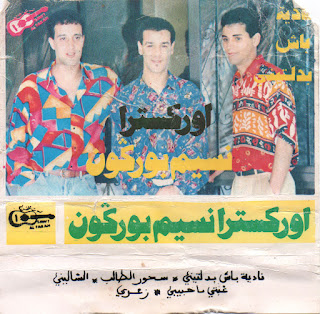
Orchestre Nassim Bourgogne - Nadia Nadia Bache Bdeltini

Here's some of that good early 90s chaâbi! The artist here is Orchestre Nassim Bourgogne - not to be confused with the famous Noujoum Bourgogne/Mustapha Bourgogne, though one assumes that they hail from the same neighborhood, namely Bourgogne in Casablanca. The catchy catchy "Nadia Nadia" was a big hit in the summer of 1993, if my memory is correct.

I thought Nassim was the name of the singer, but in fact it's the name of the group - Nassim Bourgogne means "The Bourgogne Breeze". Facebook and YouTube are my only sources of information about the group. The Facebook page شعبيات شبابية مغربية identifies the 3 members of the group as Majid Meziane (singer), his brother Saïd Meziane (percussion) and Fakir Mohamed (viola). They appear to have gained some success in the 1980s and 90s.

Many audio and video clips of the group can be found on the YouTube channel TV HADJ BOUIDI, including this great extended clip from a 1994 concert.


The album we're sharing today has orchestration similar to that in the above live clip - there's a drum kit, an electric rhythm guitar and a keyboard. The guitar doesn't get to play much obbligato, other than the opening to "Nadia". I'd love to hear more of that, but I'm also happy to hear it play rhythm/chords, which I prefer so much more than hearing keyboard string or horn pads. And it does play some nice syncopated rhythmic figures during the âita piece that opens side B (audio clip below) - love it!

Orchestre Nassim Bourgogne اوركسترا نسيم بورگون
Nadia Bache Bdeltini نادية باش بدلتيني

Sawt El Farah cassette صوت الفرح

c. 1993

A1 Nadia Bache Bdeltini نادية باش بدلتيني
A2 S'hour Ettaleb سحور الطالب
B1 Chalini الشاليني
      Zaêri زعري


B2 Qalbi Ouellate
B3 Ghebti Ya Hbibi غبتي يا حبيبي

320 | FLAC


Saturday, October 26, 2019

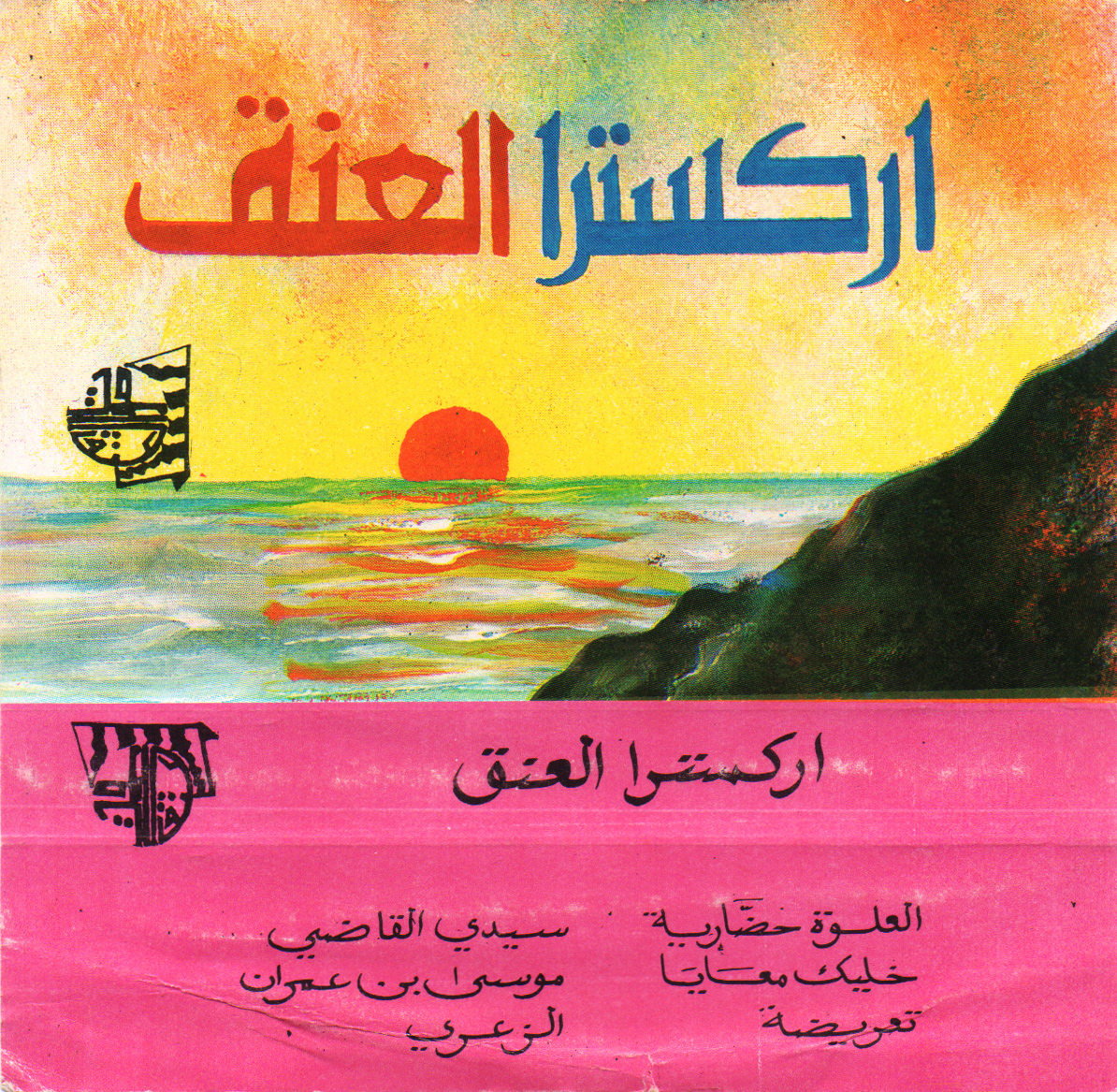
Chaâbi Sweet Spot - Orchestre el Ânq (اركسترا العنق)


Long drawn out medleys? Check. Âita melodies and structures? Check. Scratchy viola and punchy darbuka? Check. Drum kit, electric guitar and organ? Yes - right there!

This swell tape comes from a little stash of tapes that fell into my lap a few months back. All without j-cards and most with only the name of the production house on the cassette shell. This one is from a company called Sawt el Ânq (انتاج صوت العنق). I'm guessing it's from Casablanca, but only because the singer gives a shout out to the soccer teams Raja and Wydad.


[blogger knows he's seen that logo before, goes digging around in the stash...] 


Well - I knew I'd seen that Sawt el Ânq logo before on an orphaned j-card in the stash. (And a fantastic logo it is, too!) Went looking for it, hoping it would reveal the location of the production house. No luck there, but... the song titles were a match for this tape!! The tape must have bounced around among the Moroccan ladies in the Bay Area for 20 years and then landed back here in the stash where its j-card was waiting for it!

Also, my friend Jamal confirms that El Ânq is a neighborhood in Casablanca, so we're pretty sure this is a Casa production.

This is some vintage late 1980s chaâbi. Hope it hits your sweet spot too!


Orchestre el Ânq (اركسترا العنق)
Sawt el Ânq (انتاج صوت العنق) cassette
1) Sid el Qadi سيدي لقاضي
2) Melki Ma Jiti
3) Zaeri - Musa ben 3amran الزعري ‫-‬ موسى بن عمران
4) Al 3aloua Hddariya  العلوةحضارية
5) Khellik M3aya - Taârida خليك معايا ‫-‬ تعريضة

Get it all HERE.

Sunday, May 8, 2016

Pleasures of the Hello Kitty Boom Box - Chaâbi Khadija


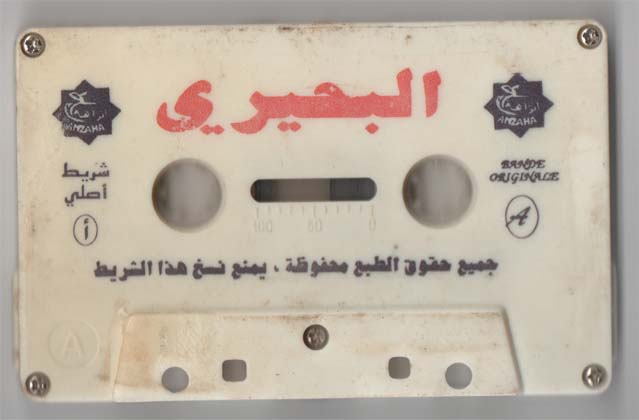
Well look what I found inside the Hello Kitty Boom Box - it's a cassette on the Anzaha imprint out of Rabat! I've shared one other Anzaha cassette here, and it was a good one!


I haven't been able to identify the singer featured on this tape. During the faux-live-audience opening banter at the beginning of track 5, I hear what sounds like the crowd chanting "Kha-di-ja, Kha-di-ja". She doesn't sound like Khadija al Bidaouia or Khadija Margoum. Sounds a bit like Khadija Laboat Al Atlas, but I haven't found any recordings of her that sound quite like this one. Please let me know if any of you can identify her.


Whoever this chaâbi-singing Khadija is, this is a jamming cassette in the Casa style with riffy viola, plinky banjo-keyboard, and driving varied percussion section throughout (some darbuka, some taârija, some bendir, and some live and/or programmed drum kit. I'd place it around the mid-aughts - the faux-live-audience, the keyboard sounds, and the absence of autotuned voices remind me of Daoudi cassettes from around '04.

Enjoy!

PS, yes, I have a Hello Kitty Boom Box.


Châabi cassette featuring singer Khadija (Anzaha cassette)
Track 5 (of 5) 

Get it all here.

Sunday, March 6, 2016

Bouchaib Ziyani: Moroccan Honky Tonk Songs


No Marriage, No Work, No Home.  That's the album title listed on this cassette from Bouchaib Ziyani, singing violist from Casablanca working in the chaâbi - âita continuum. This is some well-produced chaâbi with an insistent but not mechanical percussive drive. Bouchaib's scratchy viola blends nicely with the various synth zither, lute, flute or banjo settings.

These songs are soaked in beer, tobacco, and regret, and Ziyani's singing sounds like he's been there (or is still there). "She drank only half a beer, and started a battle between us" (Track 1). "Give the blonde a drink" (Track 2). "I drank the first beer, I drank the second one. The third one reminded me of my beloved" (Track 5). "Mama, what did I do? I sought my fortune, but in my life achieved nothing. No marriage did I marry, and no work did I find. The evil eye is upon me, but I don't who cast it." (Track 3). The songs mainly stay to the chaâbi end of the continuum, but the long Track 2 moves into âita territory with some nice interplay with a female vocalist and stretches into some extended versifying and riffing, ending up in saken/trance territory.

Ournia.com relates that Mr. Ziyani is from Casablanca but made his career in Oujda. Ournia's biography also states that the currently active Bouchaib Ziyani recorded with Khaddouj Zroukia, which would make him the same artist as featured on these 45s in Settatbladi's collection:


However, the 45 pictured above is credited to "The Late Bouchaib Ziani". And although his hair is greying, the artist on our cassette does not appear to be quite old enough to have recorded those 45s. At any rate, enjoy!

Bouchaib Ziyani - بوشعيب الزياني
La Zwaj La Khedma La Dar - لا زواج لا خدمة لا دار
Meftah Music cassette 23/10/2011 (2011)


1) Shrebt Ghir Ness Birra - شربت غير نص بيرة
2) A3ti Lesh'hiba Tshreb - اعطي الشيهبة تشرب
    Moulat Lâyoun Kbar - مولات لعيون كبار
    Htta Wahed Maiâqel 3lik - حتى واحد ما يعقل عليک
    Galt lik Mmuk 3a Toukel Allah - گالت لک امک توکل عائلة
    Jini Nhar Tnine - جيني نهار اثنين
    3lash Tebki Ya Litima - علاش تبكي يا ليتيمة
3) Lemwima Wash Dert Ana - المويمة واش درت انا
4) Wach Qdaw Ila Berku Biya - واش اقضاو الى بركو بيا
5) Fekkeretni Fi Hbibi - فکرتني في احبيبتي
6) Dwaw Fiya 3la Rejliya - دواو فيا على رجليا
7) Dat al Mal Ou Zadet Essa7a - دات المال او زادت الصحة
    Dir Lkhamiya 3a Lbab - ديري الخامية عا لباب
    Alghadi B3id - الغادي بعيد

Get it all here.
Yala has more Ziyani here.

PS, yes I know I'm a complete hypocrite calling these "honky tonk" songs, when a few weeks ago I was ranting about the use of Anglo-American popular music analogies to describe Moroccan artists.

Saturday, October 13, 2012

Kamal El Abdi - Straight Outta Beni Mellal


A generous hour-long cassette from Kamal El Abdi, the popular viola-slinging singer from Casablanca (originally from Khouribga/Beni Mellal). My in-laws are from the Beni Mellal area, and we started seeing VCDs of his countrified-chaâbi a few years ago. His chaâbi is the type you might hear at a wedding out in Beni Mellal province - viola centered, insistent bendir-darbuka percussive drive, high-pitched women's backup singing complementing the male lead vocal. And with a cadre of female dancers wearing the hzam dyal muzun (the belt/sash with all the jingles).


Sometimes the repertoire veers toward aita, and a female vocalist take center stage (as in track 5 here).

I'm trying to discern what separates this regional chaâbi from the mainstream Casablanca variety. Something strikes my ear as different in the melody and the rhythm. The vocal ornamentation seems less ornate than what you might here from, say Senhaji or other male singers from Casa. The melodies stay away from the major-mode aita marsawiya style melodies, tending toward rasd or bayati quarter-tone melodies. Maybe I'm wrong - I'll have to ponder on this a little more... Thoughts anyone?

Loads more from Kamal el Abdi over at yala.fm

Tracks 1-2 and 4-5 are in the style described above (with a synth bass and synth banjo thrown into the mix). Track 3 is more synth-poppy, and track 6 is some groovy synth ghaita riffing to fill out the cassette.

1)  Ma Khelliti Liya Walo - Ya Lahbiba Âyyeti - Taâla Ou Taâla - ما خليتي ليا والو - يا الحبيبة عيطي - تعالة و تعالة
2)  Miâd Halek Yâjeb - Moulay Brahim - Lagnawi - معاد حالك يعجب - مولاي ابراهيم - ااكنوي
3)  Ya Lebniya Hchouma Hadchi - يالبنية حشومة هادشي
4)  Sima Taoualli - Wajhek S'hih - Mali Ya Rebbi Mali - سيما تولي - وخهك صحيح - مالي يا ربي مالي
5)  Halka - Za'ri - Khellini Nebki - Ouaili Oulaili - حلكة - زعري - خليني نبكي - ويلي ويلي

6)  bonus synth ghaita derdeg

Get it here.

Saturday, May 5, 2012

L'Hajja L'Hamdawya again

Here's another Hamdawya cassette - seems to have been recorded at the same time as the one I posted last week. It has that same electric guitar and funky harpsichordey thing going on. (Plus the catalogue numbers are consecutive.)


Track 2 is the oldie "Hbibi Dyali", recorded by, among others, the great Zohra al Fassia. Track titles are taken right from the j-card except for track 4, which is unlisted. It's a tune I've heard before at Moroccan Arab weddings, played by chaâbi bands when they need to play something that sounds Berber. (This is needed if, as is common, the bride puts on a Berber-style outfit at some point during the wedding.) Note the typically Tachelhit pentatonic melody + use of the clanging naqqus.

1) Shouf ar-Rouida Ma Dir
2) Hbibi Dyali
3) 'Alah A Lalla Hyani
4) Ayla ha Lilila Ayli Awa

5) Ta'rida

Get it here.


Saturday, April 28, 2012

L'Hajja L'Hamdawya - 'Nuff Said!


I was thrilled to see the return of the fantastic diva L'Hajja L'Hamdawya to prominence in Morocco over the last decade. Through the '90s and early 2000s (when I spent a lot of time in Morocco), she seemed like nothing but a sepiatone memory. A well-loved celebrity from the '50s &'60s who, it was said, had fallen on hard times, been too generous (or foolhardy) with her money, and was now living in obscurity somewhere in Casablanca. Over the last 10 years, she's proved to be not only alive and well, but in fantastic voice, now into her '80s.


She began her career singing aita marsawiya and was one of the first artists to sing it on television (when it was still considered provocative music of ill-repute). Notably, she also performed and recorded with large orchestras of the chanson moderne style favored by Moroccan television and radio in the 50's-'60s. Such orchestras were usually reserved for artists working in the Arab-Art-Music of long-form compositions rather than the folkloric aita and popular chaâbi song forms. According to a Moroccan scholar I spoke with years ago, the sight of a woman holding the iconic bendir or ta'rija of the aita in front of one of these large orchestras was something unheard of, back in the day.


(video and audio are out of sync, but here's a rare vintage TV appearance of Hajja Hamdaouia)

This cassette features a more stripped-down ensemble - not a full orchestra, but just a couple of violas, a flute, a harpsichordey keyboard, and an electric guitar (in addition to the percussion). I'm guessing this recording is from the 1960s or early 1970s. I own an LP with this same photo on it (as well as a couple other cassettes with the same photo), so I'm guessing this is a cassette reissue of an earlier LP release.

1) Ach Ja Idir?

2) Al Asmar I'jebni
3) Ayamna Ayamna
4) Allah Ya'tik B-Sber
5) Wlida Wlida - Dawr Biha

Get it here.

Saturday, April 21, 2012

Chaâbi viola as Jilala flute - Saïd Senhaji


About 10-12 years ago, there seemed to be an explosion of pop hits in Morocco making reference to trance of one flavor or another. I don't mean pop versions of Gnawa or Jilala songs. Rather, I mean NEW songs with lyrics referring to the spirits or to the experience of trance. What struck me as odd was that most of these songs made no musical reference to trance music of the Gnawa, Jilala or other groups. Rather, they fit the basic mold of chaâbi songs, ready to slip into the repertoire of a wedding band with a viola player and a nicely dressed lead singer. You don't typically want to hire a trance music group for a wedding but, as Deborah Kapchan has noted, the aesthetics of nashat (lively, energetic, loose party feeling) often come close to those of jadba (possession trance), and sometimes bump up against each other (1).

I tend to like my trance uncut, so these songs never did much for me. Some of the tunes were pretty catchy and popular, though. You can hear a few of these on a great early-2000s chaâbi compilation Maroc by Night (tracks 6, 17 and 19). Hamri's "Samaoui" in particular was massive in the spring-summer of 2001.

One track that I do rather like is "Aicha el Mejdouba" by Orchestre Senhaji. What got under my skin was the weird sound processing on the violin. The first time I heard this, I had no idea what instrument was playing. To my ears now, the strange throb seems to hearken to the unique timbre of the gasba flutes in Jilala trance music. The lyrics of the song also refer to the Jilala. Here's a lip-sync/playback clip of Saïd Senhaji performing this tune:

 
"Aicha el Mejdouba", track 5 on today's offering, is the only tune on the album to feature the tweaked viola sound. The rest of the album is some darn fine straight-up Casablanca chaâbi music, vintage Y2K, served up by the singer Saïd Senhaji and his orchestre. Heavy on the rhythm (drum kit in effect), swell riffin' on the viola, catchy call-response vocals. The electric guitar comping doesn't always work for me, but I've heard waaaaaaay worse.

Check yala.fm for Senhaji's bio and more tunes. Amazon has LOTS of Sehaji mp3s (though, oddly, not the album I've got here.) And for those of you here on the West Coast of the USA, Saïd Senhaji will perform in Anaheim on Saturday May 19!

Discographic note: the j-card reads
 سهرة حية مع الجمهور, i.e., "live concert with audience", but that does not appear to be the case - this sounds like a studio recording.

Get it here.

---

(1) Deborah Kapchan. "Nashat: The Gender of Musical Celebration in Morocco." Pp. 251-65 in Music and Gender: Perspectives from the Mediterranean, edited by Tullia Magrini. Chicago & London: University of Chicago Press, 2003.

---

UPDATE 2012-04-21, 11:30PM - I think the link was incorrect earlier. It should be fine now.

Sunday, April 15, 2012

El Bhiri - Chaâbi from Casa, yeah!


Instead of poring through the Lomax collection yesterday, I decided to pore through a stash of about 75 cassettes I inherited from a friend recently. Separated out the Maghrebi music tapes from the Middle Eastern ones and the Islamic lectures. I was still jonesing for some chaâbi, and scored with a swell tape of El Bhiri. Yala.fm describes him as a chaâbi artist from Casablanca. The tracks here stay mostly to the aita side of the chaâbi field, with the exception of track 5, which is more of a call-response percussion band-style rave-up.

The tape is missing the first couple minutes of track 3, where someone inadvertently (or advertently?) taped some interesting but completely non-sequitur Middle Atlas tamazight song on top.

Here's El Bhiri on TV:


Get it here.

Saturday, March 10, 2012

Jilala & 'Aita Down at Bir Jdid - Mohammed L3aouina


Here's one of my fave cassettes - a particularly fierce Jilala tape for ya. Picked this up in the mid-'90s, I think in Marrakech or thereabouts. The tape is from Bir Jdid (which I had to look up on Google) - it's between Casablanca and El Jadida.

The tape doesn't say "Jilala" anywhere on it, but the tunes have that same throb and rasp that identify the Jilala groove. In addition to the gasba flutes and bendir frame drums, you'll hear some qarqaba metal clappers on the tunes labeled "Buwwab". These songs invoke some of the spirits associated with the Gnawa, who are the main users of the qarqaba.

In addition to the trance material (Sidi Slimane, Sidi Chamharouch, Buwwab), the tape also contains "Al-3aloua", a piece usually associated with aita / shikhat. The recording of this song (as well as track 6, another song that seems to be non-Jilala) features only a single gasba, rather than 2. The use of 2 gasba-s adds a loopy dimension to the sound and seems appropriate to the trance material. Whatever the aesthetics of trance textures vs. non-trance textures may be, it is certainly true that most musicians working with trance repertoires also perform other non-trance genres, and that seems to be the case with this ensemble.

Enjoy!


1) Intro
2) Chamharouche (? i guess. I can't hear the name in the lyrics, but it is written on the j-card, but then again, the tracks are all out of order too...
3) Sidi Slimane

4) Al Buwwab 1 (edited together from end of side 1 and beginning of side 2)
5) Al Buwwab 2
6) Track 6
7) Al 3aloua

Get it here.

Sunday, January 8, 2012

Hmida Boussou - Subtle and Serious Guinbri Sounds


OK - enough with the Pokémon you say? Scraping the bottom of the stash? Au contraire! If chaabi Pokémon ain't your style, consider it an audio palate cleaning, a slice of picked ginger on your sushi platter, to get your ears ready for some full-on tagnawit sounds.

The late Hmida Boussou (of Casablanca, but with roots in Marrakech) was a serious, deep Gnawi maalem. His guinbri spoke volumes, and we're lucky to have some fantastic recordings of him in the Al Sur 5-disc Gnawa Leila series. He didn't record many commercial cassettes in Morocco. This is one of only a couple that I've seen. It appears to date from the 1980s, though it's hard to say for sure. I picked it up around '93, and it's a great one.

The guinbri is prominent in the mix but not distractingly so. One of my pet peeves with Gnawa recordings and electrified performances is that the guinbri is sometimes too far up front in the mix, destroying the dynamic tension between the sound of the guinbri and that of the incessant, clattering qraqeb. That being said, Maalem Hmida's playing is so subtle and consistent that it withstands being so "naked" in the mix. (This is also the case on disc 1 one of the Al Sur series.)

Discographic note: J-card lists the cassette publisher as "Sawt er Rbi3", but cassette shell reads Edition el Kawakib. Song titles, however, appear to be correct.


With a couple of exceptions (Sadie Fulani Hiriza and Wahyana Waye), nothing here duplicates anything Maalem Hmida plays in the Al Sur series.

1) Ouled Bambara (includes Chalaba Titara, Sadie Fulani Hiriza, Wahyana Waye)
2) L3afou Moulana (climax of the Ftih ar Rahba suite. Performed atypically here with interlocking clapping rather than with qraqeb.)
3) 3aicha l-Hamdouchia (includes Baba L-Ghumami, Sidi Muhammad ya Suba3i, Marhaba ya Mimoun Marhaba, 3aicha L-Gnawiya, 3aicha Qandisha) 


Get it here.