Showing posts with label Guinbri. Show all posts

Sunday, August 9, 2026

Mustapha Baqbou - Inna Muluk El Hwa Style (or perhaps Bahjawa Style)


Here's a very nice and interesting cassette from the recently departed, much missed Mustapha Baqbou, and it's unlike any other album of his I've heard.

Maalem Baqbou left us a fair number of recordings - Discogs currently lists 10 albums under his name in addition to his appearances on anthologies and compilations such as the seminal Gnawa Music of Marrakech - Night Spirit Masters. In addition to a series of albums for Edition Hassania (Discogs lists 5 of these, though I would not trust the listed release dates), Baqbou recorded a number of one-off albums for other Moroccan cassette labels. We shared one of these, a fantastic release on Sawt al Haouz, several years ago. Today's tape is on the Fassiphone imprint (out of Fes, of course). It's a very enjoyable cassette, though I have a lot of questions:

  • The ensemble on this cassette is that of the standard Ghiwani-style group: guinbri (bass lute), banjo (or perhaps bouzouk or other plucked steel stringed instrument), bendir buzzy frame drum, and tbilat (pair of small kettle drums). Normally this sort of group would record under the name of a group, not that of a single musician. 
  • The two tracks on side B are straight versions of songs from the Gnawa ritual repertoire, and the lead vocalist on these tracks does sound like Baqbou. The tracks on side A, on the other hand, are in a more Ghiwani vein, or better, in a Muluk el Hwa vein. They are very much centered on the guinbri and use Gnawa or Gnawa-styled melodies, but with additional or alternate lyrics. 
  • On first listen, I wondered whether this was actually a Baqbou album, as I did not hear his voice right away. On second listen, I did recognize his voice - he's not the vocal soloist on the first track, but I do hear him on the other three tracks. Not sure why I didn't recognize him at first - perhaps the recording is from early in his career, or perhaps the playback speed on my edition of the tape is faster than the original recording, or perhaps I'm just thick-headed.
  • On track A1 "Al Hal", the solo singer does not sound to me like Baqbou, though Baqbou may be one of the choral responders. This track reminds me of Muluk el Hwa in its overall groove and production style.
  • Track A2 "Menni Mennek" features a recited declamation at the beginning, like what is heard at the start of many Nass el Ghiwane or Jil Jilala tracks. This recitation is definitely NOT Baqbou, and the supporting banjo accompaniment is in a different key from that of the rest of the song. I'm guessing it was part of a separate recording of the song. The main body of the track sounds to me like Baqbou, possibly double-tracking vocals in unison in the group passages, and in call-and-response with himself in the second half of the song. Either that, or his musical collaborator sings very much like him.
  • In the second half of "Menni Mennek", the melody and rhythm switch to that of the Gnawa song "Fofo Denba". Instead of singing the traditional refrain Fofo denba, Fofo denba ya Sidi, Baqbou here sings: Wa ya denya, hadi denya ya Sidi "Oh life, this is life". I am reminded of a track by Paco Abderrahmane "Ma Fik Khayr Ya Denya", which similarly uses "Fofo Denba" as the basis for the second half of the song. Paco sings Had denya, hara ou marra ya Sidi "This life is hot and bitter". We shared that album in the early days of Moroccan Tape Stash, and I have always attributed the use of lyrics about denya to this recording of Paco's. But since I don't know the dates of either the Paco cassette or the Baqbou cassette, it's possible that the substitution could originally be Baqbou's, or perhaps it was something floating around among Gnawa musicians that both of them brought to the studio independently.
  • I wonder when this was recorded and released, and how it relates to Baqbou's work with other Ghiwani-style group formations. Biographical sketches of Mustapha Baqbou mention that he was a member of a Ghiwani-style group in the Netherlands in the mid-1970s called Tiq Maya, but I've found no audio clips of this group. His tenure with Jil Jilala ran from approximately 1985 through the late '90s or early 2000s.
  • The artwork style of the j-card, with the psychedelic purple background looks to me like a release from the late 1990s or later, but I would date the photo of Mustapha and the sound of the recording to the 1980s. So I wonder if this is a reissue of a cassette that originally had different artwork.
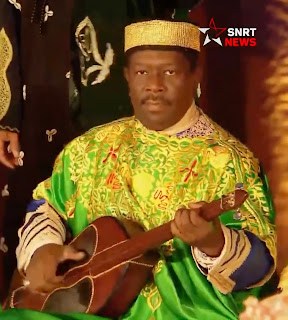
  • OH WAIT, I just re-stumbled across a pair of YouTube clips on the legendary Cafe Matich channel that purport to be of Mustapha Bakbou with Groupe Bahjawa in either 1975 or 1980. Both of these tracks are on the Fassiphone album I'm sharing today! The clips feature this enticing photograph of Baqbou and Bahjawa: 
  • I have been sort of obsessed with the Marrakchi group Bahjawa for some time. I will eventually write something about them. There's not too much information about them online, but the longer I wait to write about them, more information and audio continues to trickle onto the internet, so hopefully I will piece together some audio and coherent information about this interesting group for you one of these days.
  • At any rate, perhaps one question about this Fassiphone cassette is solved, and the group accompanying Mustapha Baqbou here is Groupe Bahjawa. I am in no way certain that this is the case - Cafe Matich could be wrong in attributing these recordings to Baqbou with Bahjawa. And the question remains why would this be released under Mustapha's name and not under Bahjawa's name.

I should have some more Baqbou for you in the not-too-distant future. Hope you enjoy this one for now!

Mustapha Baqbou مصطفى باقبو
Fassiphone cassette فاسيفون

A1 Al Hal الحال
A2 Menni Mennek مني منك
B1 Lâribi العربي
B2 Turku Lila ترك وليلة

FLAC | 320

Tuesday, June 30, 2026

Mâalem Mohamed Daoui - Gnawa Variétés From Meknes - Track 2 Destroyed Me


Here's a nice old-school Gnawa cassette from Mâalem Mohamed Daoui. During my research days (late 1990s - early 2000s), Daoui was the most well known Gnawa mâalem from Meknes. I believe he was the primary interlocutor for the German researcher Frank Welte, whose Der Gnawa-Kult: Trancespiele, Geisterbeschwörung und Besessenheit in Marokko (1990) was one of the first books on Gnawa ritual and repertoire. 

The cassette contains 3 tracks - the first is a 25-minute non-stop suite of songs from various sections of the Gnawa lila ceremony (black, blue, and red songs). This track crosses sides 1 and 2 of the cassette, but I was able to edit them together relatively seamlessly. 

The track that destroyed me was the second track. I made the mistake of transferring this tape when I was trying to do work for my day job. "Moulay Abdellah Ben Lhoucine" came out of the speakers and within about a minute my hair was down and I was stamping the floor with my bare feet and banging my hands on my desk/workstation. (Good thing I am working remotely these days...) The singing unfolds at its own pace, going on as long as it needs to, to give a listener (trancer) the lines of text that invoke the ambience of wali (saint), while the guinbri marks time, provocatively, underneath, and the choral responders keep the energy high and provacative. On the ritual floor, singing would continue until the mâalem judges that trancers are competently riding the groove and are ready to interact directly with the guinbi. His manipulation of riffs responds to (or provokes) the movements of whatever trancing body is directly in front of him, moving in dialogue or in concert with his guinbri. In this state of heightened musical awareness, trancers are keenly aware of the slightest variations of phrase, accent, and volume level. The job of the mâalem is to give the trancer the musical support to express in movement whatever needs to expressed. This track, better than most Gnawa tracks you will hear, gives a sense of how that conversation unfolds - though of course you are only hearing one side of it.

Daoui الضاوي
Variétés Marocaines Gnaoui منوعات ڭناوية

Sawt Isamailia cassette 015 صوت الإسماعلية


A1-B1 Berkilia - Fofo Denba - Lgnaoui Baba Mimoun - Samaoui - Marhaba Sidi Komwi
B2 Moulay Abdellah Ben Lhoucine - Moulay Brahim
B3 Mekkaoui Habib Allah - Âmmar Douwaya Abdellah

FLAC | 320 

Wednesday, June 17, 2026

Paco Abderrahmane - T'hayyer A Moul al Hal (new rip, remix, remaster)

Here's new digitization of one of my favorite Gnawa cassettes. I shared a version of this back in 2011. I recently obtained a new copy of the tape and a new cassette deck too, so I thought I'd try to improve the sound compared to the earlier version. 

This is an album by Paco Abderrahmane (of Nass el Ghiwane, as the j-card points out). It features 4 songs from the Gnawa repertoire. See my original post to hear me sing the praises of the instrumentation and ensemble.

A couple of things strike me upon listening to this album again. 

1) Paco's singing. It's completely unrestrained and I love it - he reaches for notes and doesn't always hit them, but I'll take his conviction and energy on every failed attempt over a smooth restrained performance any day of the week. 

2) The swing of the guinbri. The way Paco's guinbri lines sit on the beat FEELS different from what I hear from players of the Marrakech school (Boussou, Baqbou, Sam, Baska, et al. ), but I find a similarity with the feel of Mahmoud Guinia's playing - so maybe it's an Essaouira thing. Like maybe they're playing more on top of the beat where the Marrakech players play a little behind it. I may be completely wrong... 

I may also have been wrong to try to remix this cassette. The tracks on side A were recorded or mastered very hot, and the vocals max out in the refrains - even when I split the stems and tried to work on the vocal sound there was not much I could do for the distorted passages. I tried to give some more definition to the guinbri and the tbel barrel drum, but it was a challenge since they exist in a similar frequency range. (I think that's one reason those instruments are not played together very often.)

Anyway, I'm tired of tweaking and re-tweaking the eq, imaging, and other settings. I'm an amateur engineer, so this has been, shall we say, a "learning opportunity" for me. I'm happy with some of the results, and meh with other parts of it. So what I'll do is share my remix as well as a raw rip of the cassette (which is at least an improvement over my 2011 rip). And the music is still fantastic, whichever version you may prefer. 

Raw cassette rip of track 1 (below) for comparison with remix version (above in YouTube clip), if you're interested in that kind of thing:

Best of luck to your teams of choice in the World Cup, or boycott the whole damn thing if you are so inclined.

Thayyer A Moul Al Hal Mâ  تحير امول الحال مع
Paco Abderrahmane باكو عبد الرحمن
(Nass el Ghiwane ناس لاغيوان )

Edition Sonya Disque cassette ESD 322 سونيا ديسك
1993 + Moroccan Tape Stash Remix 2026

A1 Subaîi السباعي
A2 Lyaburi اليابوري
B1 Damman Lbled ضمان البلاد
B2 Lâtfa Lillah العطفة لله

Raw Rip: FLAC | 320
Remix/Remaster: FLAC | 320

Sunday, January 18, 2026

Jil Jilala - Daouiwah (1984)

Here is an absolutely gorgeous album by Jil Jilala. As I understand it, this album dates from 1984 and is the last of the group's albums made with the participation of Moulay Abdelaziz Tahiri, the guinbri player and singer who joined the group in the mid-1970s after leaving Nass el Ghiwane. 

As a guinbri player, Tahiri differs from both Paco Abderrahmane (who he replaced in Jil Jilala and who replaced him in Nass el Ghiwane) and from Mustapha Baqbou (who replaced him in Jil Jilala) in that he did not emerge from the Gnawa ritual tradition. Having grown up in Marrakech, however, he was familiar with the sound and melodies of the guinbri. In a 2006 interview, he addresses his relationship to the instrument and to Gnawa music:

Q: Why did you choose this magical Moroccan instrument, the sintir
A: The sintir existed long before Nass El Ghiwane and Jil Jilala. I saw it in Jamaâ El Fna square. Admittedly, I've been presented as the first Moroccan artist to have used this instrument. In fact, it belonged to a great master of the sintir: the late Layachi Bakbou, who participated with us in the play "El Harraz," performed by the El Wafa troupe. I was happy to learn alongside him, especially since I could create and play pieces outside of the Gnawa tradition. 

Indeed, I have always felt Tahiri's playing did not sound rooted in the Gnawa tradition. This is not a criticism - his guinbri melodies are inventive and unbound to traditional role of the instrument, which makes sense in the then-uncharted musical field of Ghiwani song.

I am particularly struck by the album's title track "Daouiwah". The opening guinbri solo passage showcases Tahiri's approach to the instrument - he strums it here like an oud, using pull-offs and tremolos, exposing the melody of the song before the rhythm enters. At that point, there is a glorious, shimmering 3-lute approach - guinbri, gnibri, and buzuq - exposing the lovely, angular melodyAdd the soaring group vocals and the drums, and you have something special! 

I've shared this video of Jil Jilala lip-syncing "Daouiwah" before, but I'll share it again here 'cos I love everything about it so much:

Enjoy the whole album here. And condolences to supporters of the Moroccan national football team on the AFCON loss this weekend. 💔

Jil Jilala جيل جيلالة
Daouiwah دَاوِيوَهْ

Disques GAM cassette G.B.25 اسطوانات ڭام
1984

A1 Daouiwah دَاوِيوَهْ
A2 Anti Zian Halak أَنْتِ زْيَانْ حَالَكْ
B1 Assabtya السَبْتِيه
B2 Dak Bya Amrak ضَاق بِيَ أمْرَكْ
B3 [bonus guinbri]

FLAC | 320 

Reference cited:

[1] Omar EL ANOUARI. "Moulay Abdelaziz Tahiri : Pourquoi la chanson marocaine n'est pas exportable ?". La Gazette du Maroc, 2006-07-31.

Tuesday, December 30, 2025

Mustapha Baqbou - Negcha: Dancing Together Out Of Our Constrictions

Here's another great cassette by Mustapha Baqbou: a nicely recorded effort with Maalem Mustapha accompanied by what sounds like 4 singers who also provide percussive accompaniment in the form of the tapping of cassette tapes and a couple jingly percussion instruments - possibly the sersara (shaker plate with jingles) that normally sits atop the neck of the guinbri . The jingles are not to my taste - perhaps they were meant to be a more gentle accompaniment than the crazy-making sound of the qarqaba iron clackers. However, they feel sloppier than qarqabas because one cannot control the jangle of the jingles after the plate is struck. Qarqabas or cassette tapes, on the other hand, give a very controlled sound with a very quick decay after they are struck.

Despite the jingle jangle issue, the tape is very enjoyable. The guinbri and the vocals are strong, and the album includes almost the entirety of the Negcha suite (minus a couple of fadeouts). As always Mustapha gives a master class in how to manipulate one or two simple guinbri phrases into endless, compelling variations.

Negcha is the second of the two Fraja (entertainment) suites that open the Gnawa lila ceremony. I adore the Negcha, and I find it the most joyful part of the lila. The Gnawa dancers move counter-clockwise in circle formation, facing inwards toward each other. Although Negcha song texts lament the Gnawa of old who have passed on and recall the slave experiences of the Gnawa forbears, the rotating Negcha dancers celebrate life together in the present moment. Dancers lock eyes with each other across the circle and coordinate their spins, crouches, and leaps. Older musicians in attendance join the circle to share the moment. Most movement in the lila is that of an individual body (dancer or trancer) coordinating/dialoguing with the phrases of the guinbri. In the Negcha, it's a collective endeavor, it's about the group. 

Thanks for continuing to stop by Moroccan Tape Stash after all these years. Here's wishing you all the best in 2026. May we find a chance to joyfully dance our way out of our constrictions.

Mustapha Bakbou مصطفى باقبو
Edition Hassania cassette EH1598

1995

Side A: Negcha (Oye Waye) - Lalla Fatima - Tanglamo - Chabakro - Bukiriri
Side B: Mbirika - Allah Ya Buderbala - Rebbi Moulay - Hada Waâdo Meskin - Zid El Mal - Yomala| 

FLAC | 320

Discographic notes:

  • My copy of the cassette contains a faint clicking that runs through the entire tape. You can only hear it in the fadeouts or introductions. Other pressings of the album seem not to include this - you can hear a clean copy at Cafe Matich's YouTube (Side A | Side B). I think you will like my version, though. As usual, I have used Logic's Mastering Assistant tool to tease out a more dynamic sound from the cassette.
  • Cafe Matich dates this to 1985, but I think that date is incorrect. The catalog number EH1598 is very close to Najat Aatabou's EH1595, which is undoubtedly from 1995. I'm pretty sure the Baqbou album dates to 1995 as well.

Tuesday, November 18, 2025

Mustapha Baqbou - Moroccan Tape Stash Remix

Still hard to believe that Mustapha Baqbou is gone. The great guinbri player from Marrakech passed away in September, as we commemorated in a previous post. I checked the stash to see if I any additional recordings of his that I could share. I found a copy of a cassette of his that has appeared online before: many years ago at the defunct Murky Recesses blog, and recently in a YouTube complete album upload: 

The album is very good and well recorded, but there is a lot of tape hiss on the recording, especially on side B (at least this edition of it - my copy is the same edition as the embedded YouTube video above). I was able to roll back a fair amount of the hiss using Audacity. My audio software (Logic) recently rolled out a new stem splitter feature that can identify voices and some instruments in a recording and separate them into tracks. So I thought I'd try my hand at a remix - eq'ed the vocal and the guinbri, added a tiny bit more stereo separation between them and a little reverb (between the noise reduction and the stem separation, the sound had become very dry). Finally, I used the mastering tool to algorithmically improve the overall sound, and I'm pretty happy with the results! Hope you enjoy it too!

Mustapha Baqbou مصطفى باقبو
EH1271 (2025 Moroccan Tape Stash Remix)

A1 Baniya - Sidi Hammou
A2 Chalaba Titara - Mimouna
B1 Berrma Nana Soutanbi - Aicha Lagnawiya
B2 Hamdouchia
B3 Jilali Boualam (fadeout)

FLAC | 320

Sunday, August 17, 2025

Muluk el Hwa postscript 1: Hassan Baska

Continuing from my series of posts about the group Muluk el Hwa from Marrakech (see here, etc.), this begins a series of posts that follows the careers of group members after their association with the group. 

Although several members of the group seem fluent in the Gnawa repertoire, Hassan Larfaoui Baska is the only one that I can verify has worked in Gnawa ritual ceremonies, with his brothers Abbas, Ahmed, and Abdelkader. 

I know of only two releases by Hassan under his name, both released on Safi Disque (a Marrakech imprint) around the year 2000. We shared Volume 2 here many years back (now reupped in FLAC here). Sharing Volume 1 today from a CD copy. This is a straight-up solid Gnawa album - guinbri, 2 or 3 qarqabas and choral responders, songs from the ritual repertoire. Like Volume 2, I think this may feature Ahmed Baska on lead vocals. 

As far as I know, Hassan continues to work in Gnawa music in Marrakech but has not worked in other folkloric or fusion projects since Muluk el Hwa. However, do check out his Volume 2 on Safi Disque, which includes a sweet Gnawa blues piece.  

Hassan Baska حسن باسكا
Festivale Marrakech فستفال مراكش
Volume 1

Safi Disque CD صافي ديسك

1) Tingouba - Berrma Berrma Soutanbi
2) Sala Nabina (Musawi) - Sidi Musa
3) Fofo Dinba - Rijal Lghaba
4) Bangoro Bangoro - Amara Musaye
5) Yobati - Kalkani Boulila
6) Fulani Hiriza - Ahayo
 

320 | FLAC 

Wednesday, April 9, 2025

Radio Khiyaban - Streets of Marrakesh: Field Recordings From Morocco

I stumbled across this on Discogs - street recordings from Marrakech in 2018, released by Radio Khiyaban out of the Netherlands. Sounds from walking and hanging around Marrakech, primarily at the Djemaa el Fna plaza. There's plenty of music here, including some spirited tracks from an "Electric Banjo Band", including the old Houcine Slaoui standard "Alala Yelali" and the Nass el Ghiwane standard "Allah ya Moulana", 70 and 45 years old respectively (in 2018) and still pleasing the assembled crowds! Also some nighttime Gnawa sit-down musicking with guinbri and full group. 

If you've spent any time strolling around the Djemaa el Fna, or even if not, you may enjoy this. A physical cassette edition was released but is sold out. However, the album is free to download via Bandcamp.

Tuesday, February 25, 2025

Muluk el Hwa - Kasbah (1992)

Kasbah is the third of the three albums released in Spain by Marrakchi folk ensemble Muluk el Hwa. Recorded in 1991 and released in 1992, the excellent album shows some personnel and stylistic changes from the previous album, but many continuities as well.

Remaining in the group for this album are guinbri player Hassan Larfaoui and percussionist Sidi Mohamed Sahal as well as the artistic director of the group, Abderrahim Elaadili. On the previous album Cançons De Jmà-El-Fnà, Elaadili is not credited with singing or playing an instrument, only with "Dirección", and as lyricist and arranger on some songs. On this album, Elaadili adds percussion, vocals, and the cover illustration to his credits.

The departure of Abderrahim Ben Bich and Abdeljalil Koddsi removed two of the group's composers and arrangers. Filling the gap in a big way on this album is Abdeljalil Belkabir. Belkabir was a member of the group Tagada from 1973 to 1977 [1], and he provides arrangement and musical composition on 5 of the album's 7 songs. He also provides banjo, oud, and vocals to the session. Other new members add flute, oud, and violin, broadening the group's musical textures while retaining its acoustic character.

The result is another excellent mix of traditional songs and original compositions. The fine original songs "Soubanak" and "Hadafna" would appear again later on Nass Marrakech's 2000 debut album Sabil 'A 'Salaam as "Allah" and "Salaam Aleikum" (with different composer credits as well 🤔). And the folk sources include Gnawa, Sahrawi (a remake/rearrangement of "Tafla Zina"), and Hawara of Agadir (the energetic "Sidi Hbibi"). The expanded instrumental palette allows for different pairings of melodic instruments on different songs - the version of the Gnawa song "Hammadi", for example, uses violin and flute, giving it an almost Irish flavor. I hope you enjoy the album!


Muluk el Hwa املوك لهوا
Kasbah
قصبة
Di-fusió Mediterrània LP DMM-41
1992

A1 Banguey بانڭري
A2 Tafla Zina الطفلة زينة
A3 Essayeh السايح
B1 Hammadi حمادي
B2 Sidi Hbibi سيدي احبيبي
B3 Soubanak سبعانك
B4 Hadafna هدفنا

320 | FLAC

[1] according to a post on the Tagada Officiel Facebook page

Saturday, February 15, 2025

Muluk el Hwa - Cançons de Jmà-el-Fnà

Marrakchi folk/Gnawa/Ghiwani ensemble Muluk el Hwa not only released a number of albums on cassette in Morocco, but also released 3 albums in Spain. According to a 1988 article in El País (1), the group came to Spain thanks to author Juan Goytisolo, "who met them by chance in the barbershop run by one of the members of the quintet."

Their first Spanish release was the 1985 album Xarq al-Andalus, a collaboration with Valencian folk revival group Al Tall. It is the only Muluk el Hwa album available on streaming platforms

Xarq al-Andalus is an interesting project - translations into Catalan of Arabic poetry from the region of Valencia from the 11th to 13th centuries, set to music by Al Tall with some musical support from Muluk el Hwa. Using Muluk el Hwa for the project is an unusual choice. The obvious or easy choice might have been to collaborate with an Arab-Andalusian group from North Africa, but Al Tall preferred a different trans-regional Mediterranean mix.

Muluk el Hwa's contribution to the album is rather limited. The track embedded above, "La Tirana", is the only one to feature prominent vocals from the group, and the only one to list Muluk el Hwa as a composer/arranger (at least on my CD copy).

Their other two Spanish albums, including 1986's Cançons de Jmà-el-Fnà present them doing what they do best: mixing up Gnawa tunes, Marrakchi and Sahraoui folk and popular pieces, and original compositions. As usual, they take the Ghiwani model of a folk ensemble: the guinbri, a plucked string instrument (here I belive it's some sort of mandol), and several drums, and augment it by adding qarqabas and sfiqa (interlocking clapping) to the mix, accenting that Marrakchi feeling. Cançons is a lovely album. Its varied musical textures engage the ears of listeners who may not understand the Arabic lyrics. 

Of note is track B1, "Ghziel Miel". Like "Tafla Zina" (featured in a post last week), this is another song that Muluk el Hwa credits to a Saharan folk origin. Led Zeppelin fans may recognize it as the basis for the tune "Wah Wah" that was featured on the Jimmy Page & Robert Plant album No Quarter and the related Unledded live video. It's one of two songs that Page & Plant recorded in Marrakech. Hassan Larfaoui "Baska" of Muluk el Hwa can be seen playing bendir in the video:

Cançons is out of print and unavailable via streaming platforms. Happy to share it here - hope you enjoy!

Muluk el Hwa
Cançons de Jmà-el-Fnà أغاني جامع الفناء

Di-fusió Mediterrània LP, 1986

A1 Ued الواد
A2 Taleb Hanaya طالب هنايا
A3 Aununa Rijal Elah عاويونا رجال الله
A4 Anti Arfa Elebia انت عارفة اللي بيا

B1 Ghziel Miel الغزيل ميل
B2 La Ilaha Ila Alah لا إلاه إلا الله
B3 Jhar Medlam جحر مظلام
B4 Mizem De Marraquech ميزان مراكشي

FLAC | 320


(1) Luis Hidalgo, "El grupo Muluk el Hwa cree que el éxito de la música africana se debe a su vitalismo". El País, February 16, 1988. Accessed at https://web.archive.org/web/20160604000234/https://elpais.com/diario/1988/02/16/cultura/571964407_850215.html


Thursday, February 13, 2025

Muluk el Hwa - All Gnawa Album (upgrade)


A friend and neighbor of the Stash has shared with us an undistorted version of this Muluk el Hwa album. Many years ago I shared here a copy whose head and tail end are marred (or enhanced) by an amazing bit of distortion that provides a unique sci-fi cyborg-Gnawa vibe. Despite the charm of that copy, I expect many of you will be pleased to have a distortion-free upgrade.

Unlike the tape I shared earlier this week, this Mluk el Hwa album consists purely of songs from the Gnawa ritual repertoire, primarily from the opening Fraja sections of the lila ceremony. Group member Hassan Larfaoui ("Baska" ) grew up in a family of Gnawa musicians in the ritual tradition, so he brings that tagnawit feeling to the session. The rest of the group add qaraba and clapping and on some tracks add the banjo and hand drums, giving that Ghiwani edge to the proceedings.

Discographic note: My copy of this album was published on Sakhi Disque. Today's copy was released on an imprint called Sawt el Hassania (not to be confused with the Edition Hassania that released the classic early albums of Najat Aatabou). The tracks on side 1 of my tape appear on side 2 of this copy, and vice versa. Track titles below are taken from the j-card of the Sakhi Disque cassette.

Muluk Lahwa ملوك لهوى
Sawt Hassania cassette صوت حسنية

A1 Allah Allah Moulana الله الله مولانا
A2 Ahayo آه أيو
A3 Baniya بنيا
B1 Âli علي
B2 Laghmami لغمامي
B3 Zid el Mal زيد المال

256

Saturday, March 19, 2022

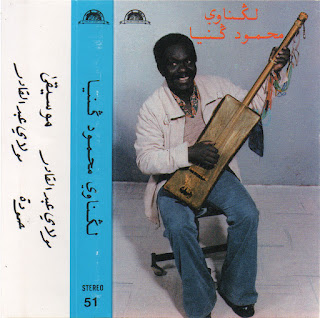
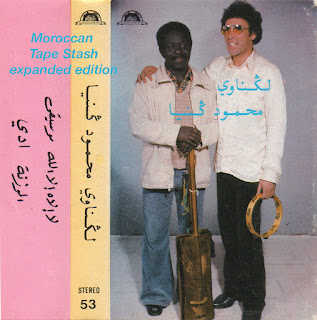
Mahmoud Gania - More from the Crazy Drum Kit Session

This post is a sequel to one of the earliest posts on Moroccan Tape Stash back in 2011. That post shared the tape Voix de Casablanca VDC 53, one of the wildest tapes in the Stash - raucous drum kit rolicking and punctuating along with in-your-face breakneck qarqabas, and non-stop thumping guinbri. 

Today I'm sharing VDC 51, which duplicates a fair amount of what's on VDC 53. Of its six tracks, only 3 do not appear completely or partially on VDC 53. These 3 new tracks (A1, B3, and B4) do not feature the outlandish drummer, but from the sound of the mix and the musicians, they sound like they come from the same recording session. Of the 3 overlapping crazy drummer tracks, 2 contain shorter versions of things on VDC 53 (A2 and B1), while one contains extended material not found on VDC 53 (B2).

So in addition to sharing the full version of VDC 51, I'm also sharing an EXPANDED EDITION of VDC 53, incorporating 4 additional glorious minutes of insane drum kit mayhem not featured on the original tape. I was going to call it The Complete Warren Beatty Sessions since, as I noted before, the gentleman pictured on the j-card, who we assume to be the drummer, does bear a resemblance to the actor. However, one holds out hope that there is a VDC 52 cassette out there somewhere that may contain even more drum madness from this session.

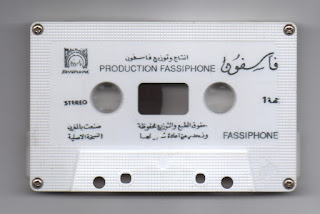
VDC 51 shell

Discographic Questions: The two albums VDC 51 and VDC 53 are clearly related - the cassette company is of course the same, the photos show Mâalem Mahmoud in the same clothes at the same studio, and the music on the two tapes appears to come from the same session. However, I do have questions. The cassette shells for both tapes do not read Voix de Casablanca, but rather Fassiphone. The track names listed on each j-card are completely different from the songs featured on each cassette. And the singing doesn't really sound to me like Mâalem Mahmoud. So I have wondered whether in fact these cassettes are matched with the correct j-cards. If it were just one cassette, it would be plausible that the wrong tape ended up in the wrong jewel box at the tape shop one day. However, for the same error to happen to 2 different, clearly related tapes, is a bit much to believe.

So the questions remain: Is this really Mahmoud Gania? Are these tapes really meant to accompany these j-cards? If so, why are the track names wrong? Who is the funky drummer and where can I hear more of him? Maybe we'll learn more, maybe not. At any rate, I hope you enjoy these, and I wish you all a good Ramadan coming up.

L-Gnawi Mahmoud Gania لڴناوي محمود ڴنيا
Voix De Casablanca cassette VDC 51 صوت البيضاء


A1) Allahuma Selliw 3la Nbi Ou S7abu Lillah
       Sala 3lik Ya Nabi
       Marrakchia a Lalla
       Aicha ou Mali
       Moulay Atferrej 3lia
       Salla 3lih
       Malika
A2) Lalla Mira
       Moulati Fatma
       Soussi
       Malika
       Moulay Abdellah Cherif
B1) Salbani 'Awju Koman Aliya
B2) Galuli Toubi
       Wali Moulay Driss
       Tijania
B3) Allah A Baba Mimoun
B4) Mwi A Mwi Wach Qdaw Ila Berhu Bia
       Malika

 
L-Gnawi Mahmoud Gania لڴناوي محمود ڴنيا
Voix De Casablanca cassette VDC 53 صوت البيضاء

Moroccan Tape Stash Expanded Edition 2022

 
01) Lalla Mira
       Moulati Fatma
       Soussi
       Malika
       Moulay Abdellah Cherif
       Bouya Ribu
       Lemwima Hada Mektab
       Llahi blik ma blani
       Selliw 'ala Nnbi
       Llah Llah Nabina
02)  Galuli Toubi
       Wali Moulay Driss
       Tijaniya


03)  Jilali Dawi Hali
       Lagnawi Baba Mimoun
04)  Salbani 'Awju Koman 'Aliya
       Lalla L'arosa
       Mulay Abdellah Cherif
       Lalla Fatima Zohra
       Lahbib Sidi Rasul Allah
       Sla u Salam 'alik a ya Taha

Friday, December 31, 2021

It's Been A Weird Year - You Deserve Some Great Gnawa Music from Essaouira

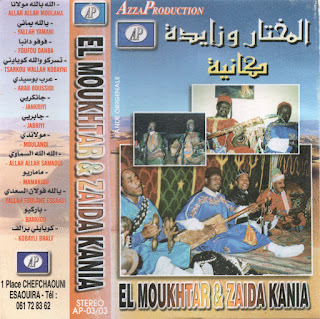
A Gnawa offering to round out the strange year that was 2021. Here's a lovely album from Mokhtar & Zaida Gania. Mokhtar and Zaida are the brother and sister of the late mâalems Mahmoud and Abdellah Gania, and I believe they are the last surviving children of Mâalem Boubker Gania. 

Zaida is a mqaddma ritual leader in Gnawa ceremonial life, and of course grew up in a family of Gnawa musicians and ritual practitioners. In addition to performing music with her male Gnawi family members, she also leads all-female haddarat percussion groups:

mokhtar_with_badass_guinbri

Mâalem Mokhtar has performed in traditional and fusion Gnawa settings. His singing voice is deeper and more resonant than that of his late brother Mahmoud. And he plays this badass guinbri:

The tracks of this album feature an appealing variety of textures. Gnawa music in its traditional form stays pretty uniform in terms of texture (a guinbri, some qarqabas, and some male call/response vocals). It's a great texture, and sometimes that's exactly what the doctor ordered. But sometimes it's nice to change things up too. On this album you get: songs with added percussion (A2, and especially B5), songs with Zaida singing lead (A1, B1, B2, B5) or along with the male chorus (A1, A3, A5, B4), and songs with a tenor sax (A4, B2). 

Female and male voices together in Gnawa music don't always work for me, but in this instance the combination sounds great - perhaps the fact that it's family makes the blend organic. Men and women of the Gania family can also be heard singing together on Maâlem Mahmoud's 1994 album with Pharoah Sanders The Trance of Seven Colors, and the blend there is likewise wonderful.

The use of tenor sax on this album also hearkens to The Trance of Seven Colors. In fact, it's the only other recording I can think of that features a full Gnawa group augmented only by a saxophone. Typically when you hear a saxophone with Gnawa, you are also hearing other instruments like a drum kit, keyboards, guitars and other percussion. I wish I knew who was playing the sax here - the approach is nice, and somewhat reminscent of the way Pharoah played with Mahmoud's group.

Mokhtar remains active as one of the elders of Gnawa music in Essaouira. His performance with his nephew Houssam was one of many highlights of the huge Gnawa concert that was broadcast on Christmas day on Moroccan TV. The concert, which was filmed in Essaouira, featured dozens of Gnawa mâalems and koyos from across Morocco. You can watch the entire show, which was very good, on YouTube:

Thanks to all of you who continue to visit Moroccan Tape Stash after all these years. May 2022 bring goodness and joy to you all, and may humans across the planet join hearts, hands, and minds in love and mutual respect to confront the formidable challenges we continue to face.

El Moukhtar & Zaida Kania المختار و زايدة كانية
Azza Production AP-03/03

2003

A1 Tsarkou Wallah Kobayni تسركو والله كوبايني
A2 Foufou Danba فوفو دنبا
A3 Jabriyi جابريي
      Moulandi مولاندي
A4 Jankriyi خانكريي
A5 Barkiou باركيو
      Kobayli Bralf كوبايلي برالف
B1 Yallah Foulane Essaadi يالله فولان السعدي
B2 Yallah Yamani يالله يماني

B3 Sidi Sma Samaoui
B4 Allah Allah Samaoui الله الله السماوي
B5 Allah Allah Moulana الله الله مولانا

320 | FLAC


Tuesday, September 29, 2020

Maalem Aziz Arradi - 7-Hour Gnawa Lila Recording

Salaam, friends - I just stumbled across a 7-hour (!!) recording of a Gnawa lila from Marrakech/Tamesloht that was posted on the Internet Archive by French musician David Vilayleck. It dates from November 2018 and features Maalem Aziz Arradi from Marrakech. I'm about 3 hours into it, and it's a real gift of a recording. Not because of its sound quality (it was recorded on a smartphone), but because of the pace of the performance and the overall ambiance of the recording.

You can't hear all of the lyrics, the guinbri is a bit buried, the qarqabas are pretty loud, and there's a fair bit of discussion going on among the assembled. In other words, this is what it sounds like to be at a lila. The songs take as long as they require to get where they need to go - or rather, to get people where they need to get to. 

Listen in the player above, or download from the Internet Archive HERE.

Thanks David and Aziz for sharing this recording, and alhamdulillah I found it on good night to be aurally transported away from the shitshow that my country has become.

Thursday, April 11, 2019

Houssam Gania - get a copy of his new cassette before they're gone!


Houssam Gania is the son of the late Gnawi mâalem Mahmoud Guinia, and a fine guinbri player in his own right. Like his father, his playing isn't flashy, but is deeply in the pocket.

Hive Mind Records in the UK released this new album by Houssam on cassette (!!!!!) a couple of months back. The j-card design is a lovely homage to the Tichkaphone cassettes of his father. The album contains a great version of the Essaouira version of "Sidi Musa" - a different flavor than you hear in Marrakech, Casablanca, or elsewhere.


As of today there are only 10 copies of the cassette left at Bandcamp. You will still be able to download digitally thereafter, but why not get a copy for your own tape stash!!

Huge props to Marc over at Hive Mind for this release, as well as for the vinyl releases of Mahmoud Guinia and Moulay Ahmed el Hassani over the last couple of years.

Order you copy HERE!

Sunday, June 3, 2018

Mustapha Baqbou Upgrade (best ever gnawa tape!)


Here's an upgrade of my all-time favorite Gnawa tape! This is a great recording of Marrakech's Mustapha Baqbou, solo with a guinbi, singing and masterfully strumming a few songs, mainly from the Black repertoire (the Ouled al-Ghaba). Without qarqaba-s and choral responses, this is an intimate session where the guinbri is on display. And nobody rivals the virtuosic touch and subtlety that Mâalem Baqbou brings to the instrument. I estimate a late 80s or early 90s date to the recording.

Double big thanks to Mr. Tear: first for the original upload at the Snap, Crackle & Pop blog, and then for finding another copy of it and sending it to me! The sound is a little better on this copy than on his. However, it's about 8 minutes shorter - so I digitized this one and patched the remaining minutes from the other copy. I think it's an upgrade to the earlier upload, though that one is still available here if you want it.

Disco-Graphic notes: I used to have a copy of this years ago - the photo of Mâalem Baqbou was the same, but the background was different. I think my copy was on the widely-distributed Fassiphone label (out of Fez), as was Mr. Tear's copy. The j-card of this one, however, indicates that it was issued by the Marrakech label Sawt el-Haouz. My guess would be that it was originally recorded for the Marrakech label, then licensed to Fassiphone. But I could be wrong. Also, the cassette shell for this copy gives yet another production house: Disco Phone, way over in Oujda.

Also, the identities of Side A and Side B are not clear. Mr. Tear's copy (and I believe my old lost copy) began with Kubaily Mama/Mamaryo. However the j-card and this copy have Balini/Allah ya Rebbi ya Moulay as the first track. The latter order makes more sense from the running order of these songs during the lila. But I really got used to having Kubaily Mama at the beginning of the album, so I'm leading with that here. You are welcome to retag if you like :)

Sawt el Haouz presents صوت الحوز يقدم
Mustapha Baqbou مصطفى باقبو
Sawt el Haouz cassette S.H.57
(cassette shell reads Disco Phone)

1‫(‬ Kubaily Mama - Mamaryo ممريا
2‫(‬ Fulani فولان
3‫(‬ Balini - Allah ya Rebbi ya Moulay الله يا ربي يا مولاي
4‫(‬ Bouchama - Mekkawi بوشامة

Get it all HERE.

Sunday, November 12, 2017

Houssaine Kili - Great Gnawa Fusion in the Early 90s


Houssaine Kili is a singer, songwriter, and string player (bass, guitar, guinbri, mondol, lotar...), originally from Agadir, who notably collaborated with the German rock group Dissidenten for a series of albums and tours in the 1980s.


The origin of these collaborations is recounted in the notes to Kili's first solo album. Kili has released 2 solo albums, produced and recorded in Germany: Safran (1999) and Mountain to Mohamed (2001).

From what I could find online, Kili appears to have led and toured with his own band throughout the 2000s, and he did some touring with jazz pianist Omar Sosa after participating in the latter's album Sentir in 2002. I couldn't find much online trace of Kili more recent than 2009.

Although I can't fill in his more recent history, I can share a fantastic live tape that gives an idea of what he was doing between his departure from Dissidenten (1988) and the release of Safran (1999). The Safran notes state that "Kili left [Dissidenten] in 1988 and started working on a solo project", but no details of this project are given. If this tape is any indication, it's a shame that this project did not result in an album.

The tape reveals a fully realized fusion band, drawing heavily on Gnawa source material, and performing thoughtful, tight, punchy arrangements. The tape came into my hands in Marrakech in 1992, and I was told it was recorded in Germany. That seems likely, though the introductory narrration to the first song, "Marrakech", is in French, and some of Kili's banter is in English. (Sometimes it's "danke", sometimes it's "thank you".)

Strangely (and disappointingly to me), none of the material from this concert tape shows up on either of Kili's two albums which, to my ear, were good but less exciting than this live tape. Some tracks on Mountain to Mohamed come close, particularly, the fantastic "Kfaya":


Both of Kili's albums, however, aim for a broader mix of textures and Moroccan source materials than the repertoire of the focused, Gnawa-centric live performing unit. I could find barely a trace of this band or these songs online anywhere. The closest I got was a live clip of Kili in 1998 leading a band in a performance of "Ya Sandi".


While the 1998 performance retains a couple elements of the arrangement performed on my tape (particularly the short instrumental transition phrase that begins/ends some sections), it is missing many delightful features of the early 90s version: call/response and harmony from a second vocalist, intricate rhythm guitar work, middle-section breakdown, and overall propulsive rhythmic drive:


I would love to know more about this early 90s band, and about this tape:
  • Who are the musicians? The only person introduced by name is Roland Schaeffer on saxophone and guitar (and ghaita). Schaeffer was a member of Embryo, the group from which Uve Müllrich and Michael Wehmeyer broke away to form Dissidenten, and with whom Kili collaborated as well. Who is playing keyboards and drums, and who is singing the Arabic backing vocals?
  • Where and when did this concert take place? Though my copy has quite a bit of tape hiss, the overall mix is very good - it sounds like a professional soundboard recording. (I would looooove to hear a clean version of this recording, and one that fills in some of the portions missing in my tape)
  • Where else and how often did this band perform? Did they ever make studio recordings? If so, why did they never see the light of day? 
  • Why did Kili abandon these songs and arrangements when he recorded his 2 albums?
Some clips of Kili's bands in the 2000s do retain the excitement and energy of the early 90s band, for example, this great 2002 clip:


It's not easy to keep a North African fusion band going outside of France or North Africa. (Believe me, I've tried!!) It's too bad there's not more recorded music available from the talented and creative Houssaine Kili, and that he wasn't able to find sustained international success over the years. His website remains active, but contains no news or recent updates. I hope he'll resurface with something new and interesting! The most recent clip I could find of him was something very different and very nice:


Houssaine Kili Band, featuring Roland Schaeffer, 199X-XX-XX, Germany
tape obtained in marrakech in 1992
01) Marrakech (baniya)

02) Jilali
03) Ya Sandi
04) rai song (contains fade out and in)
05) Roland Schaeffer instrumental
06) Of Course One Day the Sun Will Shine (contains tape flip)
07) Ah Wlidi
08) M3a Mourad Allah
09) Negsha (incomplete - fades out)
10) Yobati
11) Jilala (encore)

Get it all here.


Sunday, April 23, 2017

3 hours of Gnawa music from 1966


Those of you with a taste for field recordings may enjoy perusing the online collection of CREM (Centre de Recherche en Ethnomusicologie), housing the audio archives of the CNRS and the Musée de l’Homme. Much of this vast audio archive of commercial and unpublished recordings is available for online listening.

I'm currently enjoying a remarkable collection of recordings made by one Mohammed Aït Youssef in Marrakech in 1966, featuring over 3 hours of Gnawa music:

http://archives.crem-cnrs.fr/archives/collections/CNRSMH_I_1968_021/

The online documentation does not indicate the name of the performer, but I believe it is the Gnawi Ahmed ben Lahcen.


He can be heard in some of Cafe Matich's YouTube uploads of recordings from Marrakech's Djemaa el Fna plaza:


It is certainly the same Gnawi that is heard in Gerard Kremer's recordings for Arion (released 1975):


Some of the recordings in the CNRS collection appear to have been made in the Djemaa el Fna plaza. Others, perhaps not - it's difficult to say. At any rate, it's a great collection of recordings - a lot of Ouled Bambara and Negsha songs, some with clapping, some with qarqaba, a few tracks of drumming and qarqaba-ing. (Almost no mluk trance songs, though.) There are also a few tracks of odds and ends. 08-03 features the bells of Djemaa el Fna water sellers. 07-01 is a drum and qarqaba song featuring the ismkhan (also known as âbid chleuh - Berber-speaking Gnawa who have a repertoire completely separate from that of the more well-known Arabophone Gnawa), and 07-02 is entitled "Solo de flûte Gnawa". The latter track sounds to me like an instance of the Soussi Berber style of âwad flute. Perhaps it's a Gnawi musician who doubles on flute - I've never heard of a discrete Gnawi flute tradition or repertoire, but the world is full of musical surprises, so perhaps I'm wrong!

I couldn't find any information about the researcher Mohamed Ait Youssef, what sort of research he was doing, or how his recordings ended up in the CNRS archive. The archive contains other recordings of his dating from1965 and 1968. These recordings, also from Marrakech, feature several different genres (as well as a few more Gnawa tracks). Whatever his story may have been, it's wonderful that he left us such extensive recordings, and that CNRS has shared them online.

CNRS Collection: Maroc, Marrakech; Musique de confrérie. Enregistrements sonores inédits réalisés par Mohammed Aït Youssef au Maroc (Marrakech), en 1966: http://archives.crem-cnrs.fr/archives/collections/CNRSMH_I_1968_021/

Sunday, March 19, 2017

Gna Abdellah


Here's a lovely old Gnawa tape appearing to date from the 1980s. This looks like Abdellah Guinia, brother of Mahmoud, from Essaouira. The cover reads "Gna Abdellah". (I wonder if it was supposed to read "Guinia Abdellah", or "Gnawa Abdellah", or whether it's deliberate.) Although less well known than Mahmoud, Abdellah did release a couple of recordings available internationally. This is the first time I've seen a Moroccan cassette under his name.

It sounds like Mahmoud is singing on this tape, but perhaps it's just a family resemblance. In addition to Abdellah's guinbri-playing, there is a tam-tam and a banjo on some tracks, à la Nass el Ghiwane. Thanks to musician and Stash visitor Fritz Catlin who used one track in this swell mix (at about 38:55):
and then shared the full album with the Stash!

 Gna Abdellah (Abdellah Guinia) Sawt el Janoub cassette
1) 3arbiya Moulati
2) Sadati Huma Shorafa
3) Hada Wa3du Meskin - Woye Wahyana
4) Allah Denya Wo Ho
5) Hada Wa3du Meskin - slight return (seems like the beginning of track 2 again)
6) bonus ahouach (not abdellah guinia, or even gnawa, but there it is, and it rocks!)

Get it here.


Saturday, December 3, 2016

Âita With Guinbri Really Shouldn't Work, But Tagada...


Well whaddya know? The Stash yields another Tagada tape! This dates from around 1992, when Mohamed Louz was still a member of the group. (For some historical info on the group, see our previous Tagada post.)

I wrote previously that Tagada's folk-revival approach was rooted in the âita. This album stretches things a bit, while maintaining a core texture of viola driving the melody, male group or antiphonal vocals and a bendir-driven percussion section.

"Lalla Lgada" leads things off in a typical âita mode, though with what sounds like scissors hearkening back to the âbidat errma. The strange "Ach Ngoul Lik" leads off with a pentatonic viola solo somewhat evoking the amarg tradition of the Soussi rwayes, but then the rhythm enters, featuring a Gnawa guinbri (and some faint qraqeb, I think). It sounds sort of Nass el Ghiwan-ish, except for the continued presence of the viola, which pulls the sound in a different direction. "Âyyitini" goes full Soussi, adding a banjo or lotar and naqqus for that rwayes vibe, though the singing is in Arabic, not Tachelhit.

Finally "Hada Hali" returns viola and bendir to the center of the texture with a real deep âita feel - angular bendir-s, alternating solo vocals evoking shikha song, sliding eventually into trance-based and trance-evoking lyrics, idiomatic viola riffing recalling the sweaty middle-of-the-night when the âita groove gets so heavy and REAL that it crosses over into that zone where all one can do is call prayers upon the Prophet and the saints, hope for deliverance and submit to the groove. At this point in the song, Tagada incorporate the guinbri and qraqeb again. This sounds nothing like Gnawa music, though, resembling much more the saken trance songs of the âita tradition. But with Gnawa signifiers added for intensification? Mixing these elements together is a weird, improbable idea, to which I'm sort of opposed on principle, and yet somehow... it kind of works! Well played, Tagada, well played!


Tagada (تگدة) Edition Hassania cassette EH 1462
01 Lalla Lgada (لالة الگادة)
02 Ach Ngoul Lik (اش نگول ليك)
03 Âyyitini (عيتني)
04 Hada Hali (هذا حالي)

Get it all here.