Showing posts with label Darbuka. Show all posts

Thursday, November 11, 2021

Tkitikate! Tkitikate! Party Time! Excellent!

I tell ya, some of the best fun I've had in Morocco has been at parties in Marrakech where a tkitikat group comes to play. I'm surprised I'm 10 years into this blog and I've never really written about tkitikat. Well, I guess it's 'cos I didn't have any straight up tkitikat tapes (other than possibly the great Pokémon tape). Now, thanks to Mr. Tear (late of the esteemed Snap, Crackle & Pop blog, and currently hive master at Hive Mind Records), I've got a reason to write about it, 'cos he sent along this fine tape rip!

Tkitikat is a style of music played by men's percussion and singing groups. (It was always played by men, in my experience, but I haven't been to Morocco for a while, and perhaps there are female tkitikat groups now.) The primary venue for this music is at parties.

Repertoire - like a good wedding band (another type of party band), a good tkitikat group has dozens of songs in its repertoire that originate in various styles and historical periods. To end up in the tkitikat repertoire, though, they ought to share a few key elements:

  • They ought to be in that 6/8 chaâbi rhythm (or close enough that it fits)
  • They ought to be songs that lots of people know OR they ought to have short catchy refrains that people can learn easily and quickly SO THAT people can join in singing
  • Bonus points: When a song's verses are simple enough that you can make up additional verses that were not in the original. (cf. Najat Âatabou's "Hadi Kedba Bayna")

Ensemble - the group will have a variety of drums. The group here is using a tar (tambourine), a darbuka, and some tâarijas. As opposed to female percussion and singing groups like âouniyat or houariyat who perform seated, the tkitikat groups play while standing, sometimes facing each other in a circle, sometimes broken out and moving around the room interacting with partygoers. And unlike a wedding orchestra, which typically features one primary lead singer, the tkitikate group tends to feature any or all members of the group as lead singers.

PLEASE STAND BY FOR A COUPLE OF FREE-FLOATING MUSICOLOGICAL MUSINGS:

Gender and percussion groups: I wonder why the female percussion groups like âouniyat or houariyat typically perform while seated, whereas the men's groups like tkitikat and âbidat errma perform standing 🤔 ... Perhaps it's because the male groups are the sorts of groups that one might also encounter in an outdoor halqa performing circle, whereas the female groups are more exclusive to indoor private parties.

Etymology and regionality: I wonder whether tkitikat is something that originated in Northern Morocco. The word is a diminutive of taktouka, which in Morocco refers most famously to the taqtouqa jbaliya - the taqtouqa of the Jbala region of northern Morocco. (We shared a tape of that a while back.) When I was living in Marrakech, a friend who played in a tkitikat group was excited when his group was able to learn some songs and rhythms particular to the North, so there is certainly a Northern tradition. In fact, I remember the groups in Marrakech going less often under the name tkitikat and more often under the name dqiqiya. The latter is a diminutive of daqqa, which is a musical form specific to Marrakech and Taroudant 🤔 ... 

AND NOW BACK TO OUR REGULARLY SCHEDULED BLOG POST

To my mind, tkitikat groups seem like an active repository of Moroccan musical memory. Or like a jukebox - so many songs to choose from, and designed so that everyone in the crowd should find an old or new favorite song to please them and entice them to dance and be merry. The current tape is no exception. Track 1 has a Gnawa sound to it. Track 2 is an old Houcine Slaoui song from the 1940s. Track 3 is a version of Khiffat Rjel (better known as Ach Dani), Ismail Ahmed's classic 1960s hit, sung here with the words transformed from a song of unrequited love to a comic song about different kinds of food, and track 6 is a straight up version of the Jbala standard Ain Zora. Ranging wide across the regional and temporal map!

Well, while I was searching for some nice tkitikat video to share, I actually found a clip from this very album! 👆 It looks like the cassette is the soundtrack to a VCD, which dates this to probably the mid-2000s to early 2010s. And it turns out that on the first track, the lead vocal is taken by none other than the well-known Gnawi Mâalem Abdelkbir 'Lechheb' Merchane! I understand that many years ago, he was a member of Hamid Zahir's group. And Hamid Zahir's music is basically tkitikat with an oud added, so this is some old familiar musical territory for him! Abdelkbir is one of 3 lead singers on this album. He sings track1, the last bit of track 3, and tracks 4 and 7. A comic-oriented singer is featured on track 2 and most of 3, and a third singer is featured on track 6. Track titles listed here are my best guesses.

Tkitikate Marrakech Volume 2 التقيتيقات المراكشية
Société CHAMUSIC cassette
شركة شلموزيك

1 Sidi Musa Âri Âlik
2 Ahdi Rasek La Ifouzou Bik Al Qouman Ya Flan (and suite)
3 Ach Dani L-Bibi Tani (and suite)
4 Mellit Lghram
5 Malou Itghagha / Ana Mellit Lhoub
6 Âin Zora (and suite)
7 Wa Lhiha Wa Lhih
8 Qefla

320 | FLAC

Saturday, October 26, 2019

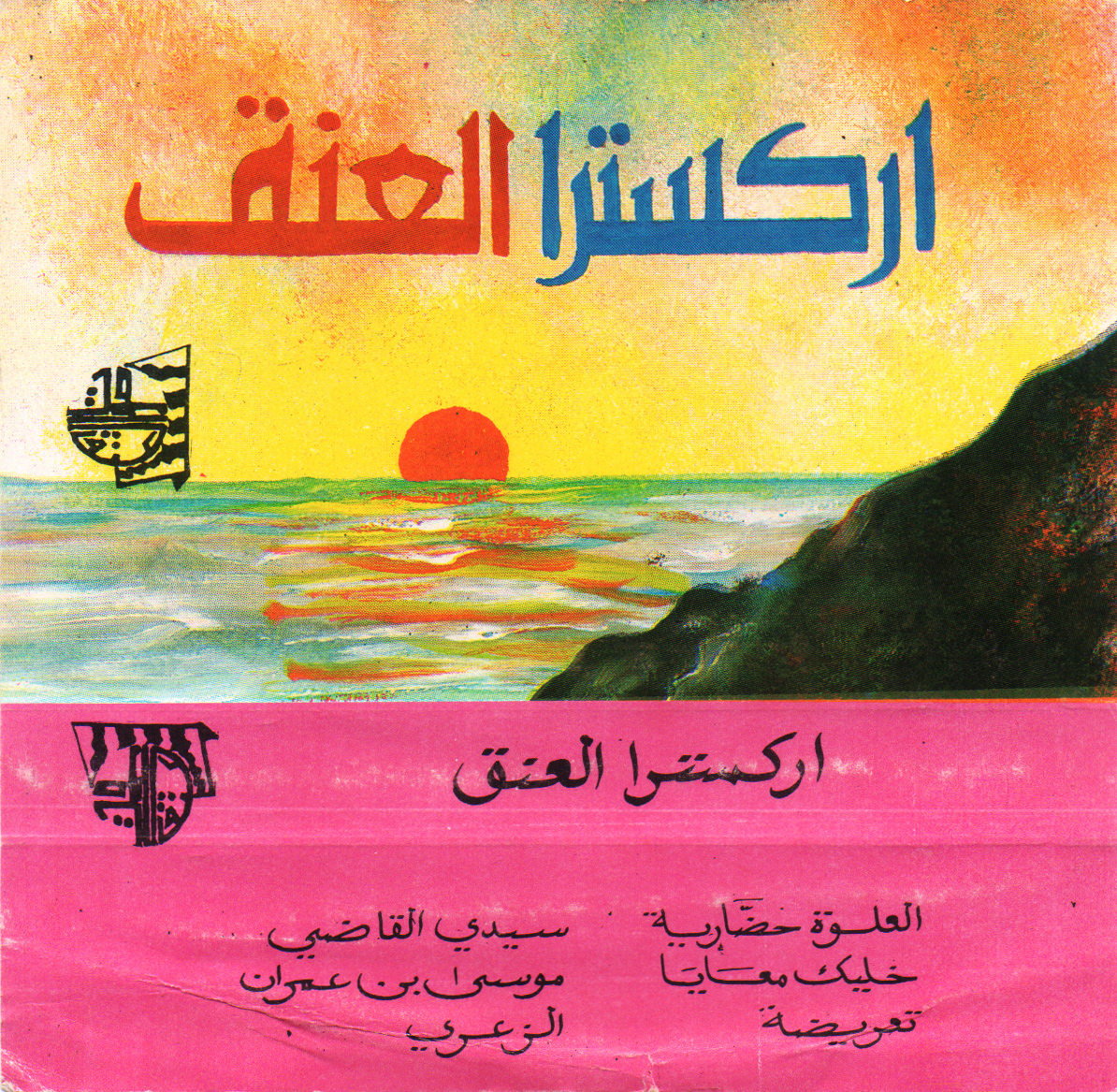
Chaâbi Sweet Spot - Orchestre el Ânq (اركسترا العنق)


Long drawn out medleys? Check. Âita melodies and structures? Check. Scratchy viola and punchy darbuka? Check. Drum kit, electric guitar and organ? Yes - right there!

This swell tape comes from a little stash of tapes that fell into my lap a few months back. All without j-cards and most with only the name of the production house on the cassette shell. This one is from a company called Sawt el Ânq (انتاج صوت العنق). I'm guessing it's from Casablanca, but only because the singer gives a shout out to the soccer teams Raja and Wydad.


[blogger knows he's seen that logo before, goes digging around in the stash...] 


Well - I knew I'd seen that Sawt el Ânq logo before on an orphaned j-card in the stash. (And a fantastic logo it is, too!) Went looking for it, hoping it would reveal the location of the production house. No luck there, but... the song titles were a match for this tape!! The tape must have bounced around among the Moroccan ladies in the Bay Area for 20 years and then landed back here in the stash where its j-card was waiting for it!

Also, my friend Jamal confirms that El Ânq is a neighborhood in Casablanca, so we're pretty sure this is a Casa production.

This is some vintage late 1980s chaâbi. Hope it hits your sweet spot too!


Orchestre el Ânq (اركسترا العنق)
Sawt el Ânq (انتاج صوت العنق) cassette
1) Sid el Qadi سيدي لقاضي
2) Melki Ma Jiti
3) Zaeri - Musa ben 3amran الزعري ‫-‬ موسى بن عمران
4) Al 3aloua Hddariya  العلوةحضارية
5) Khellik M3aya - Taârida خليك معايا ‫-‬ تعريضة

Get it all HERE.

Sunday, October 28, 2018

Khalid Bennani - Fes-Style Chaâbi, Saxophone included


Salaams, good people! Sorry for the long dry spell. All's fine here at Moroccan Tape Stash, despite the generally befuddling times.

If you’ve visited Moroccan Tape Stash before, you know that your humble curator loves chaâbi tapes from the days of drum kits and electric guitars. How about we add some saxophone to that mix! Here’s a vintage gem from the stash - an early tape by Khalid Bennani, picked up on my first trip to Morocco in 1992.

According to his biography at Ournia, Bennani performs primarily for “private parties such as weddings and engagement ceremonies”. I have the greatest respect for a good wedding band - being able to satisfy folks old and young, from near and far, is not always easy. And if we’re talking about Moroccan weddings, that means having a fresh, diverse, and extensive repertoire that will give rhythm to a party for hours, often deep, deep into the night.

In addition to wedding work, Bennani continues to record prolifically and to give concerts outside of Morocco. (Apparently he performed some dates in Texas earlier this year!)


Bennani is based in Casablanca but is a native of Taza (between Fes and Oujda) and plays a Fessi repertoire, including melodies reminiscent of the Arab Andalusian and melhun repertoire, devotional strains from the Aïssaoua brotherhood, and tunes evoking the Jbala region of northwestern Morocco.

Fessi chaâbi is usually too smooth for my tastes. I prefer things more raucous, à la Casablanca or Marrakech style. This album, though, manages to achieve a texture that is somehow both smooth and raucous! Maybe it's those snare drum punctuations from the drum set along with the syncopated electric rhythm guitar, a darbuka prominent in the mix.


Enjoy!


Khalid Bennani خالد بناني
Oscariphone (اسكارفون) cassette 11
ca 1992
1) Lhwa Bia - Ma Ândi Zhar  لهوى بيا - معندي زهر
2) Yom l-Miâd - A Latif  يوم الميعاد - ألطيف
3) Ana f-Ârek - Daba Tendem Âliya   انا فعارك ‪-‬ دابا تندم عليا
4) Goulou l-Hbibi  قولو لحبيبي

Get it all HERE.

Wednesday, May 23, 2018

Najat in the 90s


After the success of Nouveau 92, Najat Aâtabou did not return to the oud and bendir format of her earlier hits. Rather, she adopted various other instrumental combinations, moving eventually toward a more mainstream chaâbi sound.

I own copies of some of these cassettes (without j-cards), and have lost a few along the way. Also, some of these are available to stream or purchase online. So I'll mainly post here links to existing web resources and try to piece together her discography between Nouveau 92 and Attention Monsieur (2000).


Souaret (1993)


This album came out as a cassette on Edition Hassania in 1993. My copy went missing long ago, but I believe the j-card may have had this photo, which accompanies Amazon's version:

The production sounds similar to that of Nouveau 92, using the same funky synth bass on many tracks. I remember at the time being a bit disappointed with the album, feeling it was less hard-hitting than Nouveau 92, and contained no super-catchy single. Listening to it again now, though, it sounds like a breath of fresh air! It augments the unusual synth and viola texture of Nouveau 92 and fills it out with a more organic early-90s chaâbi orchestra: live strings, bendirs, full drum kit, and an occasional electric guitar. It's a more organic, orchestral overall sound. (Admittedly, I'm a sucker for the chaâbi sound of that era.)

And Najat's singing is spectacular. Those folks over at Edition Hassania really knew how to record her - whether accompanied by a simple oud-and-bendir ensemble or a full orchestra, her voice remains powerful and startling.

Here's a YouTube playlist of the entire album:


The mp3 album is available to purchase and download (or stream) at Amazon for a reasonable $3.99!: https://www.amazon.com/Souaret-Najat-Aatabou/dp/B00ERIW0MW/

Taqi Fia Allah (1995)


This is, I believe, the last album that Najat released on Edition Hassania. I used to have a copy of the cassette. Like the previous albums, this one is also driven by the viola. But the style is different here. Rather than a chanson moderne style of viola playing, hearkening to the smooth sounds of the modern Arab orchestra, here we have a straight-up dance-inducing chaâbi fiddle! The overall ensemble is more simple - bendirs, some oud and melodic keyboard here and there, and what sounds like a drum machine (hi-hat and some fills). Though a return to oud and bendir-s is nice, the chaâbi viola really dominates the mix and doesn't quite work for me. That being said, the tune "Baadou Lhih" is awesome and became part of her live repertoire.

The album's 6 tracks were remastered and released in the US as part of the Rounder compilation CD "Country Girls and City Women", which is out of print. It's worth finding a used copy of the CD - the booklet includes a nice essay, translations of all the song lyrics into English, and an interview with Najat. I can't find any streaming or download options for the album. Here's a YouTube playlist of the album's songs:


Sabara (1996)


I had a dub of this album, and I remember it being on label called something like "Safa Disque". (It wasn't the well-established Sonia Disque, with whom she would later record.) The leadoff track "Aatani Bedhar", also known as "Mali Ana Ma 3andi Zhar" was a smash hit - smooth chaâbi groups were covering it, and with its singalong chorus of "Wa-a-a-a-ayli", it was an instant classic, and one of Najat's biggest ever hits. I love it!

It was around this time that studio-produced chaabi in Morocco started to sound a bit too perfect and precise for my ears. Though rhythms were still driving and percussive, drum sets had given way to drum machines and programming, which could feel mechanical. Electric guitars for rhyhmic and chordal accompaniment were rarely found anymore, replaced by more versatile synthesizers, which could also add a variety of melodic textures. Even oud-s and violas began to sound more processed and perfect. I tend to like my chaâbi (and most music) a little on the sloppy side - I appreciate being able to hear the human interactions and imperfections.

That said, when all the elements come together in a studio production, it can be great, and that's the case throughout this album. The oud remains prominent in the mix, the real or synth strings (I can't always tell which) support without being overbearing, the rhythm section pops and crackles, the synth bass keeps things funky and in the pocket, and Najat and the backup choir sound great! A mega-post on the ARAB TUNES blog has this album, and many others by Najat!

Also, here'a YouTube playlist of the whole album:


Souvenir (1998)


According to this interview, Souvenir, like its predecessor Sabara, was produced by Najat's former husband Hassan Dikouk. It has a similar overall sound to Sabara, and Najat seems to have comfortably settled into a mainstream chaâbi setting. To my ears the sound is a little less punchy - a bit more emphasis on the viola and less on the oud, and the vocals seem more subdued. But when it works, like in "El Aati Houwa Allah" and "Daba Ytem El Nachat", it still kicks.

ARAB TUNES has this one as well, and here's the whole album on YouTube:


Et Oui Mon Ami, Parle Je T'écoute (1999)


My cassette copy of this (get it HERE) contains a track not available on streaming platforms - a spoken message from Najat to her public, presenting her new cassette, on which, she says, she has tried as always to move chaabi song forward, and that the most important measure of its success is "your entertainment, clapping, and pleasure".

I don't know what prompted the inclusion of this rather apologetic message. Perhaps her moves into mainstream chaabi were criticized by some sectors of the public. Or perhaps she was nervous about the leadoff track, which has a distinct Latin feel and a light programmed percussion track, straying further away from her roots than usual. (This was the era of Amr Diab's smash Egyptian hit "Habibi ya Nour el Ain". Unlike that track, though, Najat's does not include the soon-to-be-ubiquitous-in-Arabic-pop flamenco guitar.) On streaming versions of the album (like the YouTube playlist embedded below, or Amazon's version), there is a bonus track - a chill lounge remix of the title song, with light funk electric guitar and Middle Eastern strings replacing the punchy synth horns of the original.


Outside of the title track (which was not a big hit), the rest of the album features a pretty standard chaâbi texture, though a bit more sparse than the previous two albums. I couldn't quite put my ear on what was different at first. I heard a viola and a synth banjo, some restrained programmed rhythm with a live darbuka. There is a funky synth bass again, though it's very low in the mix as compared to the previous albums. The really key difference here, though is that there is NO BENDIR! Throughout all of her albums, whether based around the oud, the viola, or a full orchestra, the one constant is the presence of the buzzy bendir! On this one, though, the only buzzy timbre you can hear is the occasional taarija. The low percussive tones, are not buzzy booms, but clean synth bass drums. Which is a weird idea, but it sort of works for me.

The viola-centered sound of this album hearkens to 1995's Taqi Fia Allah, but with punchier rhythm and overall sound. Again, the chaabi viola isn't my favorite instrument to hear with Najat Aâtabou's voice, but this ain't bad.

---

I saw Najat Aâtabou do a concert in Casablanca in 1999, and the only songs she did from any of these 5 albums were "Mali Ana Ma 3andi Zhar", from Sabara and "Baadou Lhih" from Taqi Fia Allah. But although these albums may not be packed with hits, there's worthwhile material on all of them. My ear for Moroccan lyrics isn't developed enough to critically assess Najat's 1990s songs in comparison to the earlier hits that brought her to fame. A lot of the same themes seem to pop up - complaints about romantic relationships, trying to keep things cool with mom, patience, acceptance, and calling out hypocrites. Her turn toward a mainstream chaâbi sound strikes me as a way for her songs of support and solidarity to resonate with a broader community of Moroccan sisters. At any rate that's my interpretation for now. Am happy to hear other opinions.

Wishing a blessed Ramadan to you all. Thank you for continuing to visit, even though I seem to only post about Najat Aâtabou these days! I promise I'll get some other stuff cued up soon...
 
---
 
UPDATE: Here is another Najat album from the 90s that I didn't know about:
 

Ouejdi Atay (1997)


Sunday, February 11, 2018

Najat Aâtabou - Nouveau 92 جديد - A Whole New Bag - Hai Hai Hai!


Nouveau 92! A new sound and a new look for Najat Aâtabou. And a huge hit with "Wahdi Feddar" ("Alone at Home"), a.k.a. "Goul El Hak El Mout Kaina" ("Tell the Truth... Death is Real"), "Hadi Kedba Bayna" ("This is an Obvious Lie"), "Kedba Bayna, or "Hai Hai Hai".

New sound: We've shared several of Najat Aâtabou's early, oud- and bendir-driven albums here at Moroccan Tape Stash. (See here.) That stripped-down sound launched her to stardom in Morocco in the 1980's. (The one exception to this formula, in her early years, was a fascinating orchestral album in the chanson moderne style.) With "Nouveau 92", Najat went in a different sonic direction: the viola leads the melodic accompaniment and a funky synthesizer bass underpins a synth string section, while the rhythm section is driven by a darbuka and what sounds like a hi-hat. (If a full drum set is present, it's being played very lightly.) It's an unusual sound - not your typical viola-driven chaâbi texture. Top it off with Najat's fierce vocals, and you have something nouveau!

Huge hit: "Hadi Kedba Bayna" was an instant classic! The refrain features the repeated line "Hai Hai Hai", which is both a great singalong and an interjection expressing disbelief or annoyance, something like "whoa" or "oi" in English. And the verses were basically rhyming couplets, calling out her man for cheating on her and then lying about it. It's the type of song that can easily be incorporated into any group's repertoire and to which other singers can add new, amusing, and thematically appropriate lyrics.


"Nouveau 92" was the first Najat Aâtabou album I ever heard. When I first visited Morocco in 1992, the album was huge, especially "Kedba Bayna". The album was at one point published on CD in France (now out of print). "Kedba Bayna" was included (as "Just Tell Me The Truth") on the 1995 US compilation Morocco: Crossroads of Time (also now out of print).

In 2006, I had returned from a summer in Morocco and was watching a ball game on American TV, when during a Budweiser commercial I heard the violin riff from "Kedba Bayna" over a techno beat. Fearing I was having hallucinations, I incredulously emailed some folks and found that "Kedba Bayna" had been sampled in the song "Galvanize", released the previous year by the Chemical Brothers, featuring Q-Tip! That, at least, is still in print! (And you can find the commercial on YouTube.)

Reissue notes, for the discographically inclined: Here at Moroccan Tape Stash, I usually give you the running order of tracks exactly as they appear on the tapes. Sometimes this running order differs from what is printed on the j-card. I usually prefer to be faithful to the way the tapes were heard in thousands of Moroccan cassette players rather than the way one person transcribed the song titles when the j-card was going to print. For this album, though, I am going to go with the j-card running order. The copy I'm sharing here is not my original 1992 copy of the cassette - that one is long gone - but rather one I obtained several years later (probably in the late 1990s). I have a strong memory of this album beginning with "Wash Nsiti?", and of "Wahdi Feddar (Kedba Bayna)" being buried somewhere in the middle of the side, as is listed on the j-card. On this cassette, however, "Kedba Bayna" leads off side A.

I'm guessing that once "Kedba Bayna" became a big hit, the song order was switched so that it would appear at the beginning of the cassette, where it could be more easily found. In those days, if you went shopping for cassettes and wanted a particular song, the tape seller would pop the cassette into a deck and play it, so you knew you were getting the correct tape. That's much easier to do when the song isn't somewhere in the middle of the tape.

So... I've resequenced the running order to match what is on the j-card, because that is closer to my memory of my original 1992 copy than running order of the copy I digitized here. (And also I like it better.) For the record, the running order on this late 90's copy is: A1-Wahdi Feddar, A2 Sir Dmou3i, A3 Wayli A Lalla, A4 Ya 3achiri, B1-Wach Nsiti?, B2-Parle je t'ecoute, B3-Marad al 3ali.

Najat Aâtabou نجاة اعتابو
Nouveau 92 جديد
Edition Hassania cassette EH1460 (1992)
1) Wash Nsiti? واش نسيتي؟
2) Sir Dmou3i سير دموعي
3) Wahdi Feddar (Hadi Kedba Banya)
       وحدي في الدار (هادي كدبة باينة)
4) Wayli A Lalla وايلي الالّة
5) Parle Je T'Ecoute
6) Ya 3achiri يا عشيري
7) Marad al 3ali ماراد العالي

Get it all here.


Sunday, June 19, 2016

Yes Please, I'd Like Mine With Drum Kit and Electric Guitar - Noujoum el Haouz


Ramadan Mubarak to all, and Happy Father's Day!

This is some of the best music ever!

I recently inherited a box full of cassettes with no j-cards. The second cassette I popped in is an album by the AWESOME electric-guitar-drum-kit-and-shikhat group Noujoum al Houz, who were featured in one of the earliest posts on this blog, almost exactly five years ago!

The music of this group remains one of my favorite Moroccan sounds of all time. I've not heard another group doing quite what these folks did back in the late 80s/early 90s. The songs and singing are straight-up âita and women's chaâbi styles. The accompaniment just happens to replace the viola with an electric guitar and to move the bendir-taârija continuum of interlocking rhythms to a drum kit.

Having a guitar take the riffing melodic lead role (usually played by a viola or an oud) - is something I've not heard elsewhere in Moroccan chaâbi. Most electric guitars one hears in chaâbi (and one rarely hears them any more) are relegated to strumming rhythmic patterns and playing chords along with melodies that never used chords before (like in this old Orchestre Asri cassette, h/t Snap Crackle & Pop). This chordal support function in chaâbi was taken over by keyboards by the early 90s. One was more likely to hear melodic picking of electric guitars in Berber music (Moulay Ahmed Elhassani, Mohammed Amrrakchi), or in some of the Ghiwanesque folk revival groups (Oudaden, early Tagada).

As for the drum kit, well it does remain in chaâbi music, but it's never as in-your-face as you'll hear here. (And I mean "in-your-face" in a good way!) In most chaâbi music, the drum kit seems to play a supporting role in the overall texture of the ensemble. It doesn't drive the rhythm section, but rather provides support to the darbuka and bendirs (like dig this Daoudia live clip - you can barely hear the drum kit behind the bendirs, qarqabas, and darbuka, and it never does any fills.) But for a minute in the 80s and early 90s, the drum kit took a fantastic role in a few chaâbi recordings, stepping to the front of the mix, tumbling and accenting in a really exciting way. (In addition to these Noujoum el Haouz recordings, I'm thinking also of these bitchin' Mahmoud Guinia recordings and this excellent anonymous chaâbi tape.)

Today I'm offering a twofer. One is the newly-found cassette on the Kawakib label.


The second, let's call it a bonus album, is the actual tape that matches this j-card that I uploaded with my original post 5 years ago:


I never uploaded the actual tape that goes with this j-card because it is severely damaged. Over half of side A is barely audible due to some magnetic weirdness. Bits of side B suffer from this as well. Don't download this until you've heard the other tapes. If, like me, you can't get enough of them, you will happily sit through the magnetic weirdness in order to spend a few more minutes with this fantastic group.

I've been able to find no information online about the group or its leader, Lâyyadi Abdeljalil. I'm guessing they were a purely Marrakchi phenomenon, since both of the labels they appeared on, Sawt el Mounadi and al Kawakib, were based in Marrakech. Hope to find out more about them some day. In the meantime, enjoy!!


Noujoum el Haouz (نجوم الحوز) - Sawt el Kawakib cassette (ca. 1990)
1) Daouli Ghzali
2) A Moul L3aoud A Wlidi
3) Track 03
4) Sayh Ya Bu Derbala (see YouTube clip above)
5) Ayma Sabri Llah
6) Track 06
7) Suwwelu Moul Dar

Get it all here.

Noujoum el Haouz (نجوم الحوز) - Tansiq ou Tanshit Lâyyadi Abdeljalil (تنسيق و تنشيط العيادي عبد الجليل)
Sawt el Mounadi (صوت المنادي) cassette, ca. 1993

01) Dami
      Alf Lila Ou Lila
      Husa ya Husa
      Waye Wa Houara
02) Ila Bghiti Temchi Ghir Sir
      Ezzine oul Jamal
      Lilwajed Lmra Zwina

This tape has major audio problems on side 1 (the first 13 minutes), and a few on side 2 as well. But the music is so good, I'm uploading the whole thing anyway.

Get it all here.

Sunday, May 8, 2016

Pleasures of the Hello Kitty Boom Box - Chaâbi Khadija


Well look what I found inside the Hello Kitty Boom Box - it's a cassette on the Anzaha imprint out of Rabat! I've shared one other Anzaha cassette here, and it was a good one!


I haven't been able to identify the singer featured on this tape. During the faux-live-audience opening banter at the beginning of track 5, I hear what sounds like the crowd chanting "Kha-di-ja, Kha-di-ja". She doesn't sound like Khadija al Bidaouia or Khadija Margoum. Sounds a bit like Khadija Laboat Al Atlas, but I haven't found any recordings of her that sound quite like this one. Please let me know if any of you can identify her.


Whoever this chaâbi-singing Khadija is, this is a jamming cassette in the Casa style with riffy viola, plinky banjo-keyboard, and driving varied percussion section throughout (some darbuka, some taârija, some bendir, and some live and/or programmed drum kit. I'd place it around the mid-aughts - the faux-live-audience, the keyboard sounds, and the absence of autotuned voices remind me of Daoudi cassettes from around '04.

Enjoy!

PS, yes, I have a Hello Kitty Boom Box.


Châabi cassette featuring singer Khadija (Anzaha cassette)
Track 5 (of 5) 

Get it all here.

Thursday, December 24, 2015

Houssa Ahbar 97


Here's some late '90s Middle Atlas Amazigh viola-driven pop music. On the spectrum between the two Amazigh viola tapes I shared on this post last year, this falls closer to the earlier, folkier, acoustic end.

I couldn't find out much online about Houssa Ahbar (or Ahbbar, not to be confused with the prolific Houssa 46). This tape predates anything of his I found online. The j-card bills him as "The Star of Khenifra", implying that he comes from the same city as Rouicha.

Houssa appears to remain active via recordings and live performances. You can find some recent albums of his over at izlanzik.org. Interesting to compare the sound of these newer albums to the one offered here. Production values for Middle Atlas popular music have sure changed since the late '90s. No autotune, no keyboard, no lotar. Just the viola, bendir, men's and women's voices, and what sounds like a darbuka added to the percussion section.

Iconographic query: Here is the logo for the label Ain Asserdoun Disque. "Ain Asserdoun" is the name of the lovely spring up the mountain above Beni Mellal. The word "Asserdoun" means "mule" in Tamazight, and "Ain" means "spring" or, literally, "eye". So Ain Asserdoun could be translated as The Mule Spring or the Mule's Eye. So can anyone explain to me what is depicted in this logo?

Houssa Ahbar - New 97 (Ain Asserdoun Disque cassette 51)
Excerpt from Track 4 (of 6)

Get it all here.

Saturday, April 25, 2015

Najat Aâtabou - Live in Paris and in Tamazight


Here's a live album from Najat Aâtabou released around 1985, not long after she first burst onto the Moroccan music scene. She's in fine form here, performing in Paris at The Olympia with oud, bendir-s, a darbuka and the backup singing of the male band members.

The album opens with an evocative (orientalist?) intro featuring audio snippets of a Middle Atlas ahaidous communal dance (one wonders if there was video at the concert as well) with a spoken narration extolling the bounties of Moroccan traditional music, before introducing Najat herself.

Tracks 3 and 4 are sung in her native Central Atlas Tamazight dialect, while the others are sung in darija (Moroccan Arabic). I've become obsessed in particular with Track 4, "Nikkine Admough" or "Ad 3mough Izri". Here's a different live performance, longer than the one on the album. The moment where the band stops and Najat continues singing a capella breaks my heart:


According to this interview and performance from Moroccan TV, the lyrics are about a woman who was separated from her lover because of travel. Upon her return she finds that he has died, and she cries at his grave. (A kind soul has also translated some of the lyrics from Tamazight to French in the comments.)

Another native speaker of Central Atlas Tamazight who found success using Arabic lyrics with Berber musical forms was Mohamed Rouicha. However, Rouicha recorded some entire albums in Tamazight, whereas I don't think Najat ever released an album in Tamazight. I have found only a few live performance clips on YouTube from her early days where she performs songs in Tamazight. Conveniently, they are all linked from this page at izlanzik.org. I'd love to be proved wrong, though - does anyone know if she ever made studio recordings in Tamazight?

Najat Aâtabou at L'Olympia (EH1280)
1) intro
2) La Tbkich (= El Mektab)
3) Mani Lâhad
4) Nikkine Admongh
5) J'en ai Marre
6) 1, 2, 3

Get it here.

Thursday, November 6, 2014

El Khalfi Bouchaib - Country vs. Auto-Tune


Here's another tape from my summer 2012 trip. I believe I picked this up in Beni Mellal, though the longstanding Sawt Ennachat label is out of Casablanca. The music sounds Mellali to me - heavy on the zaêriya.

On first listen, this sounded to me like pretty standard early 21st century countrified chaabi. However, a couple of cool things stood out on additional listens:
  • The rhythm is pretty kicking, though it stays pretty mechanical throughout. However, the darbuka player gets pretty OUT in some places, embellishing all over the place. (See track 3.)
  • The viola is not auto-tuned, and it hits a few unusual notes/intervals that sound great in contrast to the otherwise perfect pitches. (See track 4)
  • Bouchaib's country vocal phrasing and embellishment often seem to subvert the auto-tune on his voice. The shikha, on the other hand, is auto-tuned to the max. (See tracks 2 and 6)
  • Track 7 ditches the auto-tune for some straight-up pitch-non-perfect zaêri goodness! 

Mastering note: Track 4 fades out quickly at the end of side 1 of my tape. I was able to find an mp3 of the full track over at psdojo.com and grafted it onto the end of my version. So the last 6 minutes of track 4 comes from that source. (Excuse the obnoxious voiceover at 6:30.)

El Khalfi Bouchaib - Ezzine Ihebbel (Sawt Ennachat cassette)
01) Bin Ezzriba u Lhendia
02) Ezzaêri
03) Ba3 Btata
04) Ezzaêri
05) El Âgra
06) Ezzine Ihebbel
07) Ennegara
Get it all here.


Saturday, November 23, 2013

Taktouka Jbaliya with Abdelhak Lâaroussi


The last of my Jbala offerings is some relatively trad taktouka jbaliya from Abdelhak Lâaroussi. I say "relatively" because the ensemble does feature a light keyboard bass in addition to the traditional bendir, darbuka, tar, oud, viola and guinbri.

About the genre, Ahmed Aydoun writes that the name taktouka jbaliya, while commonly used, is contested and that purists still prefer the name âita jbaliya. He continues:

"This rather particular âita is placed by its practitioners under the spiritual guidance of the patron saint of the Beni Âros and the Jabal al-Âlam, the [spiritual] pole Mulay Abdessalam Ben Mshish. There is no âita in which he is not cited." (1)

I love the little guinbri. You can see it held by the gentleman at the far left in the photo above. I own one and play it when I have a chance. A violin-playing colleague dubbed it the "plinkophone" because of its distinctive "plink plink plink" timbre.

I also love the loopy 9/8 (3+2+2+2) rhythm (also heard in my previous Jbala posts). In a full performance of taktouka, the 9/8 gives way to a 5/8 section and ultimately ends up in 6/8. You can hear this progression on the Musique du Monde album "Maroc: Taktoka Jabalia", in particular on the track "Aita Jabalia". On my tape, you don't get that progression, but you do get 40 glorious minutes of non-stop 9/8

More love - the Jbala rock the brown jellaba, wearing one sleeve on and one sleeve out. What a great look! 

This tape again comes from my 2001 visit to Tangier. All the Jbala tapes I picked up were issued by companies based in Fes, which is not part of the Jbala region, but is apparently far enough north to be a center for the recording and production of Jbala music. Interestingly, I also picked up a few Riffi tapes on the same trip (coming soon to the blog), and those were all issued by companies based in Nador.


This particular tape was issued by "Disque Les Fêtes de Fes". Can anybody tell me what this logo signifies? It looks like a craftsman's hammer of some kind. I will update this post if I figure it out.


Regarding the artist Abdelhak Lâaroussi, most examples of his music that I find online are in a chaâbi mode, though with a Jbala flavor. Yala has several recent albums of his. I'm happy to be able to show a different side of his work.


Abdelhak Lâaroussi - Taktouka Jbaliya - Moulay Abdeslam (Disque Les Fêtes de Fes AF11)
excerpt from Track 1 (of 4)

Get it all here.

(1) Aydoun, Ahmed. Musiques du Maroc, Casablanca: Editions EDDIF, 1992, pp. 111,  my translation.

Sunday, January 6, 2013

Hi Y'all - Back with More Marrakchi Party Tunes - Si Mohamed Aguir

Happy 2013 to all. Sorry for the long absence - tape deck needed a little maintenance, and I guess I needed a little break too. Thanks for the comments and well wishes in the interim!

Still have a bunch of tapes from my summer trip to get digitized and out to ya. For now, though, here's a couple of oldies from deep in the stash. These both feature my fave oud man out of Marrakech, Hamid Zahir, but also highlight a particular member of his group, Si Mohamed Aguir.

The first tape, pictured above, is credited to Alfarqat Almarrakchiya (The Marrakchi Ensemble). It's basically the Hamid Zahir group, but featuring some different lead singers. I'm pretty sure that the singer on some of these tracks is Si Mohamed Aguir, and I think he's the one pictured on the cassette j-card. The only picture I could find online is from the sleeve of the 45 seen in the YouTube clip below. Does it look like the same guy to you? It sure sounds like him:


The cassette contains some tracks that appear on other cassettes credited to Hamid Zahir (#2 and #3 specifically). You'll still want to hear this album, though, if only for the insanely catchy singalong "Lebniya Llah Ihdik" (preview below).

The second cassette, pictured below, features tracks recorded live by Hamid Zahir and troupe (somewhere outside of Morocco, if I'm hearing the introductory comments to track 5 correctly).


This set features Si Mohamed Aguir singing on track 5. Zahir introduces Si Mohamed as the singer (and, at the end of the song, dancer). You'll hear Aguir's prominent rhythmic footstamping on several tracks. I believe Si Mohamed is the heavy set gentleman clapping, dancing and singing back-up in the following YouTube clip.


Even when he's not singing lead, he's a huge part of the atmosphere of Zahir's performances - adding the percussive clapping, cadential call-outs, and syncopated footwork. The songs he sings are more ironic and comedic than than those sung by Zahir. I don't know if he's still with us, but his good-time vibe is still in effect when the Marrakchi groove hits!

Any corrections or additional info about Si Mohamed Aguir would be greatly appreciated!!

Audio transfer notes: I did a time-pitch correction on track 4 of "Alfarqat Almarrakchi". It always seemed to run too fast to me - now the oud is in tune with that of the other tracks on the tape, though this track was certainly recorded at a different session. The Koutoubiaphone tape seems to me to run on the slow side, but I didn't adjust anything on it.

Discographic note: The Zahir live tape says "Koutoubiaphone" on the j-card, but the cassette shell bears the Tichkaphone imprint. They are one and the same company.

Tagnawit note: Track 2 of the Koutoubiaphone tape contains 2 Gnawa-related songs. "Hada Wa'du Meskin" takes lyrics from a Gnawa song but gives them a different (but still pentatonic) melody. "Lagnawi" refers to the Gnawa melk Sidi Mimoun. However I believe this song has its origins in the Aissawa repertoire - I've heard the melody played at an Aissawa ceremony, but it's not typically played at Gnawa ceremonies.

Alfarqat Almarrakchia - Editions Hassania EH1097
1) Lebniya Llah Ihdik

2) A Bgha Itjewwej
3) Kulshi Msha Ghafel
4) Farkh Lehmam (or so it says on the j-card - the only refrain I hear sung refers to "Al-ghaba")

Hamid Zahir - H. Azzahir (live) Koutoubiaphone/Tichkaphone CKTP5006
1) Lalla Souad
2) Hada Wa'du Meskin - Lagnawi
3) Lil Lil Ya Sidi Âamara
4) Lghorba
5) Ma Bghit Zuwwej 


And of course there's more Hamid Zahir stashed away here and here.

Saturday, October 13, 2012

Kamal El Abdi - Straight Outta Beni Mellal


A generous hour-long cassette from Kamal El Abdi, the popular viola-slinging singer from Casablanca (originally from Khouribga/Beni Mellal). My in-laws are from the Beni Mellal area, and we started seeing VCDs of his countrified-chaâbi a few years ago. His chaâbi is the type you might hear at a wedding out in Beni Mellal province - viola centered, insistent bendir-darbuka percussive drive, high-pitched women's backup singing complementing the male lead vocal. And with a cadre of female dancers wearing the hzam dyal muzun (the belt/sash with all the jingles).


Sometimes the repertoire veers toward aita, and a female vocalist take center stage (as in track 5 here).

I'm trying to discern what separates this regional chaâbi from the mainstream Casablanca variety. Something strikes my ear as different in the melody and the rhythm. The vocal ornamentation seems less ornate than what you might here from, say Senhaji or other male singers from Casa. The melodies stay away from the major-mode aita marsawiya style melodies, tending toward rasd or bayati quarter-tone melodies. Maybe I'm wrong - I'll have to ponder on this a little more... Thoughts anyone?

Loads more from Kamal el Abdi over at yala.fm

Tracks 1-2 and 4-5 are in the style described above (with a synth bass and synth banjo thrown into the mix). Track 3 is more synth-poppy, and track 6 is some groovy synth ghaita riffing to fill out the cassette.

1)  Ma Khelliti Liya Walo - Ya Lahbiba Âyyeti - Taâla Ou Taâla - ما خليتي ليا والو - يا الحبيبة عيطي - تعالة و تعالة
2)  Miâd Halek Yâjeb - Moulay Brahim - Lagnawi - معاد حالك يعجب - مولاي ابراهيم - ااكنوي
3)  Ya Lebniya Hchouma Hadchi - يالبنية حشومة هادشي
4)  Sima Taoualli - Wajhek S'hih - Mali Ya Rebbi Mali - سيما تولي - وخهك صحيح - مالي يا ربي مالي
5)  Halka - Za'ri - Khellini Nebki - Ouaili Oulaili - حلكة - زعري - خليني نبكي - ويلي ويلي

6)  bonus synth ghaita derdeg

Get it here.

Sunday, June 10, 2012

The contemplative side of Hamid Zahir


Most of Hamid Zahir's oeuvre is pretty formulaic, and it's a formula I love: uptempo, singalong Marrakchi party tunes with light, catchy, often humorous lyrics, an insistent percussive drive from darbuka and tar (tambourine), interlocking syncopated handclapping, call-response vocal punctuations, and Zahir's funky oud. This album, at least to my ear, deviates just slightly from that formula - most of the familiar ingredients are the same, but tempos are just a tad slower, the melodic modes tend toward the minor (track 3) or rast (tracks 1 & 4) rather than the major, and the lyrics seem somehow a little more world-weary than usual. Not as obsessive and bluesy as Rouicha's work, but more contemplative than the typical Hamid Zahir tape.

Speaking of tapes (and ignore this if you're not interested in how I edited the album), I own 2 cassette copies of this album, both of which have incorrect pitch - one too high and the other too low. (I wonder if I perceive this album as contemplative because for years I listened to a tape that ran lugubriously slowly.) I found what appears to be a CD rip online. I planned to use that to find the correct pitch. But the CD also contained "extended" or full versions of a couple of songs which faded out early on the cassettes. Conversely, one of my cassettes contained several extra phrases of Zahir's fantastic oud soloing at the beginning of two different songs, where the CD cuts into the solos late.

So here is my edit of the CD rip (which had better audio quality overall than my tape) with the missing opening phrases appended to the beginning of tracks 1 and 3 from my cassette, with pitch correction. Whew...

1) Tiqi Biya Rak Âziz
2) Haram Âlik ya Dunya
3) Mali ou Mal Ennas

4) Daba Iferrej Allah

Get it here.

Saturday, May 19, 2012

Najat Aatabou (and the Jordanaires)


Here's another oldie from Najat Aatabou. I was always curious about this tape - All of her other albums from her debut in 1984(-ish) up to the mid-'90s were released on the Editions Hassania label. I'm guessing this tape, on the Nabilophone imprint, is an early one. It features the simple ensemble of her early Hassania cassettes - oud, bendir, darbuka, Najat's voice, and a male backing vocal section. This a great album with some classic tunes. I saw her in concert in 1999, and she included a couple of these in her set: "Halfa 'Alih" and "Sh'hal Suwwelt 'Alih".

** WARNING: SILLY MUSICOLOGICAL TANGENT AHEAD **

I've always found it unusual when a backing vocal group doesn't merely repeat lyrics sung by a lead singer but instead transposes those lines to the third person. I'm thinking of Elvis Presley's "Teddy Bear", where he sings "Oh let ME be...", and the backing vocal group, the Jordanaires, echo with "Oh let HIM be...". I wonder what factors into a composer/arranger's decision to use this technique rather than a straight repeat of the lyrics.

Off the top of my head, I'd think that the technique could be used for any of several reasons, among these:
  • a) dramatic reasons - to highlight the subject position of the lead singer's persona in the song; 
  • b) gender reasons - when the lead singer is of a different gender than that of the choral group (i.e., when it might sound silly for a man to be singing the words just sung by a woman)
  • c) rhythmic reasons - e.g., in "Teddy Bear", Elvis sings "Oh let me be" to 4 straight quarter notes (not including the hiccups) - that is, all syllables are of equal duration. In the Jordanaires' echo, the rhythm changes to a syncopated one - the syllable "let" becomes a short one (an eighth note), followed by a longer "him" (quarter note). It would sound awkward to sing "let me" to this rhythm - "let him" sounds much more natural. (If you want to hear this, the phrase comes at about 0:15 in the clip below.)

 
Najat has a few songs that use this technique. On this album, the refrain of "Sh'hal Suwwelt 'Alih" features different lyrics when sung by Najat than when it is sung by the male response vocalists:

Najat The Boys
Sh'hal suwwelt 'alih
'Ajbu-ni 'aynih
Jibu-li dak elloun
Jibu-li k'hel laayoun
Ana ken-bghih
Aha ken-mout 'alih
Sh'hal SUWWLAT 'alih
'Ajbu-HA 'aynih
Jibu-L'HA dak elloun
Jibu-L'HA k'hel laayoun
RAHA KET-bghih
RAHA KET-mout 'alih


  For so long I've asked about him 
His eyes please me
Bring me that kind
Bring me the black-eyed one
I want him
I'm crazy about him


  For so long SHE's asked about him 
His eyes please HER
Bring HER that kind
Bring HER the black-eyed one
SHE wants him
SHE's crazy about him

Since none of the changed lyrics come at the end of the line, the rhyme scheme remains intact.

Off the top of my head, I can't think of songs by other Moroccan artists that use this technique. But in Najat's repertoire, you can hear it in "Sh'hal Suwwelt 'Alih" (listen below) and in "Mali Ana Ma 'Andi Zhar".

On another silly tangent, I always liked the outfit Najat is wearing on the right panel of the j-card. I recently found a video from a live performance where she wears it. In fact, I think the photo comes from this performace:


1) Halfa 'Alih
2) Mchite ou Jite
3) Ach Blani Bik, Ach Dani Lik
4) Sh'hal Suwwelt 'Alih


Get it here.

Sunday, May 13, 2012

Najat Aatabou - The Orchestral Album


Here's another goodie from Najat Aatabou, the siren of Khemisset, whose first album I posted here some time ago. As I mentioned then, my favorite recordings of hers keep the texture simple. In the early days, this was an oud and some percussion (bendir-s & maybe darbuka). This album, from around 1987, was, I believe, the first time she broke out of that style.

And what a way to go. You can tell this tape is something special because it has an extra fold-out panel at the right side of the j-card. The only Moroccan cassettes that get this sort of treatment are of the chanson moderne genre, where it is customary to list the lyricist, composer, and singer, in that order. (See, for example, the tape of Latifa Raafat I posted a few months back.)

Indeed, this is Najat Aatabou singing chanson moderne with a large, modern orchestra. Sort of like Hank Williams singing with the Nelson Riddle orchestra. Improbable, but it sort of works! The sharp, country edge of Najat's voice makes a nice contrast with the lush arrangements and melodies of Ahmed el Alaoui (who's written some nice stuff for other singers, including the song "Nasyak" on the aforementioned Latifa Raafat album.) It's an interesting combination, and I wonder what was the backstory to this cassette - Whose idea was it? How did it come to fruition?

Oddly, the j-card omits track 3, "Lillah Ya S'haba". It's listed on the cassette shell, so why isn't it on the j-card? It's the only track not written by lyricist Ali el Haddani and composer Ahmed el Alaoui. The out-of-print Globestyle album "The Voice of the Atlas" credits this song to Najat herself. She tends to compose her own material most of the time, but most chaâbi cassettes do not list composer credits.

"Lillah Ya S'haba" is an interesting song of Najat's. Unlike most of her compositions, which follow a simple verse/refrain form, this one is an extended long-form composition with several discrete sections. Yep, it's basically a chanson moderne form. Well done, Najat! The version on this album appears to be a live performance (dig the feedback at about 4:35). Here's a performance of the song with a more typical Najat backing group:


If you have the "Voice of the Atlas" album, then you already have all 4 of these tracks. Perhaps it's understandable that a western release included these orchestral tracks - its target audience might get bored with a whole album of just oud and bendir-s. Or perhaps the folks over at Editions Hassania, when approached for international licensing, chose to pitch these more "serious" tracks of Najat's. But these orchestral tracks are not what made Najat Aatabou famous - it was the stripped-down stuff like this. Don't get me wrong - I love this album, it's just not the most "representative" of her work. If you like the tape, you should seek out a copy of the Globestyle album - much nicer digital transfers from the master tapes than my garage transfer from an old well-loved cassette... (but you can hear the love, can't you?)

Discographic note. The first song, Baghi Nertahuh, appears on both the Globestyle album (where it is listed as "Baghi Nerjah") and the Rounder CD "Country Girls and City Women" (where it is listed as "Ar-Rih").

01) Zourouni Lillah
02) Baghi Nertahuh
03) Lillah ya S'haba

04) Feen Triqi