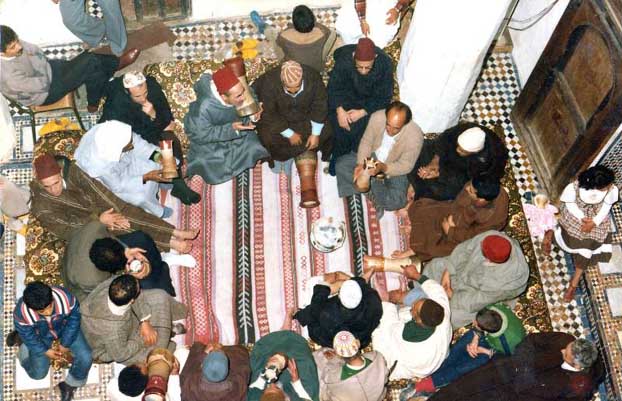
It's 2026 and the heyday of the music blog recedes into the rearview mirror of our music consumption patterns along with the era of the cassette tape itself. However, there's still plenty of North African musical goodness being shared online via the form of the anachronistic blog and its various successors.
Here's some recent shares that might pique your interest:
GET THESE BEFORE THEY DISAPPEAR - THE BIG 4 MOROCCAN TRANCE TRADITIONS AT HIVE MIND
Marc at Hive Mind has been sharing some great cassette audio at "Name Your Own Price" on his Bandcamp page. These generally disappear after 1 month, but he's currently made all four them available again for a limited time. So get over there and pick up some choice Hamadcha, Gnawa, Jilala, and Aissaoua sounds. (And chip in a few dirhams for the good causes he supports if you're able to do so.)
(And most of Marc's shares are still available at his old Snap, Crackle & Pop blog.)
SWEET ANADALUSIAN SOUNDS FROM CONSTANTINE AT MUSIC REPUBLIC
Reda at K7MATIC continues to share loads of Algerian cassette audio, primarily but not exclusively rai music, this unusual cassette caught my ear recently - stripped down rai from singer Cheikha Houaria, but replacing the typical gasba flute accompaniment with a ghaita oboe provided by an Aissawa ensemble.
KHADIJA ATLAS ANTHOLOGY AT ARAB TUNES
Lazyproduction continues to compile anthologies and mixtapes from across the Arab (and Amazigh) music world at the Arab Tunes blog. A recent highlight is a compilation of the Zayane singer Khadija Atlas, featuring recordings under her name as well as her appearances on recordings of other artists such as Rouicha, Abdelaziz Ahouzar, and Mustapha Oumguil.
KHADIJA EL BIDAWIYA AT WALLAHI LE ZEIN!
A welcome recent development is Matthew's return to posting at Wallahi Le Zein! He recently reupped a compilation of the late âita marsaouia singer Khadija el Bidaouia, and the post includes excerpts from a 2011 interview he did with her.
NORTH AFRICAN VINYL PROGRAMS AT BODEGA POP
No, not the old Bodega Pop blog, but the Bodega Pop radio program at WFMU's Give The Drummer Radio stream every Wednesday from 7-10 PM Eastern Time. Gary continues to confound expectations with his broad knowledge and musical omnivorosity for 3 hours every week. These programs live forever on the WFMU website, so you can enjoy them anytime you like. Many of his 2026 shows are devoted to vinyl from specific countries. In the North African vein, you can listen to entire programs devoted to music on vinyl from Morocco, Egypt, Algeria, and most recently Tunisia.
Lastly, there are some great North African mixes among the many streamable mixes at Radio Is A Foreign Country. Most recent North African offering was a great audio montage of recordings from Radio Mauritanie put together by Matthew Lavoie of Wallahi Le Zein! Keep an eye on Radio Is A Foreign Country for a Moroccan mix by yours truly, dropping very soon! 😉
Sharing links to a couple of Moroccan recordings that recently surfaced on the interwebs.
Friend of the Stash Mr. Tear dropped a compilation of Aïssaoua tracks over at Hive Mind Records. Sourced from cassettes, he
fed the tape rips into vocal removal software to produce some rudimentary stems and then... processed these in Audacity adding some selective reverb, delay, distortion with the intention of accentuating the overwhelming, heady aspects of this music.
The result is a set of tracks that gives a mildly psychedelic aura to this already powerful music, while preserving its structure and flow. That is, it brings the vibe of "Brian Jones Presents the Pipes of Pan at Joujouka" without completely uprooting and overwhelming the source material. Nice job, Marc!
Available only until the end of November 2025, the album is available as "Pay What You Like", and all proceeds collected will go to the UK advocacy group Hope not Hate. Follow links in the embedded Bandcamp player below to pick up your copy.
Meanwhile over at Fuji Puzzle Box, blog curator (and Firesign Theatre archivist) Taylor Jessen has shared an obscure 1965 LP Music of Northern Morocco, Vol. 1. Recorded in cafes in Chefchaouen and Tetouan during Ramadan 1963 by one Binx Shelby of Arizona, the album is the sole record released on the "Band Box Ethnological Series" label.
While the recordings were certainly made in northern Morocco, they are
not particularly representative of the regional traditions of that area.
They consist mainly of songs that were popular at the time, including
both Middle Eastern and North African pieces - whatever these musicians
in cafes felt like playing. It's a bit like someone recording an open
mic at a neighborhood bar in Oakland where people are singing Eagles
covers and releasing it as "Music of Northern California". Still, it's
cool to hear what types of songs were played by guys in cafes in the
mid-60s in Chefchaouen and Tetouan. And the graphic design is quite
lovely!
The liner notes state that side 2 consists of ancient religious songs, but it's actually just more popular songs of the day. The first song on side 2 is a questionably executed version of Ismail Ahmed's smash hit 'Khiffat Rajl' (better known by its refrain lyric 'Ash Dani')
Visit Fuji Puzzle Box to check out the album and to read Tyler's EXTENSIVE research on Binx Shelby!
And congratulations to Morocco's U20 team for winning the FIFA U-20 World Cup today in Chile!!
For your Ramadan pleasure, here's a nice tape from Al Haj Said Berrada. The Fes-based Aissawi moqaddem here gives us one side of verses dedicated to God and the Prophet, and one side of trance music including the Aissawa take on Sidi Mimoun the Gnawi.
Enjoy, stay safe, be well, and we'll dance together on the other side of all this!
Al Haj Saîd Berrada الحاج سعيد برادة Allahuma Selli 3la Nnbi اللهم صلي على النبيFes Maatic cassette
1) Allahuma Selli 3la Nnbi اللهم صلي على النبي
3ashqi ou Ghrami f-Rasul Allah عشقي و غرامي في رسول الله
A Rebbi ya Moulay أربي يا مولاي
Allah Daim الله رايم 2) Almjerred المجرد
3) Lgnawi Baba Mimoun الکناوي بابا ميمون
Allah Moulana Llah الله مولانا الله
The most popular post on this blog to date is my post from February 2012 about the Hamadsha and Lalla Aisha, featuring the music of Abderrahim Amrani. I was delighted to receive this message last week from Chris Witulski, an ethnomusicologist currently doing research in Fez. Mr. Amrani saw my blog post and wanted to share some information about Lalla Aisha for the followers of this blog! Many thanks to Chris and to Si Abderrahim for their interest and generosity!
---
Tim,
I am a researcher working with the Gnawa, Hamadsha, and Aissawa here in Fez. Amrani has been a good friend of mine for a few years from now, and he just sent me a link to this page with a request. First, I appreciate the recording. Even he has trouble finding some of these older tapes of himself now. He did not realize that you posted a link to his own opinions about Aisha, but he asked that I translate a part of a recent conversation between us regarding who Aisha is into English for your page. He cites four Aishas, three of whom were different living figures that should not be compounded or confused. This, of course, runs counter to many contemporary opinions about the mysterious Aisha that is so present in Moroccan life.
So please pardon the long comment that is to follow. Hopefully you or your readers find it to be an interesting perspective. We were speaking of Sidi Dghughi's trip to see Sultan Bil-Khir at the request of Sidi Ali Bin Hamdush, during which the king gave Dghughi Aisha as a gift for Sidi Ali. According to Amrani, we do not know if his intention was that Aisha be Sidi Ali's wife or servant.
"For six months, Sidi Ahmed traveled to return to Sidi Ali with Ayisha. When he arrived to the place where Sidi Ali had been sitting, he found his master dead under the tree. Sidi Ahmed began to strike his head. In the poem "Al-Warshan" (the carrier pigeon) we hear the story. Then this Aisha, now without Sidi Ali there to marry or serve, began to do miracles of healing. She healed those who would come from afar: the desert, Algeria, Tunisia, and other cities across Morocco. (In Tunisia, there is still an active hamadsha zawiya that celebrates the hamadsha mussem in the city of Um Al-'Arais with Moroccan clothing. She saw many people before suddenly disappearing. No one knew what happened to her or where she was. Her cave, however, remained and became a pilgrimage site just downhill from the zawiya of Sidi Ali Bin Hamdush. Despite the fact that she was no longer there, her cavern became a place where one could bring a sacrifice, light candles, and be healed. This practice entered the tradition, as people would continue to visit and live within the proximity of her past and continuing miracles. This is Aisha Sudaniyya. She was the one who came from the Sudan, from King Bil-Khir, to Sidi Ali Bin Hamdush.
There is a second Aisha: Aisha Bahariyya (of the ocean). She came to Azemmour from Baghdad. Now people go to Azemmour (near El-Jadida) to see her and visit her qubba. Mulay Bu Sha'i al Rddad is the wali of Azemmour, just as we have Moulay Idriss here in Fez. He studied in Baghdad, where she saw him, fell in love, and followed him here (to Morocco). But he was like Sidi Ali, tsawwuf. She came to the edge of the ocean and slept there. The women from here came to know her after hearing her story, that she followed him here out of love. [He did not bring her. She came on her own.] She asked about him when she arrived to learn that he had given up women, cigarettes, alcohol, etc (لقاتو زهد). She had no house, no friends or family. All the woman knew of the story of her love for him. The waves took her [she was sleeping on the beach] and killed her. They buried her body near the coast and now people in love [especially women] visit her marabout in order to write their names and those of their beloved on the walls of the building in henna. She blesses them with requited love. There is a well nearby with very cold water. She is not a jinn, but was a woman.
The third Aisha was Aisha Qadissa from Portugal (not Qandisha, a mispronunciation of her Portugese name). She was a beautiful woman. The Portuguese colonizers killed her husband. She would make herself available to any man who wanted her [Portuguese soldiers], and over the course of an evening, she would kill him, avenging her husband's death. She killed 500 soldiers. ("She was like Zorro.") She was not a jinn.
But those here, the Gnawa, Jbaliyya... shame on them [hashuma alihum]. They create the atmosphere that she is a jinn. Aisha was one of Mohammed's women, how could there be a jinn with the same name? The first two of these examples were holy [ربنية, Sudaniyya and Bahriyya] and the third is powerful [قوية, Qadissa].
There is a fourth Aisha. That's the life that we live, you and me and everyone."
Thank you for reading, and allowing him to speak to his music a bit more directly (albeit translated).
Christopher Witulski
-----
Unfortunately I have no more Hamadsha tapes in my stash (that I can share, at least...). I was going to share an Aissawa tape that has some Gnawa songs on it (to further exemplify the borrowing and sharing of songs between the Moroccan trance music repertoires. But then when googling around to find more information about the performer, Al-Hajj Said Al-Guissi I found that the tape has been issued on CD and is available on iTunes as "L'Art Aïssawa, Vol. 2". (Though the cassette j-card pictured here is much more glorious!)
So instead, here's a vintage Jilala cassette on Tichkaphone. I'm pretty sure I bought this one sealed, but the lyrics (what I can make out of them) don't seem to have any relationship to the song titles on the j-card. Unusual that one of the vocalists is female!
Happy 2013 to all. Sorry for the long absence - tape deck needed a little maintenance, and I guess I needed a little break too. Thanks for the comments and well wishes in the interim!
Still have a bunch of tapes from my summer trip to get digitized and out to ya. For now, though, here's a couple of oldies from deep in the stash. These both feature my fave oud man out of Marrakech, Hamid Zahir, but also highlight a particular member of his group, Si Mohamed Aguir.
The first tape, pictured above, is credited to Alfarqat Almarrakchiya (The Marrakchi Ensemble). It's basically the Hamid Zahir group, but featuring some different lead singers. I'm pretty sure that the singer on some of these tracks is Si Mohamed Aguir, and I think he's the one pictured on the cassette j-card. The only picture I could find online is from the sleeve of the 45 seen in the YouTube clip below. Does it look like the same guy to you? It sure sounds like him:
The cassette contains some tracks that appear on other cassettes credited to Hamid Zahir (#2 and #3 specifically). You'll still want to hear this album, though, if only for the insanely catchy singalong "Lebniya Llah Ihdik" (preview below).
The second cassette, pictured below, features tracks recorded live by Hamid Zahir and troupe (somewhere outside of Morocco, if I'm hearing the introductory comments to track 5 correctly).
This set features Si Mohamed Aguir singing on track 5. Zahir introduces
Si Mohamed as the singer (and, at the end of the song, dancer). You'll
hear Aguir's prominent rhythmic footstamping on several tracks. I believe Si Mohamed is the heavy set gentleman clapping, dancing and singing back-up in the following YouTube clip.
Even when he's not singing lead, he's a huge part of the atmosphere of Zahir's performances - adding the percussive clapping, cadential call-outs, and syncopated footwork. The songs he sings are more ironic and comedic than than those sung by Zahir. I don't know if he's still with us, but his good-time vibe is still in effect when the Marrakchi groove hits!
Any corrections or additional info about Si Mohamed Aguir would be greatly appreciated!!
Audio transfer notes: I did a time-pitch correction on track 4 of "Alfarqat Almarrakchi". It always seemed to run too fast to me - now the oud is in tune with that of the other tracks on the tape, though this track was certainly recorded at a different session. The Koutoubiaphone tape seems to me to run on the slow side, but I didn't adjust anything on it.
Discographic note: The Zahir live tape says "Koutoubiaphone" on the j-card, but the cassette shell bears the Tichkaphone imprint. They are one and the same company.
Tagnawit note: Track 2 of the Koutoubiaphone tape contains 2 Gnawa-related songs. "Hada Wa'du Meskin" takes lyrics from a Gnawa song but gives them a different (but still pentatonic) melody. "Lagnawi" refers to the Gnawa melk Sidi Mimoun. However I believe this song has its origins in the Aissawa repertoire - I've heard the melody played at an Aissawa ceremony, but it's not typically played at Gnawa ceremonies.
2) A Bgha Itjewwej
3) Kulshi Msha Ghafel
4) Farkh Lehmam (or so it says on the j-card - the only refrain I hear sung refers to "Al-ghaba") Hamid Zahir - H. Azzahir (live) Koutoubiaphone/Tichkaphone CKTP5006
1) Lalla Souad
2) Hada Wa'du Meskin - Lagnawi
3) Lil Lil Ya Sidi Âamara
4) Lghorba 5) Ma Bghit Zuwwej
And of course there's more Hamid Zahir stashed away here and here.
Well, his Moroccan stash is but a tiny tiny pinch of shake from his huge stash of field recordings. His recordings of American folk music are, of course, the most famous, but he also did his share of international recordings during his many years of research.
Association for Cultural Equity and the Alan Lomax Archive recently went live with over 800 hours of sound recordings as well as video and photographs from Lomax's collection. Perhaps the mother of all tape stashes!
I had no idea Lomax had recorded in Morocco! I'm just starting to dip into this collection, and I'll try to link to anything that particularly catches my ear.
Explore the Moroccan collection here.
Explore the entire audio collection here.
Or start at the main menu to get to photographs, video, and other resources.
---
UPDATE:
I found 2 more short Gnawa tracks, in Lomax's recordings from Fez. They are from outdoor processional âada repertoire, thus feature the tbola rather than the guinbri. The recordings were made at the moussem of Moulay Idriss, and include recordings of Aissawa and Hamadcha as well!
In the weeks following the Eid al Miloud, pilgrimage celebrations (moussem-s) are held all over Morocco at the shrines of local awliya saints. Possibly the biggest of these celebrations is the moussem in Meknes for L-Hadi ben Aissa, eponym of the Aissawa brotherhood. Pilgrims from across the region and across the country descend on Meknes for a 2 weeks of devotion and renewal, and nights of trance music.
Here are 2 tapes of Aissawa music I picked up in Meknes ca. '99. Unlike the released CDs of Aissawa music available in da West (featuring groups from Meknes, Marrakech, and Fes), these tapes make no pretense of presenting a balanced overview of the Aissawa ritual. That is, they don't include any of the lovely sung poetry in honor of the Hadi ben Aissa that would typically open a ritual performance. They cut straight to the chase, hitting the ground running with with blaring ghaita oboes and pounding tbel drums!
I'm not familiar enough with Aissawa music to know if these tunes are from the trance repertoire or from the street/processional repertoire. Whichever it is, these are some serious long jams - the group riffs it non-stop for 3+ sides of these 2 volumes:
Most of Vol 2 side 2 is taken up with a suite of melodies in 5/4 - it sounds like the rhythm used by the Hamadsha brotherhood.
If anyone can identify any of the melodies or the context of these recordings, please let me know!
At any rate, this is definitely a live performance - either the musicians, the microphone, or all of them are in motion - the oboes and drums change places in the mix constantly during the recording. Add to that some weird phasing that carries on through most of the tape, just the right amount of crowd noise, chattering and occasional chanting, and you've got an unintentionally awesome Brian Jones Presents the Pipes of Pan at Joujouka vibe!