Showing posts with label Vinyl-to-Cassette dubs. Show all posts

Saturday, September 10, 2011

Bouchaib el Bidaoui - Mellifluous-Voiced Cross-Dressing Singer of Aita Marsawiya


Continuing with another aita post, and vintage stuff too. This tape is another vinyl-to-cassette dub, purchased from a vendor in Rabat in the mid-'90s.

My translation of a short article on Bouchaib el Bidaoui:
He is regarded by many experts as the renovator and modernizer of the art of Aïta. "Before Bouchaïb the Aïta was limited to being a traditional country song, tribal and pastoral. He succeeded in urbanizing the art by maintaining the lyrics while developing more sophisticated musical arrangements, says Hassan Bahraoui, author of "The Art of the Aïta in Morocco".
Bouchaïb formed, with violinist Marshal Kibbou and Bent Chikha Louqid the star-troupe of the 50s and 60s. At first, nothing predisposed this colonial French lawyer's accountant and native of Derb Dalia (in the old medina of Casablanca) to become the darling of the Moroccan pop music. It was at a chance meeting in the 1940's with two bourgeois fans of chikhate, Benjdiya and Ben M'sik... that he attended performances of the stars at the time, Hajja Rouida and Arjouniya, at moussem-s and weddings. "It was from there that Bouchaïb choose his vocation as a chikh," says Mr. Bahraoui.
With independence [1956], festivity gains the four corners of the kingdom to celebrate the return of Mohammed V and regained freedom. The artist increased his appearances and made his first recordings for Boudraouaphone and Baïdaphone. "He did fantastic work on the repertoire. He excelled in Marsawi aita-s and made the songs of Abda available to the general public. Finally, Bouchaïb would improvise his own successful aita-s that are still performed today, such as "Dabayji", "Milouda bent Driss" and "Alkass a Abbas," the professor emphasized...
Bouchaïb died in 1964 at the age of 35.
Although the quote states that Bouchaib el Bidaoui chose the profession of shikh, it would be more accurate to say that he chose the profession of shikha - he sang women's songs in a woman's vocal range, and performed wearing women's clothing. He was not the first Moroccan performer to do this, but was the first to reach national stardom in this role, in the age of mechanical reproduction.


The style of aita represented here is different from that of my previous aita posts. If my memory is correct, this style, aita marsawiya, is associated with the coastal region around Casablanca and El Jadida. In addition to the viola, oud, and bendir, the darbuka is used here.

I don't see any Bouchaib el Bidaoui video footage on the web (though I could swear I've seen some before, perhaps on Moroccan TV.) However, if you close your eyes and listen to Khalid from the Ouled Bouazzaoui group, you could swear you're hearing Bouchaib el-Bidaoui - he's a dead ringer. But don't close your eyes - Khalid's a great performer and plays the viola as well as sings (though he doesn't wear women's clothes).


Here are a couple of websites with a bunch of streaming audio of Bouchaib el Bidaoui:
Some songs on my tape can be found in the above links - some in different recorded versions, some duplicates of what are here. Some have less surface noise than my versions, though bitrate is not always so good. A few of the songs on my tape I couldn't find anywhere else on the web, including the famous "Daba Iji". Can't find my original cassette j-card for this, so track titles are best guesses or cribbed from elsewhere:
  1. Daba Iji
  2. Ma Cheftou Leghzal
  3. Ma Cheftou Leghzal pt. 2
  4. Kharboucha
  5. Kharboucha pt. 2
  6. Track 06
  7. Al-Ma'bud Allah
  8. Rkoub el Kheil (Mal Hbibi)
  9. Rkoub el Kheil pt 2
  10. Lli Bgha Habibou
  11. Lli Bgha Habibou pt 2
  12. Chiaa Alik
  13. Nghadrou Kissane
  14. Aalach Taadini
  15. Taarida 
Get it here.

BTW - More quintuple meter featured here in this tape ("Lli Bgha Habibou").

BTW2 - The marsawi version of "Kharboucha" (heard on this tape and in the video clip) opens with a 42-beat rhythmic cycle. This differs from the hasbawi version of "Kharboucha" performed by Fatna bent el-Houcine here, which opens with a 40-beat cycle.

Monday, June 20, 2011

Nass el Ghiwane - the rare 2nd album (with both Boujemâa and Paco)

 L-R - Omar Sayed, Boujemâa H'gour, Allal Yaala, Abderrahmane "Paco" Kirouche, Larbi Batma

Nass el Ghiwane - what can I say. Like trying to introduce rock and roll in one blog post. They set the world of Maghrebi music on fire in the early '70s. Fierce, driving rhythm. Trenchant resonant lyrics. Fiery group singing, heartbreaking solo singing. Archaic and modern, subversive and traditional. And, to the best of my knowledge, the first time the now ubiquitious Gnawa guinbri (or sintir or hajhouj or whatever name your prefer) was used in a popular music context.

The most long-lived incarnation of the group was from '74 to '95, as a quartet with Larbi Batma (tam-tam & vocal), Omar Sayed (bendir & vocal), Allal Yaala (snitra & vocal) and Abderrahmane "Paco" Kirouche (Gnawa guinbri & vocal). Most of the available classic recordings of the group (like this and this) feature this lineup.

The original, mythic lineup thru '73 was a 5-piece featuring Larbi, Omar and Allal plus Moulay Abdelaziz Tahiri on guinbri and Boujemâa H'gour on da'du' and vocal. Boujemâa is remembered as the fire and spirit of the group in these early days. The group's first recordings feature this lineup. They are often hard to find, but have recently been reissued as the first 7 tracks of this collection.

After Tahiri's departure in '73 to join Jil Jilala, Paco joined the group, which remained a 5-piece until Boujemâa's untimely death in '74. This lineup is pictured above. Some of the classic songs of the group's repertoire date from this period but can be found only in re-recordings by the later quartet (or, worse, by the group after Paco's departure in '95 and/or Batma's death in '97). I have never once seen a release of the recordings of this quintet on cassette or CD.

Yet several singles and an LP were released by the '73-'74 quintet. I've run across this single a couple of times:


And on one occasion I saw a full LP featuring this line-up. The design of the album cover looked similar to the single shown here. The LP was in a shop in Marrakech in Riad Zitoun. If you've ever looked for vinyl in Morocco, you know that most stores that own vinyl will not sell it to you, but are happy to record it onto cassette for you.

Here's a digital transfer of my cassette copy of the Marrakchi shop owner's vinyl copy of the 2nd Nass el Ghiwane album. All of these songs were re-recorded by the quartet after Boujemâa's death, and some of them were released on an album called "Hommage à Boujemâa". It was particularly moving for me to hear this version of "Ghir Khoudouni", with Boujemâa singing the final verse:

Good luck doesn't die
Love doesn't die
Goodness doesn't die
Justice doesn't die
Peace doesn't die

In later recordings and performances, Omar would sing that verse and add the line "Boujemâa doesn't die".

I'm not convinced that Paco is on all of these tracks.  He's definitely on "Ghir Khoudouni" (both singing and playing. Some tracks feature no guinbri at all, and the guinbri playing (and tuning) on "Youm Malkak" sounds like Moulay Abdelaziz Tahiri.  But Boujemâa's great singing can definitely be heard singing on all tracks. (He's the one that sings the solo portions at the opening of "Lahmami")

Tracks:
1) Al Hessada
2) Ghir Khoudouni
3) Lahmami
4) Mzine Mdihek
5) Youm Malkak (Ah Ya Ouine)
6) Ya Sah

I have no idea why these tracks have never been reissued.  Luckily, you can get them here.
And there's more Paco here and here.

UPDATE 3/24/2013:
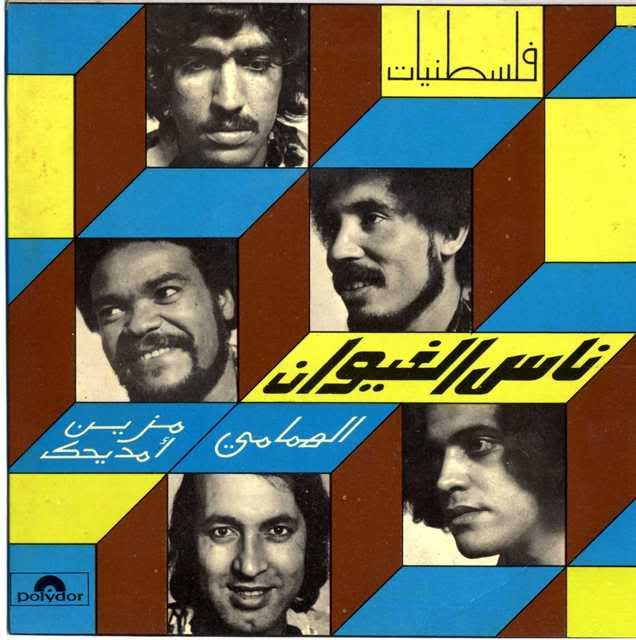
I just ran across these images online - someone was selling a vinyl copy of the album in France, and uploaded the following images:


This is not the cover I remember seeing in the Marrakech shop, but perhaps my memory is hazy. Or perhaps this is an alternate cover - I could have sworn the album looked like the Polydor 45 pictured above.

At any rate, it looks like the running order of tracks is as follows:

1 Lahmami
2 Mzine Mdihek
3 Youm Malqak
4 Al Hessada
5 Ghir Khoudouni

Which means "Ya Sah" was a bonus track that the Marrakchi shop owner added to the tape. Indeed, it does sound like it comes from a different slab of vinyl than the other tracks. A non-LP 45 then?

Twinge-of-nostalgia-for-bygone-audio-technology-days note: For those of you who used to copy LPs onto cassettes for friends (or receive such dubs from friends), remember when you'd have a 45 minute side of a tape and the album would only be 37 minutes long and you would search for 2 or 3 perfect bonus songs to fill up the blank space at the end of the tape? Such were the joys...