Here's a cassette of Aita Haouzia from the year 2000. The performers are the group Ouled el Haouz featuring Shikh Hassan Dariouki (here misspelled as Darouki, elsewhere spelled Driouki or Daryouki). During my fieldwork time in Morocco, they were ubiquitious - I saw them perform on the Djemaa el Fna in Marrakech, at an Aita festival in Safi, and at a gathering of ethnomusicologists in Tangier.
We've featured some fine Aita Haouzia recordings before in the stash here and here, but it's been a hot minute since we did so. Frankly I'd forgotten I had this tape. I think I never shared it because I thought it wasn't as good as the other two, but upon listening again, and aided by the magic of a little EQ and compression, it sounds pretty good to me today.
Aita Haouzia is such a great sound - scratchy fiddle and screechy vocals staying within the range of a minor third for the entire song, accompanied by explosive beats on the little tarija clay goblet drums (how do those little drums make such startling big noises?). The Dariouki group seemed to be the primary exponent of Aita Haouzia back around the turn of the century, or at least the most famous. Here's a video clip of them in action around this time - I believe this comes from a 2004 VCD:
One thing I love about this group is the old thin guy with glasses who doesn't sing but just dances and wanders around the stage, sometimes getting up on the qaada to stamp out a beat with his feet. Hassan El Dariouki has passed away, but according to this article, the dancer, Mohamed Zaitra, was still alive and stepping in beat as recently as 2024. May God give him, and all of us, health, joy, and transcendent grooves.
Cheikh Hassan El Darouki شيخ حسن الدروكي M3a Farqat Oulad Al Haouz مع فرقة ولاد الحوز [with Ensemble Oulad al Haouz] Safi Disque cassette 15/2000 صافي ديسك
Âita, Moroccan deep Arabic folk song, doesn't need modernization - it's perfectly fine and powerful in its own right as performed by traditional ensembles. At the same time, it doesn't necessarily suffer when musicians put it into conversation with other genres and styles. Sure, this CAN be done in a simple way that doesn't add anything interesting and just waters down the hard-hitting time-tested acoustic textures of aita with modern instruments or vocal styles. In the best cases, though, something interesting emerges.
Last week I digitized a 1990's tape that Gary from Bodega Pop sent me by the group Toulati El Farah Lamnawar. It's a chaâbi album of the era but it's based in the âita repertoire, and pushes the right buttons for me. I also found out this week that the debut album of the group Aïta Mon Amour came out in January of this year. Their initial singles caught my attention last year with their clever settings of âita songs to modern electro beats and the powerful vocals of singer Widad Mjama.
Toulati El Farah Lamnawar
The cassette comes to us courtesy of Gary of Bodega Pop whose weekly program on WFMU's Give The Drummer Radio stream is eclectic, educational, and always entertaining.
The group Toulati el Farah Lamnawar [1] was led by the late producer, songwriter, and musician Abdeltif Lamnawar (1968-2022), who I believe is from Casablanca. I was not familiar with the group previously, but they seem to have produced a lot of music over the years in a number of formations. The presence of the name Lamnawar after Toulati el Farah suggest that this is Lamnawar's version of the group, which reached its initial successes as simply Toulati el Farah. You can find a couple of these early albums on the streaming platforms under the names "Dami" and "Ana Melit". I believe the initial formation of the group included Lamnawar as well as the vocalist Hassan Lougato. Later albums are attributed to "Orchestre Toulati el Farah" (Trio el Farah Orchestra). And I see some recordings and videoclips that mention the participation of the well known chaabi singer/violinist/arranger Mustapha Bourgogne. At any rate, as Lamnawar relates in this interview, the group formed around the idea of doing the old bendir-and-kamanja (violin) songs with drum set, guitar, and keyboard.
Followers of this blog know that I'm a sucker for electric guitar and drum set, so yes I did enjoy the early 1980s version of Toulati El Farah linked above. This cassette, however, dates from sometime in the 1990s, and chaâbi styles, like all popular music styles, can change substantially in a few years' time. How different is this? Well, it's smoother - seems like there is some drum programming that keeps the beat very steady, as opposed to the raucous drum set of the earlier recordings. However, the darbuka is high in the mix, keeping the music punchy and live. As a bass player, I tend to disdain the use of programmed keyboard bass, but I gotta say, this one here is pretty enjoyable - its syncopated runs provide some of the rhythmic variety that was previously provided by fills on the drum set. And the electric rhythm guitar is still there, buried a bit in the smooth mix, but prominent enough to provide that strummy goodness. Best of all, the 2 fine singers trade off verses, retaining the interactive excitement of shikhat groups. My assessment is of course a completely subjective one, based on my own personal tastes and experiences dancing to this sort of band years ago. For others, this may just sound old-fashioned, or may not work at all. But hey, you can be your own judge:
Toulati El Farah Lamnawar الثلاثي الفرح لمنور Rddou Ouarana Âacha ردو ورانا عاش Disco-Disc cassette ALBUM 19 ديسكو ديسك
[1] Depending on which words you want to translate and how, the group's name can be translated something like:
Lamnawar's Trio El Farah
Lamnawar's Trio of Joy
Lamnawar's Happiness Trio
Aïta Mon Amour
The group Aïta Mon Amour released their debut album Abda in January 2025. I'd been greatly anticipating the album after hearing the group's initial singles in 2024. The group is a powerhouse duo: Widad Mjama on vocals (and occasional drum pounding) and Khalil Epi on multiple instruments.
Like Toulati el Farah, the group was conceived as a vehicle for presenting the old songs in a new format. Here, the venue is not the chaâbi dance/wedding floor, but concert and festival stages, and the beats are contemporary and electronic. Normally I like my âita with a group of singers and musicians to provide that interactive texture that is such a vital part of this music. What Aïta Mon Amour lacks in that regard is made up by the power and expression of Widad's singing and the complex, suprising textures of Khalil's arrangements.
You can hear their album on all of the streaming platforms, but why not support the band and purchase a copy on Bandcamp.
How will these beats sound to ears 30 years from now? Who can say? But I have no doubt that the deep well of âita will still be a source of inspiriation for generations to come.
2 long tracks of 21st century âita & chaâbi for your pleasure, from the microphone of Haj Abdelmoghit. I know I tend to wax nostalgic for the era of electric guitars and raucous drum kits in chaâbi, but I am not immune to the joys of more recent stylings. This album keeps it real with a viola, some light keyboard (and yeah, a synth bass), heavy on the percussion, and isn't that a drum kit down there in the mix? This works for me. And the album has the flow of an actual live set of music as you'd hear it in performance: begin with something slow and heavy, move through several songs, connected via violin-driven instrumental passages as the tempo speeds up and the sung call/response phrases get shorter and shorter, and ending at blistering speed with a punchy rhythmic phrase to cue the end of the song.
Ah that good âita bidaouia feeling! Abdelmoghit Essaidi (b. 1965, Casablanca) quit his bank job to pursue a career singing it. He's enjoyed great success as a real crowd-pleaser of course at weddings but also at concerts (such as the big Mawazine Festival in 2017). And he has even become a favorite among the Moroccan royals, performing at the wedding of Princess Lalla Soukaina in 2013.
Here's a tape by a young Jamal Eddine Said Elhouate, known commonly these days as Said Ould El Houate. The singer and viola player was born in 1968 in Casablanca. His real name is Jamal Eddine Said, and he was nicknamed ould el houate (son of the fishmonger) because his father worked at the port [1]. He rose to fame in the 2000s and 2010s with a chaabi style rooted in aita.
This album dates from the mid 1990s, and it benefits from the simple production values of the time. This is the simple and satisfying combination of a scratchy viola, a couple of tightly strung bendirs, Said's lead vocal, and some shikhate singing response vocals. Most recordings you find of Said Ould El Houate date from the 2000s and later, when it becomes hard to find chaabi recordings without a keyboard bass. This older style is refreshing, sort of in the vein of Abdelaziz Stati. Like Stati, Said appears to be an aficionado of aita. He has spent time in Safi learning and reviving old songs from the Abda variety of aita [1].
I was surprised to see the song title "Koubaily Baba" on this cassette. The name is reminiscent of Gnawa songs "Koubaily Bala" and "Koubaily Mama". Said's song does not sound like either of those songs, but the lyrics explicitly reference possession, Gnawa and Baba Mimoun. The music evokes Jilala trance music, with the bendirs playing a very syncopated pattern where drum strokes rarely coincide with the beat. So this track is a chaâbi evocation of a Jilala approach to Gnawa spirits.
Said Ould El Houate remains active and popular today. You can stream many of his albums at Ournia and a few on Spotify. And you can find lots of content on his Youtube channel.
Jamal Eddine Said Elhouate جمال الدين سعيد الحوات Sawt Ennachat cassette صوط النشاط mid 1990s
1) Essamra Qilini - السمرة قيليني 2) Mal Ezzine Tghayer - مال الزين اتغير 3) Ma Bin Lila ou Nhar Lhubb Tghayer - ما بين ليلة و نهار الحب اتغير 4) Daq Alhal - داق الحال Koubaili Baba - كبيلي بابا 5) Moulay Abdellah Ben Lhoucine - مولاي عبد الله بن لحسين
In 1959, noted American author and
composer Paul Bowles made several trips around Morocco recording as many strains of Moroccan traditional music as he could capture. Bowles curated some of these recordings for release on a 1972 2-LP set "Music of Morocco" issued by the Library of Congress.
Bowles recounts some of the experiences of the 1959 recording project in the essay "The Rif, to Music" in his essay collection "Their Heads Are Green and Their Hands Are Blue". For a deep dive into Bowles' musical upbringing and aesthetics and how these inform his recording project, it's well worth seeking out Philip Schuyler's essay "Music of Morocco: The Paul Bowles Collection", included in the 4-CD reissue and expansion of the Library of Congress album, released in 2016 by Dust to Digital. This release is one of the most beautiful artifacts in my own stash - from the ornate box to the leatherette-bound booklet down to the track selection, sequencing, and notes, everything was done with great care, thought, and taste.
If you can't find the box set, the album is available to purchase digitally at Bandcamp, including a pdf of the booklet. The album is also available to stream online through various platforms, though of course without the reading materials:
I had meant to post something about this back in 2016, but did not manage to do so. While scrolling through Twitter last week, I stumbled across a YouTube clip of a Gnawa recording I'd not heard before, originating from the Bowles' collection, but not issued as part of the LP or CD sets. The video was uploaded by Archnet, a digital resource sponsored by MIT and the Agha Khan Trust for Culture.
It turns out that Archnet has made the entire collection available online in YouTube form! 60 reels of tape! As Michael Toler of Archnet explains on his blog, these clips are raw transfers of the original tapes, so do not expect them to sound like the versions on Dust to Digital's release, which were nicely mastered to improve sound quality.
Still, what an amazing gift to be able to hear these tapes! As an additional gift, Archnet has uploaded a scan of Bowles' own typed notes on the recordings, which accompanied their submission to the Library of Congress: http://archnet.org/publications/10093. Excerpts from these notes appear in the Dust to Digital booklet, but you can now see the whole set.
I found the Archnet website difficult to navigate, and the way they have named the YouTube videoclips is inconsistent and often incomplete. So for my own benefit and yours, I have grouped the clips into YouTube playlists, which I hope are easier to navigate. The playlists are linked below. I generally named them by recording date, artist name/style and location. A small number of things listed by Archnet or in Bowles' notes are missing or mislabeled, but the links below will get you to nearly everything he recorded for the Library of Congress from August to December of 1959:
1956-08 Gnawa Tangier - This recording was submitted by Bowles to the LOC as a supplement to the 1959 recordings. It was made with "inferior equipment", but he deemed it to be important enough to submit.
1959-09-25 Andaluz Music of Fez - Abdelkrim·Rais, director (and rebab), Fez, Musée du Batha - Bowles' notes indicate that 2 reels of music were captured from the group: 26B and 27A. However, Archnet's link to 26B is broken, and their video for 27A contains the music from 27B (Taqtoqa Jabaliya).
1959-12-13 Chanson Moderne - Mohammed Mohiyeddine and his Orchestra, Meknes - Bowles calls this "chaabiya" in his liner notes. Perhaps it was described to him as "chaabi" or "popular", but it's not what we would call chaabi today, but rather âsri or chanson moderne. Also, Archnet has mislabeled 57A as 57B, and vice versa.
If time permits, I'll comment on some of the individual tapes in future posts. I'm of course loving the additional Gnawa material, in particular the hour's worth of material from 1956 (the first playlist above). Until then, there's plenty for you to explore!
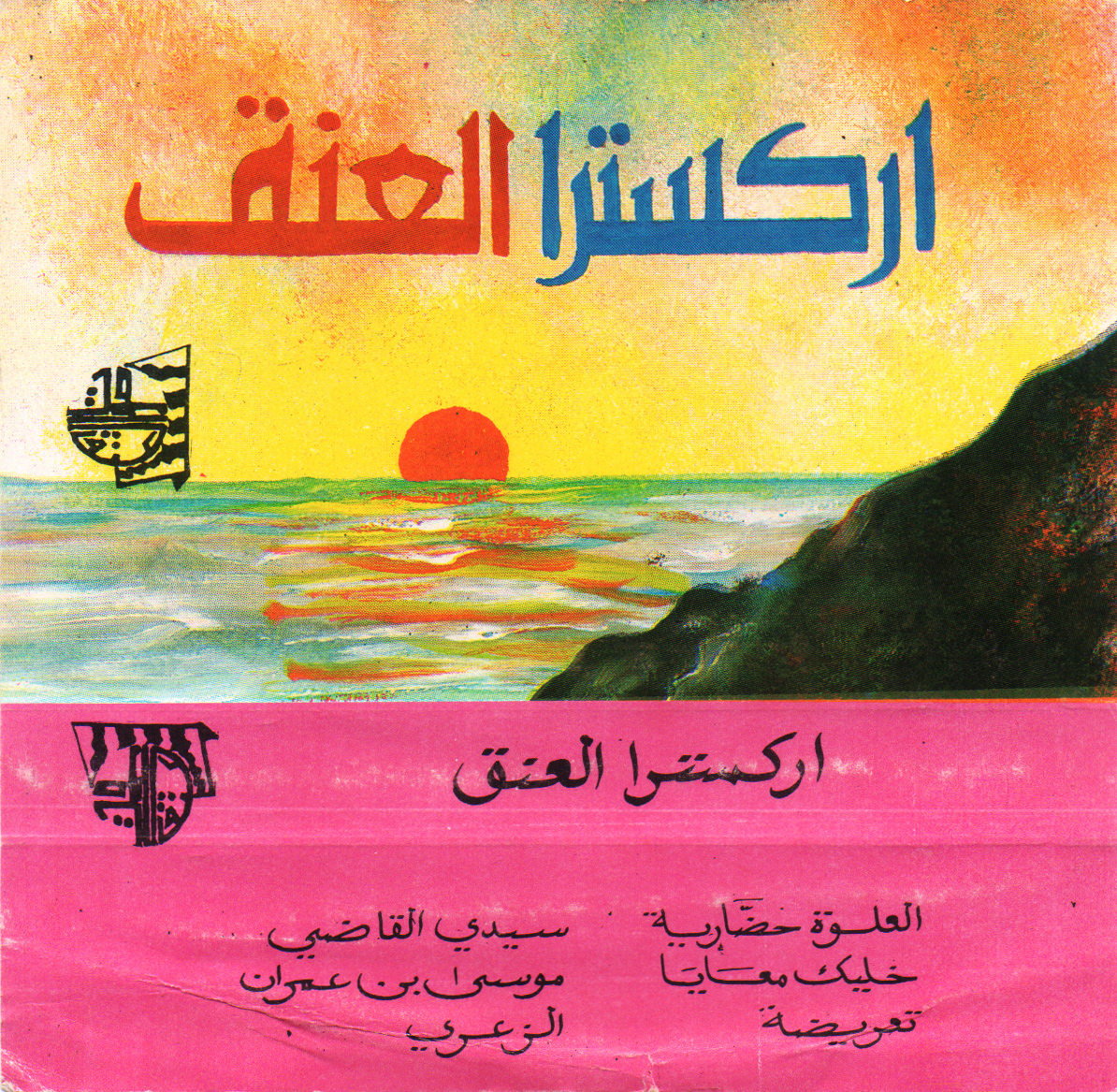
Long drawn out medleys? Check. Âita melodies and structures? Check. Scratchy viola and punchy darbuka? Check. Drum kit, electric guitar and organ? Yes - right there!
This swell tape comes from a little stash of tapes that fell into my lap a few months back. All without j-cards and most with only the name of the production house on the cassette shell. This one is from a company called Sawt el Ânq (انتاج صوت العنق). I'm guessing it's from Casablanca, but only because the singer gives a shout out to the soccer teams Raja and Wydad.
[blogger knows he's seen that logo before, goes digging around in the stash...]
Well - I knew I'd seen that Sawt el Ânq logo before on an orphaned j-card in the stash. (And a fantastic logo it is, too!) Went looking for it, hoping it would reveal the location of the production house. No luck there, but... the song titles were a match for this tape!! The tape must have bounced around among the Moroccan ladies in the Bay Area for 20 years and then landed back here in the stash where its j-card was waiting for it!
Also, my friend Jamal confirms that El Ânq is a neighborhood in Casablanca, so we're pretty sure this is a Casa production.
This is some vintage late 1980s chaâbi. Hope it hits your sweet spot too!
Orchestre el Ânq (اركسترا العنق) Sawt el Ânq (انتاج صوت العنق) cassette
1) Sid el Qadi سيدي لقاضي
2) Melki Ma Jiti
3) Zaeri - Musa ben 3amran الزعري - موسى بن عمران
4) Al 3aloua Hddariya العلوةحضارية
5) Khellik M3aya - Taârida خليك معايا - تعريضة
Some good websites exist for streaming Moroccan music. For Berber music, there's a great selection at https://www.izlanzik.org/. For Arab stuff, my previous go-to site was yala.fm, but lately the search function seems to be broken. More recently, I've been turning to http://www.ournia.co/, which has a large selection of Moroccan music (and other Arab/North African music). For some artists, one can find nearly comprehensive discographies. For others, especially those who have released albums on several different labels and over many years, the selection will be more spotty.
Case in point: the late, great âita singer Fatna Bent Lhoucine (1935-2005). When I first visited Morocco, she was on TV all the time - a real household name. However, her vast recorded output seems to have been primarily on 45s and on a variety of local cassette labels, many of which remain unreleased in digital format.
Ournia actually has a decent selection of recordings of Fatna Bent Lhoucine. Some of them appear to be reissues of vintage recordings, others are possibly recordings from late in her career. Even with album art available, it's often unclear whether the images are representative of the original album art (in the case of CD reissues of cassettes), or whether vintage photos accompany more recent recordings (or vice versa).
Another great online source of Moroccan recordings, specifically of âita recordings, is Settatbladi.org, a non-commercial online digital collection started by âita aficionados in 2007. They recently migrated the entire collection to the Internet Archive. There's an ocean of material there (over 2000 songs). Whereas Ournia seems to feature material that has been commercially issued in digital format, Settatbladi's curators have digitized their private collections of 45s, LPs, cassettes, and CDs. It's not always possible to match audio files with corresponding cover art (which is housed in a separate archive), and I don't see information there about the dates of the recordings. Still, it's a remarkable collection, and well worth swimming its seas of sound! Naturally, they have plenty of recordings of Fatna Bent Lhoucine.
Over here at Moroccan Tape Stash, I can't be very comprehensive about artist discographies - all I can do is offer copies of things that happened to fall into my hands over the years. Maybe mp3 downloads are going the way of the cassette tape and compact disc. Perhaps I should turn these into streaming versions, or put them all on YouTube to make them more accessible to all.
For now, though, we'll keep on with present format, and offer up a couple of tapes of Fatna Bent Lhoucine with her longtime collaborators the Ouled ben Aguida. These are on the label Sawt Lahbak. Neither are perfect in terms of audio, but the music on them is great.
The tape for which I actually have a j-card (V.L. 69) lists 6 songs, but only 3 appear on the 40 minute cassette. The audio quality is a bit warbly.
The other tape features 2 songs. (There were three tracks on the tape, but the third was just the beginning of the 1st song again.) The playback on the tape sounded way too slow (tempo) and low (pitch). I sped up the tempo/raised the pitch in Logic, and it sounds more natural now. The overall audio quality is better than on the 1st tape.
Ouled Ben Aguida & Fatna Bent Lhoucine - اولاد بن عگيدة و فاطنة بنت الحسين Sawt Lahbaq (صوت لحباق) cassette V.L. 69
1) Rouisi Chab (رويسي شاب)
2) Lhouaouia (لهواوية)
3) Lfraq S3ib (لفراق صعيب)
—
Ouled Ben Aguida & Fatna Bent Lhoucine - اولاد بن عگيدة و فاطنة بنت الحسين Sawt Lahbaq (صوت لحباق) cassette
1) El 3aloua
2) Za3eriya
Get em all here.
More Fatna Bent Lhoucine in the Stash here.
Here's a fantastic Stati tape that Lalla Hafida brought me in 2016. Down deep in the âita groove, this is some great stuff. I wish I knew the identity of the shikha singer featured here along with Stati - she's fabulous.
The music and the photo are clearly much older than 2016. The cassette number 20/2000 indicates that it was released in the year 2000, but I suspect it's a reissue of an earlier album. (He looks very young in the photo.)
For those of you observing Ramadan (starting at the end of this week), here's wishing you a month of peace, blessing, and remembrance.
Stati (Al Fannan Abdelaziz Stati) - الفنان عبد العزيز الستاتي Sawt Chaouia cassette 20/2000
1) La Tghib 3lia - لله لا تغيب علي
2) Lawah Ya Lebnia - لواه يا لبنية
3) Raqsa - رقصة
4) Jayeb Rou7i Lik Hdia - جايب روحي ليك هدية
5) Za3eri - زعري / Raqsa 3la Lqa3da - رقصة على القعدة
The Arab Tunes blog recently shared some excellent 45s by the great shikha Fatima Zehafa. I have one 45 of hers too, and I'm pretty crazy about it, so I'm sharing that one here. Hope you enjoy it!
Fatima Zehafa (فاطمة الزحافة) - Ya Lghadi Ou Ljai (Moussaouiphone 2848 AB)
1) Ya Lghadi Ou Ljai
2) Al Khadem
Well whaddya know? The Stash yields another Tagada tape! This dates from around 1992, when Mohamed Louz was still a member of the group. (For some historical info on the group, see our previous Tagada post.)
I wrote previously that Tagada's folk-revival approach was rooted in the âita. This album stretches things a bit, while maintaining a core texture of viola driving the melody, male group or antiphonal vocals and a bendir-driven percussion section.
"Lalla Lgada" leads things off in a typical âita mode, though with what sounds like scissors hearkening back to the âbidat errma. The strange "Ach Ngoul Lik" leads off with a pentatonic viola solo somewhat evoking the amarg tradition of the Soussi rwayes, but then the rhythm enters, featuring a Gnawaguinbri (and some faint qraqeb, I think). It sounds sort of Nass el Ghiwan-ish, except for the continued presence of the viola, which pulls the sound in a different direction. "Âyyitini" goes full Soussi, adding a banjo or lotar and naqqus for that rwayes vibe, though the singing is in Arabic, not Tachelhit.
Finally "Hada Hali" returns viola and bendir to the center of the texture with a real deep âita feel - angular bendir-s, alternating solo vocals evoking shikha song, sliding eventually into trance-based and trance-evoking lyrics, idiomatic viola riffing recalling the sweaty middle-of-the-night when the âita groove gets so heavy and REAL that it crosses over into that zone where all one can do is call prayers upon the Prophet and the saints, hope for deliverance and submit to the groove. At this point in the song, Tagada incorporate the guinbri and qraqeb again. This sounds nothing like Gnawa music, though, resembling much more the saken trance songs of theâitatradition. But with Gnawa signifiers added for intensification? Mixing these elements together is a weird, improbable idea, to which I'm sort of opposed on principle, and yet somehow... it kind of works! Well played, Tagada, well played!
Tagada (تگدة) Edition Hassania cassette EH 1462
01 Lalla Lgada (لالة الگادة)
02 Ach Ngoul Lik (اش نگول ليك)
03 Âyyitini (عيتني)
04 Hada Hali (هذا حالي)
The group Tagada arose in the 1970s alongside other Arabophone "folk revival" groups like Nass el Ghiwane, Jil Jilala, and Lemchaheb. When I first heard Tagada in the 1990s, they struck me as a bit apart from those groups. Where NG and JJ riffed on traditional songs and genres to create new and memorable original songs and styles, Tagada's repertoire sounded to me like straight-up folk material, delivered in a manner faithful to some kind of earlier, more rustic aesthetic.
Tagada's folk sources come primarily from the âita repertoire. Here's some early Tagada from the '70s. With the banjo (which they later abandoned), this recording has a very Ghiwani vibe, similar to Nass el Ghiwane's aita-based classic L-Hassada:
I haven't found much of this early Tagada available online. I would LOOOOVE to hear what THIS version of the group sounds like:
Oh joy, I found some - here's an amazing vintage 9 minute video clip, with electric guitar, even!
According to group member Dekhouche Ahmed Roudani, Tagada, like Nass el Ghiwane, came out of the theatre troupe of Tayeb Saddiki. Troupe members Omar Sayed, Boujemâa H'gour, and Larbi Batma split from Saddiki's group after the production of the play "Al Harraz" to form Nass el Ghiwane, while the future Tagada members remained with Saddiki's group for the next production, "Maqamat Badii Ezzaman al Hamadani" (1971).
In the Tagada I remember from the early 90s, the viola had eclipsed the banjo/guitar as the primary
melodic instrument in the ensemble. This amounted basically to a
stripped-down folk-chaâbi sound: viola and percussion (sometimes with a plucked banjo or oud) with âita-derived
call/response and group singing, without the modern sheen of keyboards
or guitars and without the sexy seduction of female shikhat singers.
Tagada usually performs dressed in jellaba robes. This is similar to what would be worn by traditional male folk or popular percussion ensembles like âbidat errma or tkitiqat
groups, and in contrast to both the 70s folk revival look (either with
groovy vests or the outlaw cowboy look of the album cover above) and thewell-dressed-chaâbi-orchestra-lead-singer-with-a-suit-and-tie
look. Despite their use of traditional dress and musical sources, one non-traditional practice does stand out - Mohamed Louz's unusual drum configurations: neither the double pair of tamtams (in the "Yahli" clip above) nor the conga/bongo combination (in the "Rgibaoua" clip) are traditional for Moroccan folk music - these appear to be Louz's own idiosyncratic configurations.
The only Tagada-related tape in my collection dates to 1995. I always thought it was by the regular Tagada group, but now that I'm taking a closer look at it, I see that it reads Majmo3at Louz Tagada (Ensemble Louz Tagada). The photo on the j-card features prominent photos of Louz (bottom right) and the violinist (bottom left) who were both previously with Tagada. According to Izza Genini in the film "Tambours Battant", Mohamed Louz split from Tagada in the early 1990s, though he reunited with them for a live session in the film:
Inasmuch as I can tell from YouTube videos, Louz's Tagada group and the regular Tagada group are both quite active still today. The regular Tagada had an insidiously catchy hit back in the late '90s or early 2000's with "Ach Kayn Ach Kayn", which remains a crowd-pleaser:
No Marriage, No Work, No Home. That's the album title listed on this cassette from Bouchaib Ziyani, singing violist from Casablanca working in the chaâbi - âita continuum. This is some well-produced chaâbi with an insistent but not mechanical percussive drive. Bouchaib's scratchy viola blends nicely with the various synth zither, lute, flute or banjo settings.
These songs are soaked in beer, tobacco, and regret, and Ziyani's singing sounds like he's been there (or is still there). "She drank only half a beer, and started a battle between us" (Track 1). "Give the blonde a drink" (Track 2). "I drank the first beer, I drank the second one. The third one reminded me of my beloved" (Track 5). "Mama, what did I do? I sought my fortune, but in my life achieved nothing. No marriage did I marry, and no work did I find. The evil eye is upon me, but I don't who cast it." (Track 3). The songs mainly stay to the chaâbi end of the continuum, but the long Track 2 moves into âita territory with some nice interplay with a female vocalist and stretches into some extended versifying and riffing, ending up in saken/trance territory.
Ournia.com relates that Mr. Ziyani is from Casablanca but made his career in Oujda. Ournia's biography also states that the currently active Bouchaib Ziyani
recorded with Khaddouj Zroukia, which would make him the same artist as featured on these 45s in Settatbladi's collection:
However, the 45 pictured above is credited to "The Late Bouchaib Ziani". And although his hair is greying, the artist on our cassette does not appear to be quite old enough to have recorded those 45s. At any rate, enjoy!
Bouchaib Ziyani - بوشعيب الزياني La Zwaj La Khedma La Dar - لا زواج لا خدمة لا دار Meftah Music cassette 23/10/2011 (2011)
1) Shrebt Ghir Ness Birra - شربت غير نص بيرة
2) A3ti Lesh'hiba Tshreb - اعطي الشيهبة تشرب
Moulat Lâyoun Kbar - مولات لعيون كبار
Htta Wahed Maiâqel 3lik - حتى واحد ما يعقل عليک
Galt lik Mmuk 3a Toukel Allah - گالت لک امک توکل عائلة
Jini Nhar Tnine - جيني نهار اثنين
3lash Tebki Ya Litima - علاش تبكي يا ليتيمة
3) Lemwima Wash Dert Ana - المويمة واش درت انا
4) Wach Qdaw Ila Berku Biya - واش اقضاو الى بركو بيا
5) Fekkeretni Fi Hbibi - فکرتني في احبيبتي
6) Dwaw Fiya 3la Rejliya - دواو فيا على رجليا
7) Dat al Mal Ou Zadet Essa7a - دات المال او زادت الصحة
Dir Lkhamiya 3a Lbab - ديري الخامية عا لباب
Alghadi B3id - الغادي بعيد
PS, yes I know I'm a complete hypocrite calling these "honky tonk" songs, when a few weeks ago I was ranting about the use of Anglo-American popular music analogies to describe Moroccan artists.
More of that good âita zaêriya from Shikh el Moutchou. Check here for an earlier post with some info about him (courtesy of Hammer's comments) and about the âita genre (courtesy of Ahmed Aydoun's book). And check below for a sample. Grab the whole thing to hear the bitchin' 9/8 opening track. It's on Production Hicham al Atlas, so you know it's rocks!
Shikh al Moutchou and Ibrahim - Jaîdan (Hicham al Atlas 52/10)
01 Jaîdan
02 Zaêri
03 Saken
04 Ya Chabba Ya Khumriya
05 Alawah Alawah 06 Ben Mousa Saken
I noticed recently that an old post of mine on Shikh El Houcine el Khouribgui was getting a lot of hits recently. I also noticed that Moroccan TV (الاولى) had broadcast a documentary on Shikh el Houcine. (I wandered into the living room one evening and found his scratchy viola and distinctive face coming thru the TV!) I wonder if the broadcast led to web searches that led to the stash!
I was able to find the documentary on YouTube. It's all in Moroccan Arabic, including interviews with musicians that worked with Shikh El Houcine, but there are some nice performance clips as well that non-Arabic speakers may enjoy. No live clips of Shikh El Houcine, but clips of other artists performing songs associated with him, including Ould Mbarek Khribgui, Abderrahim Meskini (heard in the stash here), and Stati Abdelaziz.
I thought I had another tape of Shikh El Houcine in the stash, but alas, there were no more to be found. I did, however, find a fine tape by Shikh Mohammed al Khirani Khribgui, who was featured in a post about a year back. This tape, again from the fabulous Production Hicham El Atlas, is a great recording featuring a side-long zaêri performance, couplets following couplets, with slow, groovy riffing alternating with ta'rija-punctuated rhythmic rave-ups for shimmying. I never get tired of this stuff. Hope you enjoy it too!
PS - thanks to those who have taken the time to leave comments. I apologize for not responding recently. I'm hoping to sit down soon and write back - I do appreciate the encouragement, feedback, and conversation!
El Khirani Mohamed - Production Hicham El Atlas cassette 2001
Track 2 (excerpt) of 4
Here's another tape from my summer 2012 trip. I believe I picked this up in Beni Mellal, though the longstanding Sawt Ennachat label is out of Casablanca. The music sounds Mellali to me - heavy on the zaêriya.
On first listen, this sounded to me like pretty standard early 21st century countrified chaabi. However, a couple of cool things stood out on additional listens:
The rhythm is pretty kicking, though it stays pretty mechanical throughout. However, the darbuka player gets pretty OUT in some places, embellishing all over the place. (See track 3.)
The viola is not auto-tuned, and it hits a few unusual notes/intervals that sound great in contrast to the otherwise perfect pitches. (See track 4)
Bouchaib's country vocal phrasing and embellishment often seem to subvert the auto-tune on his voice. The shikha, on the other hand, is auto-tuned to the max. (See tracks 2 and 6)
Track 7 ditches the auto-tune for some straight-up pitch-non-perfect zaêri goodness!
Mastering note: Track 4 fades out quickly at the end of side 1 of my tape. I was able to find an mp3 of the full track over at psdojo.com and grafted it onto the end of my version. So the last 6 minutes of track 4 comes from that source. (Excuse the obnoxious voiceover at 6:30.)
El Khalfi Bouchaib - Ezzine Ihebbel (Sawt Ennachat cassette)
Here's an odd tape I picked up in Beni Mellal in 1992. It's a ghaita ensemble, but one that seems unusual to me for a number of reasons.
The ghaita is a loud piercing oboe/shawm, typically used in outdoor processions, accompanied by tbola (barrel drums). Outdoor procession music usually incorporates any and all popular songs. Tbel players may sing, but singing isn't usually that important. The main purpose of these groups is to be heard outdoors (thus the loud ghaita) and to provide tunes that keep people moving and dancing in the streets. (We've got some northern tbel and ghaitaelsewhere in the Stash.)
In some ways, the music on this tape sounds like a Beni Mellal wedding procession - the tunes are familiar and the ghaita-led ensemble strings them together one after another. Also, the sketchy production values in the recording remind me of some of my own field recordings of street processions - bad balance between instruments, ambient noise, tape speeding up and slowing down, (OK, I never actually had that problem), etc.
In other ways, though, this differs from a typical tbel and ghaita ensemble. First, there are no tbola drums, only some bnader (frame drums). The groups I've seen around Beni Mellal usually use a combination of tbola and bnader, but usually there will be at least one tbel. Second, this recording seems to feature a designated group of female singers. This is quite unusual. Women sometimes do sing in wedding processions, but I've only ever seen that happen when no professional musical group is hired for the procession, and guests and family do the drumming and singing. Here the women, of course, are part of the professional ensemble hired for the recording. And Track 5 sounds to me like an âita zaêriya, so these could actually be shikhat.
It's a strange combination. Âita is a pretty far cry (ha ha) from tbel and ghaita processional music. But here, you basically have what could be an âita/chaâbi group with the viola being replaced by the ghaita.
The only information I found online about the artist, Hassan al Faryati, is a listing for his performance at the Aita Festival in Asfi in 2008. He is listed on a program of âita haouziya, and the listing states that he is from Kelâat Es-Sraghna (between Beni Mellal and Marrakech).
I don't know if al Faryati is a ghaita player or if he's a drummer. I believe I bought 2 tapes by this artist, but only one appears to remain, and I'm not sure whether it belongs to the j-card pictured above or the one below. At any rate, enjoy this oddity from the ragged corners of the stash.
Hassan al Faryati (Edition al Khair cassette)
Track 3 (of 7)
Here's another vintage album from âita pioneer L'Hajja L'Hamdaouya. These are some classic âita marsawiya and chaâbi tunes here, the sort you would hear typically with a small ensemble (oud, viola, derbuka, bendir) such as that of Bouchaib el Bidaoui. Hamdaouya performs them here with a larger ensemble including several violas, flute, and tar (tambourine). Interesting to hear the âita-style viola riffing with multiple violas, and the nice looooooose heterophony and prominent tambourine give these recordings an almost Arab-Andalusian âla vibe in places. And on top of that, it also manages to rock!
Some of these songs can be heard by other performers elsewhere in the Stash. "Ma Cheftou Leghzal" appears by Bouchaib el Bidaoui here. And "Elghaba" appears (in a version about 7 times faster) by Hamid Zahir and Alfarqat Almarrakchiya here. Enjoy!
Ramadan Mubarak, and prayers for the bereaved in Iraq, Syria, Palestine/Israel, the relatives of those lost over the skies of Ukraine, and all those suffering around our blue warming sphere.
Another âita tape, however great, may seem a distraction in these troubled days. I'm offering it in hopes that it warms the heart and reaffirms humanity for a moment.
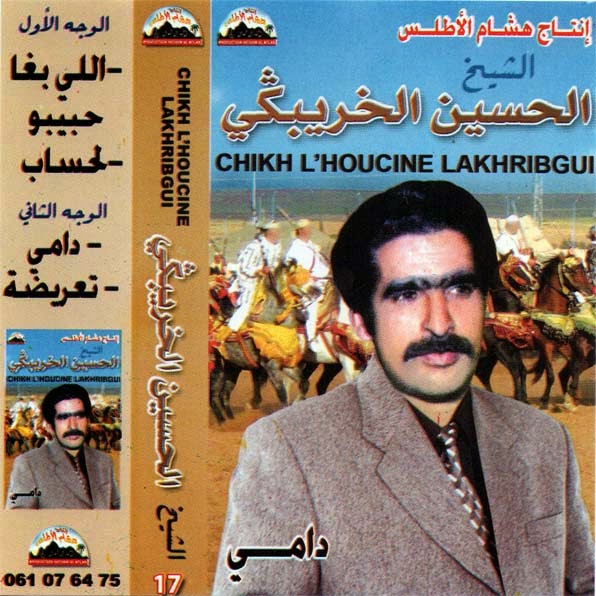
It's another vintage recording of Shikh El Houcine El Khouribgui, who has been featured here before, and it's on the great label Production Hicham El Atlas. Plucked new off the shelf in 2012 around Beni Mellal, it's definitely a reissue of an older recording. The tape begins by announcing "Istwanat Markikphone toukadime Shikh El Houcine el Khouribui" (Markikphone Records presents...). The great website settatbladi.org has this image of a cassette reissue of Shikh El Houcine on Markikphone (I assume it's a reissue because the j-card reads in Arabic "the late Shikh El Houcine...):
The centerpiece of the album is the opening piece "Dami", a long form âita with a great 10/8 rhythmic cycle. The j-card lists the titles "Lli Bgha Hbibou" and "Lehsab", but neither track 2 nor 3 sound like other versions of those songs that I know. I labeled track 2 "Nghadrou Kissane" because it shares lyrics with Bouchaib el Bidaoui's track of the same name, and I left track 3 as "Lli Bgha Hbibou", cause I hear the word habibi a lot. Whatever the correct titles may be, I hope you enjoy the old scratchy groove!
We love dem scratchy violas here at Moroccan Tape Stash! Usually, we like 'em served them up with some shikhat in old-school âita fashion. But great fiddlin' exists in Berber traditions as well. Here are two tapes of viola-driven ensembles, picked up in Beni Mellal 20 years apart.
Prelude spiel and questions about the viola in Moroccan ensembles: The European viola seems to have existed in North Africa for many many years. A couple of centuries, I'd guess. I don't know if it replaced indigenous bowed instruments in folk performance, or if it carved out its own place. Two Moroccan "art music" traditions - Arab-Andalusian âla and Soussi Berber amarg (music/song of the rwayes) - feature indigenous bowed instruments, both called rrbab, but completely different in construction and sound. The lone rebab in Arab Andalusian orchestras was joined (some would say overwhelmed) years ago by an entire section of violas. (I personally like the sound of the string section in that music.) The Soussi rrbab, on the other hand, seems to have retained its place as the sole bowed instrument inTachelhit music traditions - even modern synth pop like this.
I don't know of any indigenous fiddles out of the Middle AtlasBerber (Tamazight) areas. If they did exist, they seem to have been completely replaced by the European viola. The iconic indigenous stringed instrument for the area is the plucked lotar, most famously played by Rouicha. The rhythmic instrument of choice in the region is the bendir, heard in everything from communal ahaidous song/dance performances to izlan sung poetry to the latest synth-pop. Yet violas do abound...
Our first tape is from Mohamed Alqat (or Mohamed Qat), on the label Edition al Khair out of Beni Mellal (j-card picture above). I picked this up in Beni Mellal in 1992. The ensemble sounds like viola, oud, and a pair of bendir-s.
The use of the oud, that most Arab of instruments, seems representative of the relative fluidity between Middle Atlas Arab and Berber musical styles and traditions. Many performers in the region double in Arab and Berber music. Rouicha and Najat Aatabou both became national starts through recordings in Arabic. Even Hadda Ouakki, perhaps the most famous "traditional" Tamazight singer in Morocco, grew up performing both Berber song and Arabic âita.
This tape has a very country feel to it, and is not too far removed from âita zaêriya of the neighboring regions.
The one videoclip I found of Mohamed Qat features an ensemble with both viola and lotar:
Alqat Muhammad wal Majmuâa (Édition al Khair 55) Track 1 (excerpt) of 4
Today's second tape is from Abdelâziz Ahouzar. Yala's biography page says he's from the area of Khenifra and has been active since the 1980's. I picked up this tape in Beni Mellal in 2012.
Both tapes feature Tamazight song with men and women alternating sung verses/refrains, violas leading the ensembles, and prominent bendir. The similarity ends there, however.
Ahouzar's music has a very urban, chaâbi feel to it.Indeed, Ahouzar's catalogue, lots of which you can hear over at YalaOurnia, contains Arabic chaâbi albums in addition to offerings in Tamazight. Ahouzar's viola riffs and instrumental bridges are right out of the chaâbi playbook.
Although the bendir-s are prominently featured in the mix, Ahouzar's rhythm section features a drum kit and/or darbuka as well, adding some chaâbi propulsion. And the keyboard bass and comping give this tape a very chaâbi texture.
Some differences between the two tapes stem from the 20-year difference between them. The faux-live-audience heard at the beginning of tracks 1-4 is something that started appearing in chaâbi recordings about 10 years ago - I first remember hearing these in Daoudi's recordings. And of course, the auto-tuned voices throughout the tape give this a contemporary flavor too. I like the way it sounds on this album - the high-pitched women's auto-tuned quarter tone pitches on track 2 are fantastic!
Discographic note: This album of Ahouzar, as well as most of those featured at Yala, are released on a label called Ahouzar Phone, out of Azrou. Is this Abdelâziz' own label? Why is there a picture of a lion's face in the company logo? I don't know, but would love to find out.
Here's Abdelaziz Ahouzar at the gynormous Mawazine festival in Rabat, 2010. Like the clip of Mohamed Qat above, the ensemble here features a lotar:
Amazon has an mp3 album of Ahouzar - a steal at $2.99. Plus there's loads of his stuff over at YalaOurnia.