I've obtained copies of the two Atlassiphone singles of Jil Jilala that feature Abderrahmane Paco on sintir, before he joined Nass el Ghiwane. I wrote about Paco's early career in this post a few months ago. At that time, I thought that the Atlassiphone and Casaphone singles represented separate recordings of the same songs. I'm now convinced that they are the same recordings in different pressings.
DISCOGRAPHIC CLARIFICATION: Ismael Abo Salma (of the excellent YouTube channel of the same name) dates these two singles to 1972, and includes them as the group's first 2 singles on his massive Jil Jilala chronological playlist. When I checked his playlist back in March, I noted that he thought the Atlassiphone and Casaphone singles represented different recordings. Either I misread his posts or he has since edited his playlist and no longer views them as different recordings. His YouTube clips of the Casaphone versions of Leklam Lemrassa3 and Ha L3ar A Bouya are the same recordings heard on my rips of the Atlassiphone edition shared below. And his rip of the Atlassiphone version of Jilala is missing Paco's opening vocal and sintir solo - I previously thought this represented a different version, but it's the same version, just missing the intro.
I've done my best to clean up the sound - they aren't the most dynamic of recordings, but they sound alright here.
If the Atlassiphone 555 single of "Jilala" is in fact the first singe from Jil Jilala, it's amazing to me that it opens with a solo vocal and sintir passage from Paco - a sound and voice we would come to associate so heavily with Nass el Ghiwane in the future.
After Paco's arresting 40-second intro, the sintir repeats a single 4-beat riff over the remaining 10-1/2 minutes of the track. The simple riff is not particularly Gnawi in feel or melodic content. This initially bored me, but I've grown to appreciate the minimalism of the riff and the slow burning development of the various vocal sections of the song.
"Leklam Lmrassa3" features no sintir, but does feature an introductory vocal from Sakina Safadi, who was part of the group for its first few years of existence. Later recordings of this song feature a bouzouk through the entire song, but in this initial version, the bouzouk is heard only during Sakina's vocal intro, and the main body of the song is accompanied by drums alone.
"Ha L3ar A Bouya" is probably the most interesting track with respect to the sintir. The song features two different sintir riffs, one before the tempo change, another after the change. They are more interesting rhythmically than theriff in "Jilala" - a bit closer to a Gnawi way of playing, especially in the second half of the song, where Paco varies up the rhythmic accents and phrase repetitions in interesting ways.
"Ha L3ar A Bouya" includes the most interesting vocal and instrumental arrangements of the 3 songs. Wordless backing vocals change registers, Sakina's voice joins the male group vocals, and the initial verse returns at the song's end, superimposing itself on different backing vocals and rhythms. Unusual and innovative stuff!
After these two singles, Jil Jilala recordings would feature no sintir for a few years, until Moulay Abdelaziz Tahiri joined the group. The group's records begin to feature Tahiri's photo in 1976 (e.g. here and here). However, the lovely 1974 single "Lighrara" features Tahiri's unmistakable guinbri-playing.
Jil Jilala جيل جيلالة Atlassiphone 555 & 556 اطلسيفون 1972
555 A/BJilala جيلالة 556 A Leklam Lmrassa3 الكلام المرصع 556 B Ha L3ar A Bouya ها العار أبويا
Here's a very nice and interesting cassette from the recently departed, much missed Mustapha Baqbou, and it's unlike any other album of his I've heard.
Maalem Baqbou left us a fair number of recordings - Discogs currently lists 10 albums under his name in addition to his appearances on anthologies and compilations such as the seminal Gnawa Music of Marrakech - Night Spirit Masters. In addition to a series of albums for Edition Hassania (Discogs lists 5 of these, though I would not trust the listed release dates), Baqbou recorded a number of one-off albums for other Moroccan cassette labels. We shared one of these, a fantastic release on Sawt al Haouz, several years ago. Today's tape is on the Fassiphone imprint (out of Fes, of course). It's a very enjoyable cassette, though I have a lot of questions:
The ensemble on this cassette is that of the standard Ghiwani-style group: guinbri (bass lute), banjo (or perhaps bouzouk or other plucked steel stringed instrument), bendir buzzy frame drum, and tbilat (pair of small kettle drums). Normally this sort of group would record under the name of a group, not that of a single musician.
The two tracks on side B are straight versions of songs from the Gnawa ritual repertoire, and the lead vocalist on these tracks does sound like Baqbou. The tracks on side A, on the other hand, are in a more Ghiwani vein, or better, in a Muluk el Hwa vein. They are very much centered on the guinbri and use Gnawa or Gnawa-styled melodies, but with additional or alternate lyrics.
On first listen, I wondered whether this was actually a Baqbou album, as I did not hear his voice right away. On second listen, I did recognize his voice - he's not the vocal soloist on the first track, but I do hear him on the other three tracks. Not sure why I didn't recognize him at first - perhaps the recording is from early in his career, or perhaps the playback speed on my edition of the tape is faster than the original recording, or perhaps I'm just thick-headed.
On track A1 "Al Hal", the solo singer does not sound to me like Baqbou, though Baqbou may be one of the choral responders. This track reminds me of Muluk el Hwa
in its overall groove and production style.
Track A2 "Menni Mennek" features a recited declamation at the beginning, like what is heard at the start of many Nass el Ghiwane or Jil Jilala tracks. This recitation is definitely NOT Baqbou, and the supporting banjo accompaniment is in a different key from that of the rest of the song. I'm guessing it was part of a separate recording of the song. The main body of the track sounds to me like Baqbou, possibly double-tracking vocals in unison in the group passages, and in call-and-response with himself in the second half of the song. Either that, or his musical collaborator sings very much like him.
In the second half of "Menni Mennek", the melody and
rhythm switch to that of the Gnawa song "Fofo Denba". Instead of singing
the traditional refrain Fofo denba, Fofo denba ya Sidi, Baqbou here sings: Wa ya denya, hadi denya ya Sidi "Oh life, this is life". I am reminded of a track by Paco Abderrahmane "Ma Fik Khayr Ya Denya", which similarly uses "Fofo Denba" as the basis for the second half of the song. Paco sings Had denya, hara ou marra ya Sidi "This life is hot and bitter". We shared that album in the early days of Moroccan Tape Stash, and I have always attributed the use of lyrics about denya to this recording of Paco's. But since I don't know the dates of either the Paco cassette or the Baqbou cassette, it's possible that the substitution could originally be Baqbou's, or perhaps it was something floating around among Gnawa musicians that both of them brought to the studio independently.
I wonder when this was recorded and released, and how it relates to Baqbou's work with other Ghiwani-style group formations. Biographical sketches of Mustapha Baqbou mention that he was a member of a Ghiwani-style group in the Netherlands in the mid-1970s called Tiq Maya, but I've found no audio clips of this group. His tenure with Jil Jilala ran from approximately 1985 through the late '90s or early 2000s.
The artwork style of the j-card, with the psychedelic purple background looks to me like a release from the late 1990s or later, but I would date the photo of Mustapha and the sound of the recording to the 1980s. So I wonder if this is a reissue of a cassette that originally had different artwork.
OH WAIT, I just re-stumbled across a pair of YouTube clips on the legendary Cafe Matich channel that purport to be of Mustapha Bakbou with Groupe Bahjawa in either 1975 or 1980. Both of these tracks are on the Fassiphone album I'm sharing today! The clips feature this enticing photograph of Baqbou and Bahjawa:
I have been sort of obsessed with the Marrakchi group Bahjawa for some time. I will eventually write something about them. There's not too much information about them online, but the longer I wait to write about them, more information and audio continues to trickle onto the internet, so hopefully I will piece together some audio and coherent information about this interesting group for you one of these days.
At any rate, perhaps one question about this Fassiphone cassette is solved, and the group accompanying Mustapha Baqbou here is Groupe Bahjawa. I am in no way certain that this is the case - Cafe Matich could be wrong in attributing these recordings to Baqbou with Bahjawa. And the question remains why would this be released under Mustapha's name and not under Bahjawa's name.
I should have some more Baqbou for you in the not-too-distant future. Hope you enjoy this one for now!
Mustapha Baqbou مصطفى باقبو Fassiphone cassette فاسيفون A1 Al Hal الحال A2 Menni Mennek مني منك B1 Lâribi العربي B2 Turku Lila ترك وليلة
Here's new digitization of one of my favorite Gnawa cassettes. I shared a version of this back in 2011. I recently obtained a new copy of the tape and a new cassette deck too, so I thought I'd try to improve the sound compared to the earlier version.
This is an album by Paco Abderrahmane (of Nass el Ghiwane, as the j-card points out). It features 4 songs from the Gnawa repertoire. See my original post to hear me sing the praises of the instrumentation and ensemble.
A couple of things strike me upon listening to this album again.
1) Paco's singing. It's completely unrestrained and I love it - he reaches for notes and doesn't always hit them, but I'll take his conviction and energy on every failed attempt over a smooth restrained performance any day of the week.
2) The swing of the guinbri. The way Paco's guinbri lines sit on the beat FEELS different from what I hear from players of the Marrakech school (Boussou, Baqbou, Sam, Baska, et al. ), but I find a similarity with the feel of Mahmoud Guinia's playing - so maybe it's an Essaouira thing. Like maybe they're playing more on top of the beat where the Marrakech players play a little behind it. I may be completely wrong...
I may also have been wrong to try to remix this cassette. The tracks on side A were recorded or mastered very hot, and the vocals max out in the refrains - even when I split the stems and tried to work on the vocal sound there was not much I could do for the distorted passages. I tried to give some more definition to the guinbri and the tbel barrel drum, but it was a challenge since they exist in a similar frequency range. (I think that's one reason those instruments are not played together very often.)
Anyway, I'm tired of tweaking and re-tweaking the eq, imaging, and other settings. I'm an amateur engineer, so this has been, shall we say, a "learning opportunity" for me. I'm happy with some of the results, and meh with other parts of it. So what I'll do is share my remix as well as a raw rip of the cassette (which is at least an improvement over my 2011 rip). And the music is still fantastic, whichever version you may prefer.
Raw cassette rip of track 1 (below) for comparison with remix version (above in YouTube clip), if you're interested in that kind of thing:
Best of luck to your teams of choice in the World Cup, or boycott the whole damn thing if you are so inclined.
Thayyer A Moul Al Hal Mâ تحير امول الحال مع Paco Abderrahmane باكو عبد الرحمن (Nass el Ghiwane ناس لاغيوان ) Edition Sonya Disque cassette ESD 322 سونيا ديسك 1993 + Moroccan Tape Stash Remix 2026
This post looks at the short but seminal period of Nass el Ghiwane 2.0, from the time Abderrahmane Paco replaces Moulay Abdelaziz Tahiri until the untimely death of Boujemiî Hgour in October 1974.
Nass el Ghiwane 2.0: Exit Tahiri, Enter Paco
At some point in 1973 or early '74, Moulay Abdelaziz Tahiri left Nass el Ghiwane. Larbi Batma wrote in his memoir ar-Rahil [1] that Tahiri's leaving was a function of interpersonal matters related to an unnamed person from Marrakech, not a function of any musical or creative differences.
Although the narrative of Nass el Ghiwane's formative days centers on the creative duo of Boujemiî and Batma, Tahiri's creative contribution to NG 1.0 should not be discounted. In addition to being musically proficient on various instruments and fluent in various styles, he was absolutely committed to the project of creating a new type of modern Moroccan song anchored in traditional forms. Batma notes that Tahiri contributed to the group's songwriting in those early days. Memorably, his solo guinbri opens the Disque D'or album's opening track "El Madi Fate (The Past is Gone)", and he sings the vocal lead in the song's opening verses.
Despite Tahiri's early departure from the group, the Ghiwanis would find a more than competent replacement in Abderrahmane Kirouch "Paco". Paco would come to be one of the primary creative drivers of the group from that time forward, adding substantially to the group's already rich poetic and musical tapestry.
Like Tahiri, Paco was not native to Casablanca. Tahiri came from Marrakech and Paco came from Essaouira. Also, like Tahiri and the other Ghiwanis, Paco had some experience in unconventional theatre, but of a very different type. In the summer of 1969, the experimental American theatre troupe The Living Theatre took up residence in Essaouira, which was at that time a renowned destination for hippie and other anti-establishment seekers. Jimi Hendrix visited Essaouira that summer, and Paco claims to have performed a lila ceremony that Hendrix attended there [2]. Critically for his artistic itinerary, Paco participated with The Living Theatre in a local production in Essaouira wherein he played the guinbri and sang wordless melodies [3]. This is likely the origin of the "sonorous Gnaoua chant from Morocco" that runs throughout The Living Theatre's production "Seven Meditations on Political Sado-Masochism".
Paco's experience with Living Theatre and their deconstruction of foregoing theatrical conventions must have resonated with the other Ghiwanis' experience with Tayeb Saddiki's troupe - i.e., openness to the idea that music and performance could be deployed in the service of transformative experiences beyond the confines of the proscenium stage. And of course Paco also had practical experience of these transformative possibilities through Gnawa musical-ritual practice.
Before Paco joined Nass el Ghiwane, however, he spent time as a member of Morocco's other top group working in the new style. The Marrakech-based group Jil Jilala wanted to add a guinbri player to their ranks. Members went looking for Baqbou in Marrakech but were told he had gone to Essaouira. They set off for Essaouira and were unable to find Baqbou, but someone pointed them in the direction of Paco, who liked the idea and joined the group.
From what I can surmise from the online resources, Paco is featured on two pairs of 7-inch singles released by Jil Jilala, both containing the same songs in different versions, for the Atlassiphone and Casaphone labels. YouTube user Ismael Abo Salma (well worth following) has put together an excellent chronological playlist of Jil Jilala's recordings, and he dates these singles to 1972, making them the earliest of the group's recordings. He lists the Atlassiphone singles as being the initial recordings, and the Casaphone singles being subsequent re-recordings of the same songs:
Klam Lmrassah الكلام المرصع / Ha Lâar A Bouya ها العار أبويا (Atlassiphone ATL 556) (Discogs)
Jilala جيلالة (Casaphone CSP 5084) (Discogs , YouTube - I think this is the Casaphone recording - you can clearly hear Paco's solo voice and guinbri at the beginning of this track, and the image is from the back of the Casaphone sleeve)
Klam Lmrassah الكلام المرصع / Ha Lâar A Bouya ها العار أبويا (Casaphone ???) (YouTube)
[UPDATE 11/2026: My thinking about the Atlassiphone and Casaphone 45s has changed - I now believe that they are different editions of the same recordings, not separate recordings of the same songs. See here for more info.]
Despite Paco's participation in these early successes of the group, it was apparently not an ideal musical fit as far as Paco was concerned. The story goes that he was in a recording session with the group and got into an argument about the rhythm of the song being recorded. Frustrated, he walked out and never returned [4]. Fortuitously, this coincided with Tahiri's departure from Nass el Ghiwane, and soon thereafter Paco joined the Ghiwanis.
Nass el Ghiwane 2.0: Recordings - Falastiniyat
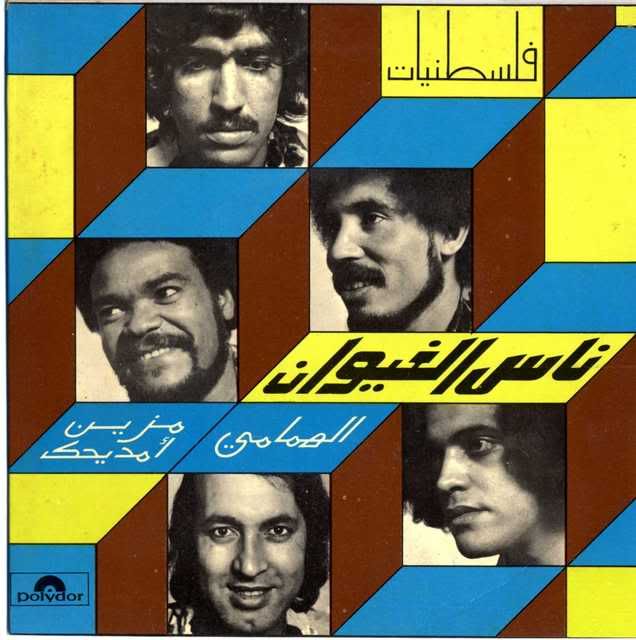
The recorded output of Nass el Ghiwane 2.0 while they were together consists of 3 singles comprising a total of 4 songs, 3 of which were included on their second LP. Each of the three singles features the word "فلسطينيات (Falastiniyat)" in the top right of the sleeve. I don't detect any explicit references to Palestine in the lyrics of these songs, so I'm not sure what is the significance of the moniker "Falastiniyat" here.
Along with his powerful singing voice and muscular guinbri playing,
Paco brought to the Ghiwane his experiences with both the ritualistic performance art theater aesthetic of the Living Theatre and the
ritual mise-en-scène of the Gnawa lila ceremony, where music is
the element that structures time. Adding this powerful force brought the group's already rich compositional and performance mix to a new level, making good on the idea of New
Dervich.
Although the recorded output of this lineup is small, it lays the course of the group for the next 20 years with the addition of the Gnawa element. Specifically here, the songs "Lahmami" and "Ghir Khoudouni" incorporate melodies, structures, and symbolism from the Gnawa ritual repertoire.
"Lahmami", which kicks off the 2nd LP, contains a whole opening section that the group seems to have dropped in future re-recordings and performances of the song ("La la la la lal ya oueddi lal"). The familiar, energetic Lahmami section of the track takes much of its melody and structure from the Gnawa song "Baba Laghami" [5]. Nass el Ghiwane transform it from a sort of saint's invocation song to something secular and quotidian, with lyrics evoking rural beauty as well as the imperative of departure and the impermanence of life, yet retaining the driving urgency of Gnawa ritual musical structures.
There is so much going on in "Ghir Khoudouni" that I'm planning to devote a separate post to a musical analysis of the song. Suffice it to say here that to this day (2026) I know of no song that has so sophisticatedly, sympathetically, and meaningfully transformed musical material from Gnawa ritual in a way that approaches the rich web of signification that drives Gnawa ritual practice.
A couple of additional subjective takes on the 2nd Nass el Ghiwane LP:
The Nass el Ghiwane 1.0 songs included on this LP are remarkable. Youm Malkak (aka Ah Ya Ouine) sounds like nothing else recorded by the group and really shows off for the first time the haunting quality Omar Sayed could bring to a plaintive melody. Al Hassada brings the rural influence to the forefront. The celebratory short call/response phrases that structure the song, the driving rhythmic punctuations, and the ecstatic singing make this one of the most joyful tracks the group ever recorded.
Side 2 of the LP juxtaposes the celebratory Al Hassada with the existential despair and defiant hope of Ghir Khoudouni. Boujemiî's unexpected death before or shortly after the release of this LP makes this juxtaposition all the more devastating and heartbreaking.
Please enjoy the Ya Sah single and the 2nd LP, remastered from my vinyl rips.
Nass el Ghiwane ناس الغيوان Ya Sah 7" يا صاح Polydor 2.225.041 1974
01 Ya Sah يا صاح
Nass el Ghiwane ناس الغيوان Polydor LP 2.944 008 1974
A1 Lahmami لهمامي A2 Mazine M'Dihek مزين امديحك A3 Youm Malkak يوم ملقاك B1 El Hassada الحصادة B2 Ghir Khoudouni غير خدوني
[2] Abderrahmane Paco, interviewed in Abderrahmane Kirouj (Paco), episode of Nostalgia, dir: Rachid Nini, 2003
[3] Hassan Habibi, interviewed in Abderrahmane Paco, episode of Fi Adhakihra, dir: Imane Tadouat, Jahan Inouaoui.
[4] Larbi Riad, interviewed in Abderrahmane Paco, episode of Fi Adhakihra, dir: Imane Tadouat, Jahan Inouaoui.
[5] L-Ghmami is one of the cohort of mluk entities known as the Bawwab that includes Sidi Mimoun the Gnawi, Lalla Mimouna, L-Ghmami, Sidi Mimoun Ganga, Baba Siyaf, etc. We've shared a version of this song as recorded by the late great maalem Hmida Boussou (blogpost, youtube). Also, here's a weird version by Mahmoud Guinia with synth drum and electric guitar.
Clockwise from top left: Moulay Tahar Asbahani, Mohamed Derhem, Moulay Abdelaziz Tahiri, Hassan Miftah, Abdelkrim Elkasbaji
I know the guinbti is not the most important thing to focus on when considering the work of the venerable Moroccan band Jil Jilala. But we're pretty mgennwi here at Moroccan Tape Stash, addicted to the guinbri. So here are some notes on the use of the guinbri in Jil Jilala before Mustapha Baqbou joined the group.
Jil Jilala has had a guinbri player from its very inception in 1972. Founding member Hamid Zoughi relates that when the group was first coming together in Casablanca, they wanted to have a guinbri player join the group. So they drove to Marrakech looking for Mustapha Baqbou. Finding that he was in Essaouira, they then drove to Essaouira. But their friends in Essaouira told them to check out a different, local guinbri player, Abderrahmane Paco. They hit it off with Paco, and Paco hit the road with them to Casablanca.
I assume the earliest recordings of the group feature Paco - he's pictured on the sleeve for the single of "Lklam Lmrassa3" above - but I don't hear any guinbri on the recording. I've heard a couple times the story that Paco left Jil Jilala in the middle of a recording session, after getting into an argument about the rhythm of the song they were recording.
Of course, Paco's story continues when he joins Nass el Ghiwane. I don't know why Moulay Abdelaziz Tahiri, the left-haded guinbri player who was in the initial lineup of Nass el Ghiwane, decided to leave that group for Jil Jilala, but it seemed to work out well for all. Here's a very early Nass el Ghiwane concert featuring Tahiri:
One huge difference between Nass el Ghiwane and Jil Jilala is the instrumentation and texture they used. Nass el Ghiwane tended to use the same instrumentation on most songs: bendir, tam-tam, snitra (banjo)and guinbri (plus the gwal, while Boujmiî was still with the group). Jil Jilala, on the other hand, used many different combinations of stringed instruments and percussion in their many recordings and performances. Not to mention the presence of a female singer, Sakina Safadi, in many of their 1970s recordings.
So when Moulay Abdelaziz Tahiri joined Jil Jilala, he was not a full-time guinbri player. In videos from his tenure in the group, he is usually featured playing ta'rija or bendir, as in the clip below - a live performance from Kuwait. Tahiri is the one in the light blue vest, singing the solo verses in this version of "Allah ya Moulana", a song made famous by Nass el Ghiwane.
The typical Jil Jilala song from this period features one stringed instrument (a banjo orbouzouki), and some combination of percussion instruments (bendir, ta'rija, tam-tam, or congas). Now and then, Tahiri plays the guinbri, but not very often on the recordings I've heard.
The last album to feature Tahiri (prior to the 1996 reunion album), according to Smagal is from 1984, entitled "Dawiweh". I haven't found the album, but I did come across an amazing video clip of the title song. The instrumentation is an unusual, shimmery combination of 3 stringed instruments - Tahiri on guinbri, Miftah on bouzouki, and Asbahani on gnibri (something I'd never seen him play before) - plus Derhem on congas and Elkasbaji on bendir. It's a lovely piece:
Tahiri's playing is great, and very different somehow from Paco's and Mustapha Baqbou's. I suppose it's because he wasn't brought up (as far as I've heard) in the Gnawa tradition. I wonder how he learned to play guinbri back in the days before it was widely heard outside of Gnawa circles - it sometimes sounds like he's translating techniques from other stringed instruments (oud, perhaps) to the guinbri.
The only tape I have from Tahiri's tenure in Jil Jilala (whose tracks aren't up on Amazon) is this album on Edition Hassania. The catalog number suggest that it dates from the early 1980s, but many of these songs are from much earlier. (I believe that Nass el Ghiwane similarly "re-recorded their old hits" for an album on Edition Hassania around this time.) The song "Al-âr A Bouya" dates from the group's earliest days (B-side of the 45 pictured above), but is re-recorded here featuring a prominent guinbri.
Jil Jilala - Rih L-Bareh (Edition Hassania EH 1274)
01 Baba Mektoubi 02 Al-âr A Bouya
I've been revisiting the Jil Jilala albums featuring the Gnawi mâalem Mustapha Baqbou. It's an interesting group of recording.
Baqbou joined the group in the mid-1980s following the departure of Moulay Abdelaziz Tahiri (who was originally with Nass el Ghiwane in the early '70s before Paco joined that group). Despite playing guinbri in Nass el Ghiwane, Tahiri was not a specialist in Gnawa music but rather in melhun, a stately old Moroccan sung poetry tradition. With Jil Jilala, Tahiri brought brought a modern, youthful exuberance to old melhun classics like "Chamâa" and "Lotfya", endearing these songs to a new, young audience.
After Tahiri's departure, the group, naturally, took a different direction, with the addition of Mustapha Baqbou. Baqbou had performed in the Netherlands-based folk-revival band Tiq Maya, but was also deeply rooted in the Gnawa ritual tradition. In the 1980s-90s, Mustapha appeared on at least the following albums:
I featured "Hada Wa'dek ya Meskine" in a recent post and I called it "the most Gnawa-influenced" Jil Jilala album. Today's offering, "Lqalb Lmeskun", is perhaps the most Ghiwani of their albums. That is, it comes closest (to my ear) to the sound and feel of Nass el Ghiwane. That ain't necessarily a bad thing - it's a great sound. But it does seem an odd direction for Jil Jilala to take so many years into the its history, and at a time when Nass el Ghiwane's style was going out of fashion. On the other hand, when you have a great Gnawi guinbri player in the group, why wouldn't you use that to its greatest effect and play up the Gnawa influence as Nass el Ghiwane did.
Apparently, these albums were not very successful commercially, and the group changed their approach for the final 3 albums listed above. The most comprehensive and concise biography I could find on the group (in English) was in a post by Smangal at rateyourmusic.com. Regarding this period, he writes:
"In a desperate move to salvage their name,
they tried to modernize their sound a little bit by introducing a drum
machine to play all their percussive sounds. As a consequence, albums La
Tayess and Nour el Anouar sounded processed and mechanical, even if
they had good song writing. They tried to follow the trends but failed
to gain any noticeable attention, and this made Mohamed Derhem amicably
leave the band in 1995."
The use of the drum machine is pretty weird. And even weirder that they would use a synthesized bass to play lines clearly designed for the guinbri, as here, in "Dib el Ghaba", a track from "La Taiesse":
Weird, but it does have a certain charm, and it clearly represents a (perhaps jarring) break from the folky/Ghiwani sound. You can hear it on the latter 3 albums listed above, as well as on Mohamed Derhem's solo album. The album Nour al Anwar in particular features some great songs.
While their albums featured these mechanical sounds, I believe their live performances always featured the organic, acoustic instruments of the ensemble. Check out this live version of Dib el Ghaba - BAQBOU'S GUINBRI RIFFING IS UNBELIEVABLY GROOVY:
My copy of Lqalb Lmeskun is a cassette dub of someone else's cassette. I don't have the album art, so am using Yala's copy of the art from the CD.
This is a gorgeous album by Jil Jilala, dating, I believe, from the mid 1980s.
Jil Jilala have featured a guinbri player at various times in their history. Paco Abderrahmane and Moulay Abdelaziz Tahiri were group members in the early days of the 1970s, and Mustapha Baqbou has been a member at various times since the 1980s. Despite this fact, Jil Jilala have, to my ear, have rarely drawn overt inspiration from Gnawa melodies, songs, riffs or rhythms. This is quite different from the approach of Nass el Ghiwane in their Paco years, when they drew liberally from the Gnawa repertoire.
This album seems to the be exception. I call it their most Gnawa-influenced tape, though even here the influence is mostly subtle. The title track, "Hada Wa'dek Ya Meskine" opens with some solo guinbri riffing. The song's title translates as something like "That's your lot, poor guy", and refers to the Gnawa song "Hada Wa'do Meskine" (That's his lot, poor guy), versions of which we've featured here and here. And when the rhythm shifts at 8:18, the melody also echoes that of the Gnawa original. "Ya Men Narjak" features Gnawa-styled guinbri riffing and rhythm. And the tracks on side 2 feature guinbri lines more Gnawa-ish than on other Jil Jilala albums featuring Mustapha (such as this and this at Yala.fm, and this at Awesome Tapes.
For some great vintage Jil Jilala, check out the posts at Snap, Crackle & Pop. And for some detailed history of the group, check Hammer's megapost at The Audiotopia.
Actually, I just found another Jil Jilala album at Yala, which does feature some very Gnawa moments.
Mastering note: I grafted the first couple measures of "Sfina", which were missing from my tape, from Yala's version.
Jil Jilala - Hada Wa'dek Ya Meskin (Disques Gam GB.85.86) 01 Hada Wa'dek Ya Meskin
Sad to report the passing of the incomparable Abderrahmane "Paco" Kirouche this past weekend. First musician to explore the resonances between the Gnawa arts and contemporary social issues in a musical way. Others have done so since, none have done it better.
I have written about and shared some of his music - both solo and with Nass el Ghiwane. The tapes in this post are the last 2 commercial solo cassettes of his that I own. The 1995 cassette pictured below was his first solo album after leaving Nass el Ghiwane in 1993. It's an odd piece of work. His guinbri playing and singing are strong, and all the tunes are right out of the lila repertoire, but the musical setting is rather bizarre. There is a synth marimba that works nicely (as it did a few years later for Gnawa Diffusion). The ambient and jungle noises are just strange, and the synth guitar, synth drum and synth horn punches seem designed to jar. This tape really rubbed me the wrong way back in the day. Listening to it now, it definitely has a "feel" to it (though not as transcendently trippy as this masterpiece of Gnawa psychedelica.) Was Paco trying to make an album as different-sounding as possible from his always-acoustic ex-band?
The cassette pictured at top dates from around 2001, and it's a straight-ahead, solid Gnawa tape, though the mix is a little weird to my ear. All songs are from the Ghabawyin (the black "Sons of the Forest") suite which is performed late in the Gnawa lila ceremony. This tape also seems to be late in Paco's recorded work. I've not come across any other cassettes of his, and for most of the past decade I heard that he was sick. Please, if anyone has other commercial recordings of Paco, let me know - I'd love to hear them!
Though neither of these tapes are as earth-shattering as his best work with Nass el Ghiwane, they still brim with the character and intensity that made Paco such an unforgettable presence on stage and in memory. Saha, Mâalem!
In honor of the pending vote at the UN regarding Palestinian statehood, here's a Nass el Ghiwane tape from around 1992 featuring the song "Intifada", commemorating the then current intifada. This was not the first time Nass el Ghiwane had sung about the situation in Palestine. Their more well-known song on the subject is "Majzara" (popularly known as "Sabra & Shatila") was released 10 years earlier, following the terrible massacres there.
It's unusual for NG to be so explicit when dealing with social and political issues. It's easier for them to do so when they are singing about situations outside of Morocco. When singing about issues within the kingdom, they danced a fine line, using metaphor and oblique references to let their audience know what they were talking about while avoiding running into trouble with the authorities.
This approach was certainly necessary during the reign of Hassan II. Nass el Ghiwane were past their prime of popularity by '92, but there were really no other outlets (to my knowledge) for music with social commentary in those days. Hassan's successor Mohammed VI has made some progressive changes since ascending the throne in 1999, and some avenues for music addressing social themes seem to have opened up for Moroccan hip-hop and fusion artists. However, artists can only go so far in what they say for, like his father, the present king does not tolerate direct criticism of his policies from journalists or musicians.
1) Intifada
2) Mardouma
3) Dallal
4) Limadha ya Karama
Another tape from Paco, the fiery guinbri-playing dynamo from Nass el Ghiwane. (My earlier musings on Paco can be found here.) I believe this is his first solo cassette, though I don't know for sure - at least this is the oldest one I ever found. I'm guessing it's from the 1980s.
In the opening track "Ma Fik Khayr Ya Denya", Paco takes an approach similar to what he did in some Nass el Ghiwane songs - using melodies from the Gnawa repertoire and adding new lyrics of his own composition. With Nass el Ghiwane, Paco used this approach for songs like "Sadma" (based on the Gnawa song "Negsha" - see vid clip below), and "Lebtana" (based on the Gnawa song "Marhaba"). The Gnawa songs being riffed on here are "Mbirkiriya" and "Fofo Denba". These adaptations were enjoyed by traditional Gnawa musicians, and I have heard Gnawa singers insert some of Paco's lyrics into ritual performances of the original songs. (Specifically, the refrain "O Ya denya, hara u marra" from this song, and the line "L-guelb majruh, la bad ineen" from "Sadma")
Tracks 2 and 4 are pretty straight-forward renditions of Gnawa songs (with some extra percussion added to the guinbri-qarqaba-vocal texture). Track 3 sounds like it could be a Soussiya song from the end of the lila repertoire, but I've never heard it before. Track 4 is an epic, side-long version of "La ilaha illa Llah" from the Gnawa repertoire, with a dramatic spoken intro à la Nass el Ghiwane.
1) Ma Fik Khayr Ya Denya
2) Sandi
3) Wadi As-Sahat
4) Ar-Rahil (=La ilaha illa Llah)
BTW - track titles on the cassette sleeve are out of order from what's on the tape. Tracks 1 and 2 are identified from the lyrics, but 3 and 4 are guesses. I'm guessing Ar-Rahil ("the departure") is the long track equivalent to "La ilaha illa Llah", since the lyrics are sort of about a journey, but I could be wrong.
BTW2 - Oops - I linked to the other Paco tape by mistake. Link is now fixed - sorry for the confusion.
Nass el Ghiwane - what can I say. Like trying to introduce rock and roll in one blog post. They set the world of Maghrebi music on fire in the early '70s. Fierce, driving rhythm. Trenchant resonant lyrics. Fiery group singing, heartbreaking solo singing. Archaic and modern, subversive and traditional. And, to the best of my knowledge, the first time the now ubiquitious Gnawa guinbri (or sintir or hajhouj or whatever name your prefer) was used in a popular music context.
The most long-lived incarnation of the group was from '74 to '95, as a quartet with Larbi Batma (tam-tam & vocal), Omar Sayed (bendir & vocal), Allal Yaala (snitra & vocal) and Abderrahmane "Paco" Kirouche (Gnawa guinbri & vocal). Most of the available classic recordings of the group (like this and this) feature this lineup.
The original, mythic lineup thru '73 was a 5-piece featuring Larbi, Omar and Allal plus Moulay Abdelaziz Tahiri on guinbri and Boujemâa H'gour on da'du' and vocal. Boujemâa is remembered as the fire and spirit of the group in these early days. The group's first recordings feature this lineup. They are often hard to find, but have recently been reissued as the first 7 tracks of this collection.
After Tahiri's departure in '73 to join Jil Jilala, Paco joined the group, which remained a 5-piece until Boujemâa's untimely death in '74. This lineup is pictured above. Some of the classic songs of the group's repertoire date from this period but can be found only in re-recordings by the later quartet (or, worse, by the group after Paco's departure in '95 and/or Batma's death in '97). I have never once seen a release of the recordings of this quintet on cassette or CD.
Yet several singles and an LP were released by the '73-'74 quintet. I've run across this single a couple of times:
And on one occasion I saw a full LP featuring this line-up. The design of the album cover looked similar to the single shown here. The LP was in a shop in Marrakech in Riad Zitoun. If you've ever looked for vinyl in Morocco, you know that most stores that own vinyl will not sell it to you, but are happy to record it onto cassette for you.
Here's a digital transfer of my cassette copy of the Marrakchi shop owner's vinyl copy of the 2nd Nass el Ghiwane album. All of these songs were re-recorded by the quartet after Boujemâa's death, and some of them were released on an album called "Hommage à Boujemâa". It was particularly moving for me to hear this version of "Ghir Khoudouni", with Boujemâa singing the final verse:
Good luck doesn't die
Love doesn't die
Goodness doesn't die
Justice doesn't die
Peace doesn't die
In later recordings and performances, Omar would sing that verse and add the line "Boujemâa doesn't die".
I'm not convinced that Paco is on all of these tracks. He's definitely on "Ghir Khoudouni" (both singing and playing. Some tracks feature no guinbri at all, and the guinbri playing (and tuning) on "Youm Malkak" sounds like Moulay Abdelaziz Tahiri. But Boujemâa's great singing can definitely be heard singing on all tracks. (He's the one that sings the solo portions at the opening of "Lahmami")
Tracks:
1) Al Hessada
2) Ghir Khoudouni
3) Lahmami
4) Mzine Mdihek
5) Youm Malkak (Ah Ya Ouine)
6) Ya Sah
I have no idea why these tracks have never been reissued. Luckily, you can get them here.
And there's more Paco here and here.
UPDATE 3/24/2013:
I just ran across these images online - someone was selling a vinyl copy of the album in France, and uploaded the following images:
This is not the cover I remember seeing in the Marrakech shop, but perhaps my memory is hazy. Or perhaps this is an alternate cover - I could have sworn the album looked like the Polydor 45 pictured above.
At any rate, it looks like the running order of tracks is as follows:
Which means "Ya Sah" was a bonus track that the Marrakchi shop owner added to the tape. Indeed, it does sound like it comes from a different slab of vinyl than the other tracks. A non-LP 45 then?
Twinge-of-nostalgia-for-bygone-audio-technology-days note: For those of you who used to copy LPs onto cassettes for friends (or receive such dubs from friends), remember when you'd have a 45 minute side of a tape and the album would only be 37 minutes long and you would search for 2 or 3 perfect bonus songs to fill up the blank space at the end of the tape? Such were the joys...
Paco was the fire behind Nass el Ghiwane from 'til '95, when he left the group. It was during his tenure in the band that they made their most driving music, drawing heavily on his phat guinbri lines. (Compare recordings from the pre- and post-Paco period with those featuring him - although there has always been a guinbri player in the group, none but Paco were steeped in the Gnawa traditional repertoire or could bring the hal (the funky groove condition) like him.
This cassette, which I believe is Paco's second solo cassette, dates from about 1993, when he was still with Nass el Ghiwane. His earlier cassette (which I will post here soon), featured Gnawi melodies with some reworked lyrics (à la Nass el Ghiwane). This one features strictly Gnawi lyrics. But musically, there are a few stylistic elements that set it apart from typical Gnawa recordings. The normally clattering qraqeb of Gnawa music are here quite controlled, but just as driving as in the best Gnawa recordings. Paco adds a triangle or other chime, and what sounds like a tbel barrel drum, richening the texture and giving the session a mildly Ghiwane-y feeling. Adding to the Ghiwane-y mood are the long sections of singing - the duration of each song is much longer than would be typical for a normal Gnawa version of each song. Paco brings the intensity of his Nass el Ghiwane vocal performances to these tracks. The result is a very enjoyable set of Gnawa songs which unfolds a little differently than a typical set and adds some stylistic ingredients that don't detract from the main attractions: passionate singing and thumping guinbri.