Saturday, January 8, 2022

Pluck Yeah! 1980s Electric Guitar Chaâbi Orchestre Plays Rouicha

Well here's something old yet different - it's a tape of songs by lotar-master Rouicha, performed by a 1980s chaâbi orchestre - viola, drum kit, and darbuka, and driven by an electric guitar! I was just remarking a couple weeks ago how Middle Atlas lotar songs work so well in a chaâbi context and vice versa. Here is more evidence (apologies - the audio quality is not the best, but the grooves are so good!):


The vibe here ☝️ reminds me somewhat of the âita-based guitar-driven sound of Noujoum el Haouz. The drum kit is similarly propulsive, and the darbuka and viola pull the track toward the âita sound world. On another track 👇 however, the âita/chaâbi stylings fall away - there is no viola, the singing is in Tamazight, and the drum kit and darbuka switch from chaâbi propulsion to a laid-back Middle Atlas swing. This foreshadows a bit the flangey acoustic guitar-driven Middle Atlas grooves that Moulay Ahmed el Hassani would popularize a few years later.

Unfortunately, I have no idea who are the musicians on the cassette or from where they hail. The Sawt Nassim label was (is?) based in Casablanca, but that doesn't guarantee that the ensemble was based there. I hope someone in YouTube comments can identify the musicians!
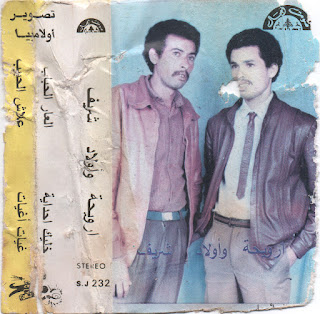
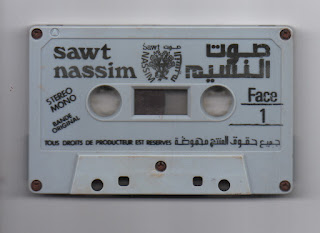
By the way, this cassette came to me from Essaouira (shukran T!) with the j-card pictured at right. I was looking forward to hearing it - the duo Arouiha and Oulad Cherif were featured in this old post over at Awesome Tapes From Africa. Was disappointed that the tape did not match the j-card. Luckily, the Sawt Nassim tape it housed is pretty great. Still - that leather tie!

The songs on side B of this album are both featured on Rouicha's fabulous album TCK790, still available here: https://moroccantapestash.blogspot.com/2011/06/mohammed-rouicha-afak-al-hwa-hda-liya.html. I couldn't identify the first track on side A, but the second track, 'Mani L3ahd Mani L3zazit' (featured in the YouTube clip above) can be found on YouTube in several versions, one of which is attributed to Rouicha. (There's no discographic information, but a YouTube commenter claims it was recorded by Rouicha in 1981). It clearly remains a well-known song, as one can find versions of it performed by many artists on YouTube.

Editing note: Side A and Side B of the tape both end with instrumental intros, and both sides begin with intros cut off. So I grafted the intro from the end of each side to the first track on the other side.

Pluck Yeah! 1980s Electric Guitar Chaâbi Orchestre Plays Rouicha
Unknown Guitar-Driven Chaâbi Orchestre

Sawt Nassim cassette 

A1 Piste 01
A2 Mani L3ahd Mani L3zazit ماني العهد ماني العزازيث (video embedded above)
B1 Toub Toub A Rasi توب توب اراس (audio embedded above)

B2 Lawah a Lawah Ammi Lhubb Iâddeb لواه امي لواه الحب يعدب

FLAC | 320

Friday, December 31, 2021

It's Been A Weird Year - You Deserve Some Great Gnawa Music from Essaouira

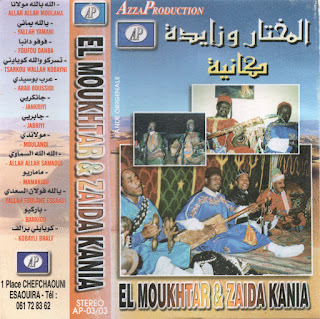
A Gnawa offering to round out the strange year that was 2021. Here's a lovely album from Mokhtar & Zaida Gania. Mokhtar and Zaida are the brother and sister of the late mâalems Mahmoud and Abdellah Gania, and I believe they are the last surviving children of Mâalem Boubker Gania. 

Zaida is a mqaddma ritual leader in Gnawa ceremonial life, and of course grew up in a family of Gnawa musicians and ritual practitioners. In addition to performing music with her male Gnawi family members, she also leads all-female haddarat percussion groups:

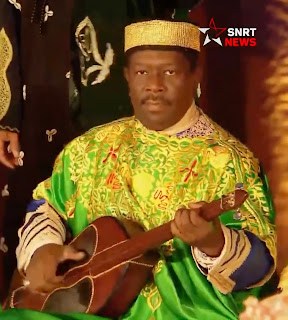
mokhtar_with_badass_guinbri

Mâalem Mokhtar has performed in traditional and fusion Gnawa settings. His singing voice is deeper and more resonant than that of his late brother Mahmoud. And he plays this badass guinbri:

The tracks of this album feature an appealing variety of textures. Gnawa music in its traditional form stays pretty uniform in terms of texture (a guinbri, some qarqabas, and some male call/response vocals). It's a great texture, and sometimes that's exactly what the doctor ordered. But sometimes it's nice to change things up too. On this album you get: songs with added percussion (A2, and especially B5), songs with Zaida singing lead (A1, B1, B2, B5) or along with the male chorus (A1, A3, A5, B4), and songs with a tenor sax (A4, B2). 

Female and male voices together in Gnawa music don't always work for me, but in this instance the combination sounds great - perhaps the fact that it's family makes the blend organic. Men and women of the Gania family can also be heard singing together on Maâlem Mahmoud's 1994 album with Pharoah Sanders The Trance of Seven Colors, and the blend there is likewise wonderful.

The use of tenor sax on this album also hearkens to The Trance of Seven Colors. In fact, it's the only other recording I can think of that features a full Gnawa group augmented only by a saxophone. Typically when you hear a saxophone with Gnawa, you are also hearing other instruments like a drum kit, keyboards, guitars and other percussion. I wish I knew who was playing the sax here - the approach is nice, and somewhat reminscent of the way Pharoah played with Mahmoud's group.

Mokhtar remains active as one of the elders of Gnawa music in Essaouira. His performance with his nephew Houssam was one of many highlights of the huge Gnawa concert that was broadcast on Christmas day on Moroccan TV. The concert, which was filmed in Essaouira, featured dozens of Gnawa mâalems and koyos from across Morocco. You can watch the entire show, which was very good, on YouTube:

Thanks to all of you who continue to visit Moroccan Tape Stash after all these years. May 2022 bring goodness and joy to you all, and may humans across the planet join hearts, hands, and minds in love and mutual respect to confront the formidable challenges we continue to face.

El Moukhtar & Zaida Kania المختار و زايدة كانية
Azza Production AP-03/03

2003

A1 Tsarkou Wallah Kobayni تسركو والله كوبايني
A2 Foufou Danba فوفو دنبا
A3 Jabriyi جابريي
      Moulandi مولاندي
A4 Jankriyi خانكريي
A5 Barkiou باركيو
      Kobayli Bralf كوبايلي برالف
B1 Yallah Foulane Essaadi يالله فولان السعدي
B2 Yallah Yamani يالله يماني

B3 Sidi Sma Samaoui
B4 Allah Allah Samaoui الله الله السماوي
B5 Allah Allah Moulana الله الله مولانا

320 | FLAC


Friday, December 24, 2021

Hamid Almou المو حميد - The Golden Plectrum of Meknes

Hamid Almou - Lachkar 4

A pair of albums this week, from lotar player and singer Hamid Almou. Like Rouicha, Almou has a groovy touch on the lotar, has a smooth, low baritone voice, and has had success recording in both Arabic (darija) and Tamazight. There's not much information about him online, but I gather from YouTube comments that he hails from Meknes, specifically the Toulal neighborhood. 

These two albums feature Almou singing in Arabic. I dubbed them from original copies in 1992 or 1993 in Marrakech. The song "Tfah Jnane Bghitou" that opens the first of these albums is somewhat well known. Several other recorded versions of it can be found online, including one by famed âita singer Khadija al Bidaouia (https://www.youtube.com/watch?v=X7I-aX2jwPU). I don't know whether Almou is the originator of the song or whether the song existed before he recorded it. It works remarkably well as both a viola-driven âita-styled chaâbi song and as a lotar-driven Zayane-styled chaâbi song.

Elmo

Digital research note: As with any Arabic or Amazigh name, there are many different ways of transcribing المو حميد with Roman letters. A Google search for the name returned results that included Hamid Almou, Hamid Al Mou, Hamid El Mou, and Hamid Alemmou. it also returned this image:

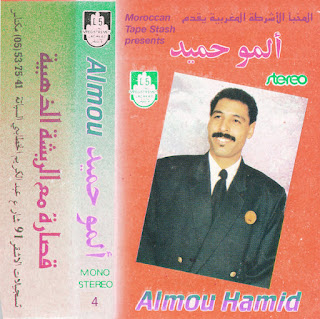
Iconographic note: Since I didn't have images of the original j-cards, i went fishing on the internet to find something appropriate. I did find an entry on Discogs for an album by Almou, also on the imprint Enregistrement Lachkar, though it's not the same album as either of my dubs. The album refers to Almou as الريشة الذهبية "The Golden Plectrum" (richa being the Arabic word for both 'feather' and 'plectrum'). Anyway, I pilfered the image of the j-card and tweaked the colors to create mock j-cards for these 2 albums, shamelessly adding Moroccan Tape Stash branding in English and Arabic. Thanks and apologies to the original uploader Hackente.

More fun facts from Discogs: The Spanish rock band Les Conches Velasques adapted a song of Almou's in their song "Cosas de usar", the opening track on their 2021 album Celebración del trance profano (which also includes a version of Nass el Ghiwane's "Mahmouma").

Hamid Almou does not appear to have a web presence on either Facebook or YouTube. As far as I can tell, he is still active and performing. He sounds good in this live clip from 2014:

More Hamid Almou at Awesome Tapes From Africa and at Fazaz Arts YouTube channel.

Hamid Almou المو حميد
Enregistrement Lachkar 4


A1 Tfah Jnane Bghitou
A2 Ya Lli Nasini
B1 Mal Hbibi Malou Ma Jache
B2 Chawerni Alfraq Chawerni

320 | FLAC

Hamid Almou المو حميد
Enregistrement Lachkar 14


A1 Âchiri Lli Wellfou Guelbi Ya Hasra
A2 Min Zinek Ya Lil Ch'hal Dlamek Khwaf
B1 Had Denb A L-Hbiba Machi Denbi
B2 Tir Tir Bnit Lu Chebbak Hrir
B3 Galt Lbniya L-Baha Lach T'hdini

320 | FLAC