Showing posts sorted by relevance for query Paco. Sort by date Show all posts

Sunday, March 22, 2026

Nass El Ghiwane 2.0 - Falastiniyat

This post looks at the short but seminal period of Nass el Ghiwane 2.0, from the time Abderrahmane Paco replaces Moulay Abdelaziz Tahiri until the untimely death of Boujemiî Hgour in October 1974.  

Nass el Ghiwane 2.0: Exit Tahiri, Enter Paco

At some point in 1973 or early '74, Moulay Abdelaziz Tahiri left Nass el Ghiwane. Larbi Batma wrote in his memoir ar-Rahil [1] that Tahiri's leaving was a function of interpersonal matters related to an unnamed person from Marrakech, not a function of any musical or creative differences.

Although the narrative of Nass el Ghiwane's formative days centers on the creative duo of Boujemiî and Batma, Tahiri's creative contribution to NG 1.0 should not be discounted. In addition to being musically proficient on various instruments and fluent in various styles, he was absolutely committed to the project of creating a new type of modern Moroccan song anchored in traditional forms. Batma notes that Tahiri contributed to the group's songwriting in those early days. Memorably, his solo guinbri opens the Disque D'or album's opening track "El Madi Fate (The Past is Gone)", and he sings the vocal lead in the song's opening verses. 

Despite Tahiri's early departure from the group, the Ghiwanis would find a more than competent replacement in Abderrahmane Kirouch "Paco". Paco would come to be one of the primary creative drivers of the group from that time forward, adding substantially to the group's already rich poetic and musical tapestry.

Like Tahiri, Paco was not native to Casablanca. Tahiri came from Marrakech and Paco came from Essaouira. Also, like Tahiri and the other Ghiwanis, Paco had some experience in unconventional theatre, but of a very different type. In the summer of 1969, the experimental American theatre troupe The Living Theatre took up residence in Essaouira, which was at that time a renowned destination for hippie and other anti-establishment seekers. Jimi Hendrix visited Essaouira that summer, and Paco claims to have performed a lila ceremony that Hendrix attended there [2]. Critically for his artistic itinerary, Paco participated with The Living Theatre in a local production in Essaouira wherein he played the guinbri and sang wordless melodies [3]. This is likely the origin of the "sonorous Gnaoua chant from Morocco" that runs throughout The Living Theatre's production "Seven Meditations on Political Sado-Masochism". 

Paco's experience with Living Theatre and their deconstruction of foregoing theatrical conventions must have resonated with the other Ghiwanis' experience with Tayeb Saddiki's troupe - i.e., openness to the idea that music and performance could be deployed in the service of transformative experiences beyond the confines of the proscenium stage. And of course Paco also had practical experience of these transformative possibilities through Gnawa musical-ritual practice.

Before Paco joined Nass el Ghiwane, however, he spent time as a member of Morocco's other top group working in the new style. The Marrakech-based group Jil Jilala wanted to add a guinbri player to their ranks. Members went looking for Baqbou in Marrakech but were told he had gone to Essaouira. They set off for Essaouira and were unable to find Baqbou, but someone pointed them in the direction of Paco, who liked the idea and joined the group.

From what I can surmise from the online resources, Paco is featured on two pairs of 7-inch singles released by Jil Jilala, both containing the same songs in different versions, for the Atlassiphone and Casaphone labels. YouTube user Ismael Abo Salma (well worth following) has put together an excellent chronological playlist of Jil Jilala's recordings, and he dates these singles to 1972, making them the earliest of the group's recordings. He lists the Atlassiphone singles as being the initial recordings, and the Casaphone singles being subsequent re-recordings of the same songs:

  • Jilala جيلالة (Atlassiphone ATL 555) (Discogs, YouTube)
  • Klam Lmrassah الكلام المرصع / Ha Lâar A Bouya  ها العار أبويا (Atlassiphone ATL 556) (Discogs)
  • Jilala جيلالة (Casaphone CSP 5084) (Discogs , YouTube - I think this is the Casaphone recording - you can clearly hear Paco's solo voice and guinbri at the beginning of this track, and the image is from the back of the Casaphone sleeve)
  • Klam Lmrassah الكلام المرصع / Ha Lâar A Bouya  ها العار أبويا (Casaphone ???) (YouTube)

Despite Paco's participation in these early successes of the group, it was apparently not an ideal musical fit as far as Paco was concerned. The story goes that he was in a recording session with the group and got into an argument about the rhythm of the song being recorded. Frustrated, he walked out and never returned [4]. Fortuitously, this coincided with Tahiri's departure from Nass el Ghiwane, and soon thereafter Paco joined the Ghiwanis.

Nass el Ghiwane 2.0: Recordings - Falastiniyat

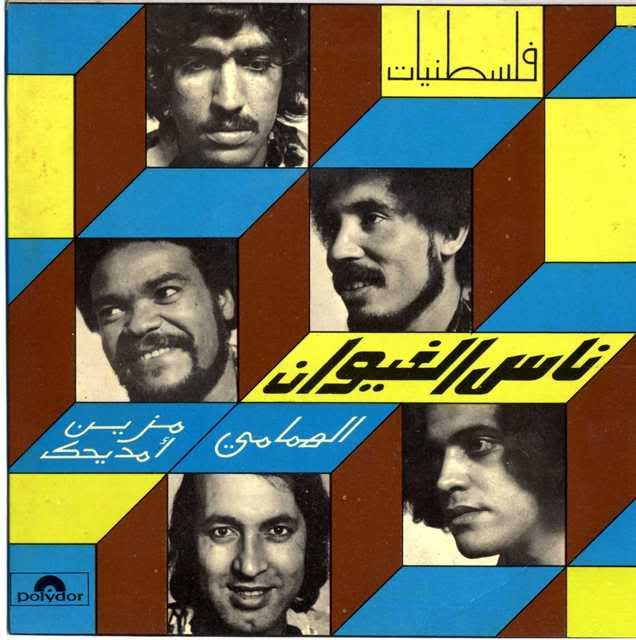
The recorded output of Nass el Ghiwane 2.0 while they were together consists of 3 singles comprising a total of 4 songs, 3 of which were included on their second LP. Each of the three singles features the word "فلسطينيات (Falastiniyat)" in the top right of the sleeve. I don't detect any explicit references to Palestine in the lyrics of these songs, so I'm not sure what is the significance of the moniker "Falastiniyat" here.

  • Song: Ghir Khoudouni (Hammouda)  غير خذوني (حمودة)
  • Polydor 2225036
  • Date: assuming 1974
  • Appears on 2nd album 
  • Discogs link
  • YouTube link 
  • Song: Ya Sah  يا صاح
  • Polydor 22 25041
  • Date: ℗ © 1974
  • non-LP
  • Discogs link
  • YouTube link 
  • Songs:  
    • Lahmami لهمامي
    • Mezzine M'Dihek مزين أمديحك
  • Polydor 2225045
  • Date: ℗ © 1974
  • Appear on 2nd album 
  • Discogs link
  • YouTube link 
  • LP contains the 1st and 3rd single above, plus the final 2 songs recorded by Nass el Ghiwane 1.0 (Youm Malkak and Al Hassada)
  • Polydor 2944008
  • Date: ℗ © 1974
  • Discogs link
  • YouTube link 

Along with his powerful singing voice and muscular guinbri playing, Paco brought to the Ghiwane his experiences with both the ritualistic performance art theater aesthetic of the Living Theatre and the ritual mise-en-scène of the Gnawa lila ceremony, where music is the element that structures time. Adding this powerful force brought the group's already rich compositional and performance mix to a new level, making good on the idea of New Dervich.

Although the recorded output of this lineup is small, it lays the course of the group for the next 20 years with the addition of the Gnawa element. Specifically here, the songs "Lahmami" and "Ghir Khoudouni" incorporate melodies, structures, and symbolism from the Gnawa ritual repertoire.

"Lahmami", which kicks off the 2nd LP, contains a whole opening section that the group seems to have dropped in future re-recordings and performances of the song ("La la la la lal ya oueddi lal"). The familiar, energetic Lahmami section of the track takes much of its melody and structure from the Gnawa song "Baba Laghami" [5]. Nass el Ghiwane transform it from a sort of saint's invocation song to something secular and quotidian, with lyrics evoking rural beauty as well as the imperative of departure and the impermanence of life, yet retaining the driving urgency of Gnawa ritual musical structures.

There is so much going on in "Ghir Khoudouni" that I'm planning to devote a separate post to a musical analysis of the song. Suffice it to say here that to this day (2026) I know of no song that has so sophisticatedly, sympathetically, and meaningfully transformed musical material from Gnawa ritual in a way that approaches the rich web of signification that drives Gnawa ritual practice.

A couple of additional subjective takes on the 2nd Nass el Ghiwane LP: 
  • The Nass el Ghiwane 1.0 songs included on this LP are remarkable. Youm Malkak (aka Ah Ya Ouine) sounds like nothing else recorded by the group and really shows off for the first time the haunting quality Omar Sayed could bring to a plaintive melody. Al Hassada brings the rural influence to the forefront. The celebratory short call/response phrases that structure the song, the driving rhythmic punctuations, and the ecstatic singing make this one of the most joyful tracks the group ever recorded.
  • Side 2 of the LP juxtaposes the celebratory Al Hassada with the existential despair and defiant hope of Ghir Khoudouni. Boujemiî's unexpected death before or shortly after the release of this LP makes this juxtaposition all the more devastating and heartbreaking. 

Please enjoy the Ya Sah single and the 2nd LP, remastered from my vinyl rips.


Nass el Ghiwane ناس الغيوان
Ya Sah 7" يا صاح

Polydor 2.225.041

1974

01 Ya Sah يا صاح 

Nass el Ghiwane ناس الغيوان
Polydor LP 2.944 008

1974

A1 Lahmami لهمامي
A2 Mazine M'Dihek مزين امديحك
A3 Youm Malkak يوم ملقاك
B1 El Hassada الحصادة
B2 Ghir Khoudouni غير خدوني 

FLAC | 320 

NOTES/SOURCES CITED: 

[1] Larbi Batma. Ar-Rahil: Sira Dhatiya. Casablanca: Manshurat al-Rabita, 1995. p. 168.

[2] Abderrahmane Paco, interviewed in Abderrahmane Kirouj (Paco), episode of Nostalgia, dir: Rachid Nini, 2003

[3] Hassan Habibi, interviewed in Abderrahmane Paco, episode of Fi Adhakihra, dir: Imane Tadouat, Jahan Inouaoui.

[4] Larbi Riad, interviewed in Abderrahmane Paco, episode of Fi Adhakihra, dir: Imane Tadouat, Jahan Inouaoui.

[5] L-Ghmami is one of the cohort of mluk entities known as the Bawwab that includes Sidi Mimoun the Gnawi, Lalla Mimouna, L-Ghmami, Sidi Mimoun Ganga, Baba Siyaf, etc. We've shared a version of this song as recorded by the late great maalem Hmida Boussou (blogpost, youtube). Also, here's a weird version by Mahmoud Guinia with synth drum and electric guitar.

Sunday, May 18, 2014

The Guinbri in Jil Jilala before Baqbou


Early 1980's Jil Jilala personnel. 
Clockwise from top left: Moulay Tahar Asbahani, Mohamed Derhem, Moulay Abdelaziz Tahiri, Hassan Miftah, Abdelkrim Elkasbaji

I know the guinbti is not the most important thing to focus on when considering the work of the venerable Moroccan band Jil Jilala. But we're pretty mgennwi here at Moroccan Tape Stash, addicted to the guinbri. So here are some notes on the use of the guinbri in Jil Jilala before Mustapha Baqbou joined the group.

Jil Jilala has had a guinbri player from its very inception in 1972. Founding member Hamid Zoughi relates that when the group was first coming together in Casablanca, they wanted to have a guinbri player join the group. So they drove to Marrakech looking for Mustapha Baqbou. Finding that he was in Essaouira, they then drove to Essaouira. But their friends in Essaouira told them to check out a different, local guinbri player, Abderrahmane Paco. They hit it off with Paco, and Paco hit the road with them to Casablanca.


I assume the earliest recordings of the group feature Paco - he's pictured on the sleeve for the single of "Lklam Lmrassa3" above - but I don't hear any guinbri on the recording. I've heard a couple times the story that Paco left Jil Jilala in the middle of a recording session, after getting into an argument about the rhythm of the song they were recording.

Of course, Paco's story continues when he joins Nass el Ghiwane. I don't know why Moulay Abdelaziz Tahiri, the left-haded guinbri player who was in the initial lineup of Nass el Ghiwane, decided to leave that group for Jil Jilala, but it seemed to work out well for all. Here's a very early Nass el Ghiwane concert featuring Tahiri:


One huge difference between Nass el Ghiwane and Jil Jilala is the instrumentation and texture they used. Nass el Ghiwane tended to use the same instrumentation on most songs: bendir, tam-tam, snitra (banjo) and guinbri (plus the gwal, while Boujmiî was still with the group). Jil Jilala, on the other hand, used many different combinations of stringed instruments and percussion in their many recordings and performances. Not to mention the presence of a female singer, Sakina Safadi, in many of their 1970s recordings.

So when Moulay Abdelaziz Tahiri joined Jil Jilala, he was not a full-time guinbri player. In videos from his tenure in the group, he is usually featured playing ta'rija or bendir, as in the clip below - a live performance from Kuwait. Tahiri is the one in the light blue vest, singing the solo verses in this version of "Allah ya Moulana", a song made famous by Nass el Ghiwane.


The typical Jil Jilala song from this period features one stringed instrument (a banjo or bouzouki), and some combination of percussion instruments (bendir, ta'rija, tam-tam, or congas). Now and then, Tahiri plays the guinbri, but not very often on the recordings I've heard.

The last album to feature Tahiri (prior to the 1996 reunion album), according to Smagal is from 1984, entitled "Dawiweh". I haven't found the album, but I did come across an amazing video clip of the title song. The instrumentation is an unusual, shimmery combination of 3 stringed instruments - Tahiri on guinbri, Miftah on bouzouki, and Asbahani on gnibri (something I'd never seen him play before) - plus Derhem on congas and Elkasbaji on bendir. It's a lovely piece:


Tahiri's playing is great, and very different somehow from Paco's and Mustapha Baqbou's. I suppose it's because he wasn't brought up (as far as I've heard) in the Gnawa tradition. I wonder how he learned to play guinbri back in the days before it was widely heard outside of Gnawa circles - it sometimes sounds like he's translating techniques from other stringed instruments (oud, perhaps) to the guinbri.

The only tape I have from Tahiri's tenure in Jil Jilala (whose tracks aren't up on Amazon) is this album on Edition Hassania. The catalog number suggest that it dates from the early 1980s, but many of these songs are from much earlier. (I believe that Nass el Ghiwane similarly "re-recorded their old hits" for an album on Edition Hassania around this time.) The song "Al-âr A Bouya" dates from the group's earliest days (B-side of the 45 pictured above), but is re-recorded here featuring a prominent guinbri.

Jil Jilala - Rih L-Bareh (Edition Hassania EH 1274)
01 Baba Mektoubi
02 Al-âr A Bouya

03 Goulou Lkhlili
04 Rih L-Bareh
05 Errifia
06 Jilala

Get it here.

Monday, May 30, 2011

Paco Abderrahmane - Thayyer A Mul al-Hal


Paco was the fire behind Nass el Ghiwane from 'til '95, when he left the group.  It was during his tenure in the band that they made their most driving music, drawing heavily on his phat guinbri lines.  (Compare recordings from the pre- and post-Paco period with those featuring him - although there has always been a guinbri player in the group, none but Paco were steeped in the Gnawa traditional repertoire or could bring the hal (the funky groove condition) like him.

This cassette, which I believe is Paco's second solo cassette, dates from about 1993, when he was still with Nass el Ghiwane.  His earlier cassette (which I will post here soon), featured Gnawi melodies with some reworked lyrics (à la Nass el Ghiwane).  This one features strictly Gnawi lyrics.  But musically, there are a few stylistic elements that set it apart from typical Gnawa recordings. The normally clattering qraqeb of Gnawa music are here quite controlled, but just as driving as in the best Gnawa recordings. Paco adds a triangle or other chime, and what sounds like a tbel barrel drum, richening the texture and giving the session a mildly Ghiwane-y feeling.  Adding to the Ghiwane-y mood are the long sections of singing - the duration of each song is much longer than would be typical for a normal Gnawa version of each song.  Paco brings the intensity of his Nass el Ghiwane vocal performances to these tracks. The result is a very enjoyable set of Gnawa songs which unfolds a little differently than a typical set and adds some stylistic ingredients that don't detract from the main attractions: passionate singing and thumping guinbri.

1) Damman Lebled (=Chalaba Titara)
2) L'atfa Lillah (L'afu Rijal Allah)
3) Essuba'i
4) Alyaburi (=Sala Nabina Musawi)

Get it here.

Sunday, August 7, 2011

Paco Abderrahmane - Monde Spirituelle Gnaoui


Another tape from Paco, the fiery guinbri-playing dynamo from Nass el Ghiwane. (My earlier musings on Paco can be found here.) I believe this is his first solo cassette, though I don't know for sure - at least this is the oldest one I ever found. I'm guessing it's from the 1980s.

In the opening track "Ma Fik Khayr Ya Denya", Paco takes an approach similar to what he did in some Nass el Ghiwane songs - using melodies from the Gnawa repertoire and adding new lyrics of his own composition. With Nass el Ghiwane, Paco used this approach for songs like "Sadma" (based on the Gnawa song "Negsha" - see vid clip below), and "Lebtana" (based on the Gnawa song "Marhaba"). The Gnawa songs being riffed on here are "Mbirkiriya" and "Fofo Denba". These adaptations were enjoyed by traditional Gnawa musicians, and I have heard Gnawa singers insert some of Paco's lyrics into ritual performances of the original songs.  (Specifically, the refrain "O Ya denya, hara u marra" from this song, and the line "L-guelb majruh, la bad ineen" from "Sadma")


Tracks 2 and 4 are pretty straight-forward renditions of Gnawa songs (with some extra percussion added to the guinbri-qarqaba-vocal texture). Track 3 sounds like it could be a Soussiya song from the end of the lila repertoire, but I've never heard it before. Track 4 is an epic, side-long version of "La ilaha illa Llah" from the Gnawa repertoire, with a dramatic spoken intro à la Nass el Ghiwane.

1) Ma Fik Khayr Ya Denya
2) Sandi
3) Wadi As-Sahat
4) Ar-Rahil (=La ilaha illa Llah)

Get it here.

BTW - track titles on the cassette sleeve are out of order from what's on the tape. Tracks 1 and 2 are identified from the lyrics, but 3 and 4 are guesses. I'm guessing Ar-Rahil ("the departure") is the long track equivalent to "La ilaha illa Llah", since the lyrics are sort of about a journey, but I could be wrong.

BTW2 - Oops - I linked to the other Paco tape by mistake. Link is now fixed - sorry for the confusion.

Wednesday, October 17, 2012

Goodbye Abderrahmane Paco


Sad to report the passing of the incomparable Abderrahmane "Paco" Kirouche this past weekend. First musician to explore the resonances between the Gnawa arts and contemporary social issues in a musical way. Others have done so since, none have done it better.

I have written about and shared some of his music - both solo and with Nass el Ghiwane. The tapes in this post are the last 2 commercial solo cassettes of his that I own. The 1995 cassette pictured below was his first solo album after leaving Nass el Ghiwane in 1993. It's an odd piece of work. His guinbri playing and singing are strong, and all the tunes are right out of the lila repertoire, but the musical setting is rather bizarre. There is a synth marimba that works nicely (as it did a few years later for Gnawa Diffusion). The ambient and jungle noises are just strange, and the synth guitar, synth drum and synth horn punches seem designed to jar. This tape really rubbed me the wrong way back in the day. Listening to it now, it definitely has a "feel" to it (though not as transcendently trippy as this masterpiece of Gnawa psychedelica.) Was Paco trying to make an album as different-sounding as possible from his always-acoustic ex-band?


The cassette pictured at top dates from around 2001, and it's a straight-ahead, solid Gnawa tape, though the mix is a little weird to my ear. All songs are from the Ghabawyin (the black "Sons of the Forest") suite which is performed late in the Gnawa lila ceremony. This tape also seems to be late in Paco's recorded work. I've not come across any other cassettes of his, and for most of the past decade I heard that he was sick. Please, if anyone has other commercial recordings of Paco, let me know - I'd love to hear them!

Though neither of these tapes are as earth-shattering as his best work with Nass el Ghiwane, they still brim with the character and intensity that made Paco such an unforgettable presence on stage and in memory. Saha, Mâalem!

Paco Abderrahmane (1995)
1)  Moulay Brahim

2)  Laghmami
3)  Mimouna
4)  Sidi Bu Derbala

Les Meilleures Chansons Spirituelles de GNAWA (2001)
1)  Allal Ya Allal - Fulani
2)  Sandi
3)  Balini
4)  Allah Ya Rebbi Ya Moulay

5)  Sellem Âla Muhammad Sidi

Monday, June 20, 2011

Nass el Ghiwane - the rare 2nd album (with both Boujemâa and Paco)

 L-R - Omar Sayed, Boujemâa H'gour, Allal Yaala, Abderrahmane "Paco" Kirouche, Larbi Batma

Nass el Ghiwane - what can I say. Like trying to introduce rock and roll in one blog post. They set the world of Maghrebi music on fire in the early '70s. Fierce, driving rhythm. Trenchant resonant lyrics. Fiery group singing, heartbreaking solo singing. Archaic and modern, subversive and traditional. And, to the best of my knowledge, the first time the now ubiquitious Gnawa guinbri (or sintir or hajhouj or whatever name your prefer) was used in a popular music context.

The most long-lived incarnation of the group was from '74 to '95, as a quartet with Larbi Batma (tam-tam & vocal), Omar Sayed (bendir & vocal), Allal Yaala (snitra & vocal) and Abderrahmane "Paco" Kirouche (Gnawa guinbri & vocal). Most of the available classic recordings of the group (like this and this) feature this lineup.

The original, mythic lineup thru '73 was a 5-piece featuring Larbi, Omar and Allal plus Moulay Abdelaziz Tahiri on guinbri and Boujemâa H'gour on da'du' and vocal. Boujemâa is remembered as the fire and spirit of the group in these early days. The group's first recordings feature this lineup. They are often hard to find, but have recently been reissued as the first 7 tracks of this collection.

After Tahiri's departure in '73 to join Jil Jilala, Paco joined the group, which remained a 5-piece until Boujemâa's untimely death in '74. This lineup is pictured above. Some of the classic songs of the group's repertoire date from this period but can be found only in re-recordings by the later quartet (or, worse, by the group after Paco's departure in '95 and/or Batma's death in '97). I have never once seen a release of the recordings of this quintet on cassette or CD.

Yet several singles and an LP were released by the '73-'74 quintet. I've run across this single a couple of times:


And on one occasion I saw a full LP featuring this line-up. The design of the album cover looked similar to the single shown here. The LP was in a shop in Marrakech in Riad Zitoun. If you've ever looked for vinyl in Morocco, you know that most stores that own vinyl will not sell it to you, but are happy to record it onto cassette for you.

Here's a digital transfer of my cassette copy of the Marrakchi shop owner's vinyl copy of the 2nd Nass el Ghiwane album. All of these songs were re-recorded by the quartet after Boujemâa's death, and some of them were released on an album called "Hommage à Boujemâa". It was particularly moving for me to hear this version of "Ghir Khoudouni", with Boujemâa singing the final verse:

Good luck doesn't die
Love doesn't die
Goodness doesn't die
Justice doesn't die
Peace doesn't die

In later recordings and performances, Omar would sing that verse and add the line "Boujemâa doesn't die".

I'm not convinced that Paco is on all of these tracks.  He's definitely on "Ghir Khoudouni" (both singing and playing. Some tracks feature no guinbri at all, and the guinbri playing (and tuning) on "Youm Malkak" sounds like Moulay Abdelaziz Tahiri.  But Boujemâa's great singing can definitely be heard singing on all tracks. (He's the one that sings the solo portions at the opening of "Lahmami")

Tracks:
1) Al Hessada
2) Ghir Khoudouni
3) Lahmami
4) Mzine Mdihek
5) Youm Malkak (Ah Ya Ouine)
6) Ya Sah

I have no idea why these tracks have never been reissued.  Luckily, you can get them here.
And there's more Paco here and here.

UPDATE 3/24/2013:
I just ran across these images online - someone was selling a vinyl copy of the album in France, and uploaded the following images:


This is not the cover I remember seeing in the Marrakech shop, but perhaps my memory is hazy. Or perhaps this is an alternate cover - I could have sworn the album looked like the Polydor 45 pictured above.

At any rate, it looks like the running order of tracks is as follows:

1 Lahmami
2 Mzine Mdihek
3 Youm Malqak
4 Al Hessada
5 Ghir Khoudouni

Which means "Ya Sah" was a bonus track that the Marrakchi shop owner added to the tape. Indeed, it does sound like it comes from a different slab of vinyl than the other tracks. A non-LP 45 then?

Twinge-of-nostalgia-for-bygone-audio-technology-days note: For those of you who used to copy LPs onto cassettes for friends (or receive such dubs from friends), remember when you'd have a 45 minute side of a tape and the album would only be 37 minutes long and you would search for 2 or 3 perfect bonus songs to fill up the blank space at the end of the tape? Such were the joys...

Wednesday, June 17, 2026

Paco Abderrahmane - T'hayyer A Moul al Hal (new rip, remix, remaster)

Here's new digitization of one of my favorite Gnawa cassettes. I shared a version of this back in 2011. I recently obtained a new copy of the tape and a new cassette deck too, so I thought I'd try to improve the sound compared to the earlier version. 

This is an album by Paco Abderrahmane (of Nass el Ghiwane, as the j-card points out). It features 4 songs from the Gnawa repertoire. See my original post to hear me sing the praises of the instrumentation and ensemble.

A couple of things strike me upon listening to this album again. 

1) Paco's singing. It's completely unrestrained and I love it - he reaches for notes and doesn't always hit them, but I'll take his conviction and energy on every failed attempt over a smooth restrained performance any day of the week. 

2) The swing of the guinbri. The way Paco's guinbri lines sit on the beat FEELS different from what I hear from players of the Marrakech school (Boussou, Baqbou, Sam, Baska, et al. ), but I find a similarity with the feel of Mahmoud Guinia's playing - so maybe it's an Essaouira thing. Like maybe they're playing more on top of the beat where the Marrakech players play a little behind it. I may be completely wrong... 

I may also have been wrong to try to remix this cassette. The tracks on side A were recorded or mastered very hot, and the vocals max out in the refrains - even when I split the stems and tried to work on the vocal sound there was not much I could do for the distorted passages. I tried to give some more definition to the guinbri and the tbel barrel drum, but it was a challenge since they exist in a similar frequency range. (I think that's one reason those instruments are not played together very often.)

Anyway, I'm tired of tweaking and re-tweaking the eq, imaging, and other settings. I'm an amateur engineer, so this has been, shall we say, a "learning opportunity" for me. I'm happy with some of the results, and meh with other parts of it. So what I'll do is share my remix as well as a raw rip of the cassette (which is at least an improvement over my 2011 rip). And the music is still fantastic, whichever version you may prefer. 

Raw cassette rip of track 1 (below) for comparison with remix version (above in YouTube clip), if you're interested in that kind of thing:

Best of luck to your teams of choice in the World Cup, or boycott the whole damn thing if you are so inclined.

Thayyer A Moul Al Hal Mâ  تحير امول الحال مع
Paco Abderrahmane باكو عبد الرحمن
(Nass el Ghiwane ناس لاغيوان )

Edition Sonya Disque cassette ESD 322 سونيا ديسك
1993 + Moroccan Tape Stash Remix 2026

A1 Subaîi السباعي
A2 Lyaburi اليابوري
B1 Damman Lbled ضمان البلاد
B2 Lâtfa Lillah العطفة لله

Raw Rip: FLAC | 320
Remix/Remaster: FLAC | 320

Sunday, August 9, 2026

Mustapha Baqbou - Inna Muluk El Hwa Style (or perhaps Bahjawa Style)


Here's a very nice and interesting cassette from the recently departed, much missed Mustapha Baqbou, and it's unlike any other album of his I've heard.

Maalem Baqbou left us a fair number of recordings - Discogs currently lists 10 albums under his name in addition to his appearances on anthologies and compilations such as the seminal Gnawa Music of Marrakech - Night Spirit Masters. In addition to a series of albums for Edition Hassania (Discogs lists 5 of these, though I would not trust the listed release dates), Baqbou recorded a number of one-off albums for other Moroccan cassette labels. We shared one of these, a fantastic release on Sawt al Haouz, several years ago. Today's tape is on the Fassiphone imprint (out of Fes, of course). It's a very enjoyable cassette, though I have a lot of questions:

  • The ensemble on this cassette is that of the standard Ghiwani-style group: guinbri (bass lute), banjo (or perhaps bouzouk or other plucked steel stringed instrument), bendir buzzy frame drum, and tbilat (pair of small kettle drums). Normally this sort of group would record under the name of a group, not that of a single musician. 
  • The two tracks on side B are straight versions of songs from the Gnawa ritual repertoire, and the lead vocalist on these tracks does sound like Baqbou. The tracks on side A, on the other hand, are in a more Ghiwani vein, or better, in a Muluk el Hwa vein. They are very much centered on the guinbri and use Gnawa or Gnawa-styled melodies, but with additional or alternate lyrics. 
  • On first listen, I wondered whether this was actually a Baqbou album, as I did not hear his voice right away. On second listen, I did recognize his voice - he's not the vocal soloist on the first track, but I do hear him on the other three tracks. Not sure why I didn't recognize him at first - perhaps the recording is from early in his career, or perhaps the playback speed on my edition of the tape is faster than the original recording, or perhaps I'm just thick-headed.
  • On track A1 "Al Hal", the solo singer does not sound to me like Baqbou, though Baqbou may be one of the choral responders. This track reminds me of Muluk el Hwa in its overall groove and production style.
  • Track A2 "Menni Mennek" features a recited declamation at the beginning, like what is heard at the start of many Nass el Ghiwane or Jil Jilala tracks. This recitation is definitely NOT Baqbou, and the supporting banjo accompaniment is in a different key from that of the rest of the song. I'm guessing it was part of a separate recording of the song. The main body of the track sounds to me like Baqbou, possibly double-tracking vocals in unison in the group passages, and in call-and-response with himself in the second half of the song. Either that, or his musical collaborator sings very much like him.
  • In the second half of "Menni Mennek", the melody and rhythm switch to that of the Gnawa song "Fofo Denba". Instead of singing the traditional refrain Fofo denba, Fofo denba ya Sidi, Baqbou here sings: Wa ya denya, hadi denya ya Sidi "Oh life, this is life". I am reminded of a track by Paco Abderrahmane "Ma Fik Khayr Ya Denya", which similarly uses "Fofo Denba" as the basis for the second half of the song. Paco sings Had denya, hara ou marra ya Sidi "This life is hot and bitter". We shared that album in the early days of Moroccan Tape Stash, and I have always attributed the use of lyrics about denya to this recording of Paco's. But since I don't know the dates of either the Paco cassette or the Baqbou cassette, it's possible that the substitution could originally be Baqbou's, or perhaps it was something floating around among Gnawa musicians that both of them brought to the studio independently.
  • I wonder when this was recorded and released, and how it relates to Baqbou's work with other Ghiwani-style group formations. Biographical sketches of Mustapha Baqbou mention that he was a member of a Ghiwani-style group in the Netherlands in the mid-1970s called Tiq Maya, but I've found no audio clips of this group. His tenure with Jil Jilala ran from approximately 1985 through the late '90s or early 2000s.
  • The artwork style of the j-card, with the psychedelic purple background looks to me like a release from the late 1990s or later, but I would date the photo of Mustapha and the sound of the recording to the 1980s. So I wonder if this is a reissue of a cassette that originally had different artwork.
  • OH WAIT, I just re-stumbled across a pair of YouTube clips on the legendary Cafe Matich channel that purport to be of Mustapha Bakbou with Groupe Bahjawa in either 1975 or 1980. Both of these tracks are on the Fassiphone album I'm sharing today! The clips feature this enticing photograph of Baqbou and Bahjawa: 
  • I have been sort of obsessed with the Marrakchi group Bahjawa for some time. I will eventually write something about them. There's not too much information about them online, but the longer I wait to write about them, more information and audio continues to trickle onto the internet, so hopefully I will piece together some audio and coherent information about this interesting group for you one of these days.
  • At any rate, perhaps one question about this Fassiphone cassette is solved, and the group accompanying Mustapha Baqbou here is Groupe Bahjawa. I am in no way certain that this is the case - Cafe Matich could be wrong in attributing these recordings to Baqbou with Bahjawa. And the question remains why would this be released under Mustapha's name and not under Bahjawa's name.

I should have some more Baqbou for you in the not-too-distant future. Hope you enjoy this one for now!

Mustapha Baqbou مصطفى باقبو
Fassiphone cassette فاسيفون

A1 Al Hal الحال
A2 Menni Mennek مني منك
B1 Lâribi العربي
B2 Turku Lila ترك وليلة

FLAC | 320

Sunday, April 6, 2014

Most Gnawa-influenced Jil Jilala Tape


This is a gorgeous album by Jil Jilala, dating, I believe, from the mid 1980s.

Jil Jilala have featured a guinbri player at various times in their history. Paco Abderrahmane and Moulay Abdelaziz Tahiri were group members in the early days of the 1970s, and Mustapha Baqbou has been a member at various times since the 1980s. Despite this fact, Jil Jilala have, to my ear, have rarely drawn overt inspiration from Gnawa melodies, songs, riffs or rhythms. This is quite different from the approach of Nass el Ghiwane in their Paco years, when they drew liberally from the Gnawa repertoire.

This album seems to the be exception. I call it their most Gnawa-influenced tape, though even here the influence is mostly subtle. The title track, "Hada Wa'dek Ya Meskine" opens with some solo guinbri riffing. The song's title translates as something like "That's your lot, poor guy", and refers to the Gnawa song "Hada Wa'do Meskine" (That's his lot, poor guy), versions of which we've featured here and here. And when the rhythm shifts at 8:18, the melody also echoes that of the Gnawa original. "Ya Men Narjak" features Gnawa-styled guinbri riffing and rhythm. And the tracks on side 2 feature guinbri lines more Gnawa-ish than on other Jil Jilala albums featuring Mustapha (such as this and this at Yala.fm, and this at Awesome Tapes.

For some great vintage Jil Jilala, check out the posts at Snap, Crackle & Pop. And for some detailed history of the group, check Hammer's megapost at The Audiotopia.

Actually, I just found another Jil Jilala album at Yala, which does feature some very Gnawa moments.

Mastering note: I grafted the first couple measures of "Sfina", which were missing from my tape, from Yala's version.

Jil Jilala - Hada Wa'dek Ya Meskin (Disques Gam GB.85.86)
01 Hada Wa'dek Ya Meskin

02 Ya Men Narjak
03 Sfina
04 Koun m3a Allah

Get it all here.

Saturday, February 14, 2026

Nass el Ghiwane 1.0: Origins and Recordings

Nass el Ghiwane - the game changers. Bursting onto the Moroccan musical scene in 1972 out of the slums of Hay Mohammadi in Casablanca, they changed what was possible in modern Moroccan music. Drawing musical and lyrical inspiration from the deep roots of Moroccan art, folk, and religious traditions, Nass el Ghiwane composed and performed new songs that felt traditionally Moroccan but spoke to modern experiences and discontents. It is said that hundreds, perhaps thousands of musical groups were launched across North Africa in their wake by young people who found the Ghiwanian expressive mode potent, timely, and accessible.

I've shared a bit of Nass el Ghiwane's music on this blog, but not a whole lot. I have written about them quite a bit here over the years, often when sharing or discussing the music of other artists. This post is intended as the first of several posts focusing directly on the group and some of the many recordings they released on vinyl and tape from 1972 to the present. This is my attempt to sketch some of the early history of the group leading up to the first recordings of the group for the Polydor label. I'll call the quintet featured on those recordings Nass el Ghiwane 1.0. And I'm delighted to share here my vinyl rip and remaster of their first LP. I think it sounds better than any of the digital versions I've heard streaming around out there on the webs and tubes.

Nass el Ghiwane 1.0: Origins 

According to Larbi Batma's memoir Ar-Rahil [1], the initial core of the group was the trio of Batma, Boujmiî Hgour, and Omar Sayed. The three had participated first in neighborhood amateur theater groups and later as actors and singers in Tayyeb Saddiki's professional troupe. Filmmaker Ahmed Maanouni (director of the Nass el Ghiwane documentary film "Trances") says that Saddiki had a grant from a trade union to produce plays using young actors from the poor neighborhoods of Casablanca [2]. By the time the young Ghiwanis were working with Saddiki, he had established a new style of Moroccan theatre that drew themes and inspiration from old literary and oral sources like melhoun poetry and the Sufi poetry of Sidi Abderrahmane al Majdoub. This new theatre movement also drew inspiration from folk performance aesthetics, specifically the halqa circles that form around street performers in places like Djemaa el Fna plaza in Marrakech, interactive circles in which the audience is as much a part of the performance as the performers. The plays were not, however, simple recreations of archaic or folk forms, but dynamic vehicles using deeply held cultural resonances to create new and modern experiences in a new postcolonial era.

Boujmiî Hgour, then Larbi Batma, singing vocal solos in the play "Al Harraz":

Omar Sayed and Boujmiî Hgour singing a duet in the play "Al Harraz":

During their tenure with Saddiki's troupe, Batma and Boujmiî began writing their own original songs and the trio began performing these as a short opening act before the start of the plays. Like Saddiki's plays, these songs drew on archaic, folk, and religious song styles, forms, and lyrics, and wove into them themes that spoke to the lives of their contemporaries. Adding to this tapestry of sources is the fact that the group's neighborhood, Hay Mohammadi, was home to migrants from every corner of Morocco. Omar Sayed has characterized the neighborhood as Morocco in miniature [3]. Thus while he and the other group members from the neighborhood grew up in close proximity, they were raised with linguistic and musical vernaculars from very different regions: Batma from Chaouia, Boujmiî from Tata, and Omar from Aït Baha in the Souss [4].

In addition to their warmup spot at the Theatre Municipale, the trio began performing their songs in cafes and other venues. Eventually they were able to record a performance for broadcast on Moroccan TV, where they made quite a splash, being absolutely different from anything seen before them. 

The group's lineup was shifting around in these early days. Allal Yaâla was known to them from their neighborhood as a top-notch musician and music teacher with an encyclopedic knowledge of Moroccan styles as well as a quick learner of songs. Allal accompanied the group on oud for its initial TV appearance, but he did not join them permanently at that time [5]. The earliest photos of the group show the founding trio along with musician Mahmoud Saadi (also an early member of Jil Jilala) playing the bouzouki and Moulay Abdelaziz Tahiri playing the sintir (the Gnawa guinbri). 

Nass el Ghiwane 0.9
L-R: Omar Sayed, Larbi Batma, Moulay Abdelaziz Tahiri, Mahmoud Saadi, Boujmiî Hgour

Unlike the rest of the group, Tahiri, whom we've profiled here before, hailed from Marrakech. He did two years of study at the prestigious Conservatoire National de Musique, de Danse, et d'Art Dramatique in Rabat, after which he returned to Marrakech and worked with several local theatre troupes [6]. 

I believe Tahiri relocated to Casablanca due to his Marrakech theatre work. He had played the role of Mahmoud in the Wafa troupe's production of Abdeslam Chraibi's "Al Harraz". That play was later produced in Casablanca by Tayeb Saddiki (see video embedded above). I read somewhere that Tahiri helped Saddiki's troupe with the melhun vocal styles used in the production. It was here that the Ghiwane group got to know Tahiri and appreciate his talents.

By sometime in 1972, Mahmoud Saadi had left the group [7] and they reached out to Allal Yaâla to join. The addition of Tahiri and Allal increased the group's scope exponentially on the strength of the stringed instruments they could bring to the songs as well as percussion and vocals. Both musicians were steeped in the melhun tradition and various other styles. It is this quintet that we hear on the group's first recordings, pictured here on the back of their first album:

Nass el Ghiwane 1.0

Left to right: 
Allal Yaala - banjo (snitra), vocals
Omar Sayed - percussion, vocals
Larbi Batma - percussion, vocals
Moulay Abdelaziz Tahiri - sintir, percussion, vocals
Boujmiî Hgour (aka Boujemaa Ibrahim) - percussion, vocals

Nass el Ghiwane 1.0: Recordings 

Nass el Ghiwane 1.0 existed from 1971 or '72 to 1973 or early '74. As far as I can tell from the world wide web in 2026, they released five 7-inch singles and one 12-inch LP during 1972 and 1973. Two songs from the 1973 singles also appear on the second Nass el Ghiwane album in 1974. By the time that album was released, Tahiri had left the group and Abderrahmane Paco had joined to begin the brief era of Nass el Ghiwane 2.0. 

Here is a detail of the releases by NG 1.0 while they were together:

NOTE 3/22/2026: I subsequently found some errors in the discography below. For details, see here.

  • Song: Sinya الصينية
  • Polydor 2225008
  • Date: assuming 1972
  • Appears on 1st album 
  • Discogs link 
  • Songs: 
    • Ya Bani Al Insane يا بني الإنسان 
    • Al Madi Fate الماضي فات
  • Polydor 2225010
  • Date: ℗ 1972
  • Appear on 1st album 
  • Discogs link 
  • Songs:  
    • Fin Ghadi Bya Khouya (live) فين غادي بى خويا
    • Wach Hna Houma Hna (live) واش احنا هما احنا
  • Polydor 2225014
  • Date: assuming 1972
  • Record sleeve reads في سهرة عمومية, indicating that it is a live recording: https://www.youtube.com/watch?v=iRYgimz7pkA
  • Non-LP (The songs appear on the 1st album in studio versions)
  • Discogs link 
  • LP including heretofore unreleased songs:
    • Dane Dany (Allah Ya Moulana) أدَانْ دَاني - الله يَا مُولانَادة
    • Yamna (Joudi Berdak) جودي برضاك
    • Fin Ghadi Bya Khouya (studio version) فين غادي بي خويا
    • Wach Hna Houma Hna (studio version) واش احنا هما احنا
  • Polydor 2.944.007
  • Date: ℗ © 1973
  • Discogs link 
  • Song: [Ah Ya Ouine] Youm Malqaq آه يا وين اوين - يوم ملقاك
  • Polydor 2225021
  • Date: assuming 1973
  • Appears on 2nd album 
  • Discogs link 
  • Songs:
    • Al Hassada  الحصادة
    • Joudi Berdak  جودي برضاك
  • Polydor 2225023
  • Date: ℗ © 1973
  • Al Hassada appears on 2nd album, Joudi Berdak (aka "Yamna") appeared previously on 1st album.
  • Discogs link 

Some concert recordings of Nass el Ghiwane 1.0 were released commercially in the 1980s. I have not included them in this list, but I am planning to devote a blogpost to them sometime this year.

Disque D'or: A spurious album title, but golden nonetheless

The album cover for the first Nass el Ghiwane LP reads prominently "Disque D'or 1973". In his memoir, Larbi Batma writes that this gold record award was announced by the record company Phillips (I think he means Polydor) but the group never saw or received an actual prize. He eventually asked someone about it and was told that the record company just wrote Gold Record on the album for publicity [8]. Despite this unawarded award, the record will always be gold in my book. It's a collection of groundbreaking, classic songs with inventive arrangements, sung passionately and with an urgency that leaps off the record over 50 years later. Here are a few of my subjective takes and random thoughts:

  • El Madi Fate (The Past is Gone) - leading off the album with a bold, anti-nostalgic declaration of a new (cultural) moment. 
  • As Siniya (The Tea Tray), the group's first single and probably their most well-loved song, a complaint sung to a tea tray, the tea tray being the physical artifact around which a ritual of sociality and belonging is enacted - the preparing and sharing of tea. A complaint about the state of the singer's tea glass among other glasses on the tray. Language evocative - unspecific about what has brought on this condition, but universally resonant in Morocco by virtue of its imagery. And with a rousing refrain declaring departure and that "bahr al ghiwane ma dkhaltu bil3ani بَحْرَ الْغِيوَانْ مَا دْخْلْتُ بَلْعَانِي" - the ocean of Ghiwane - I didn't enter it intentionally. The cryptic term "Ghiwane" which of course became synonymous with the group itself - Nass el Ghiwane = People of Ghiwane - something to do with song, something archaic, something that one does not simply walk into by design but that one falls into. The references to trance were here from the very beginning of the group, even before the Gnawi Abderrahmane Paco joined them. (See also the name of the group in English on their first 2 singles: New Dervish.) 
  • Allah ya Moulana - cooling down with a heartfelt supplication to God and the Prophet ﷺ in the form of a legitimate earworm, complete with an unforgettable wordless singalong wo-wo-wo melody before the Dan-Dani part of the song. 
  • Side two expands the discourse to more philosophical and ethical matters, leading off with Ya Bani Al Insane (Oh Children of Man) - my condition, my promise, today pushes me, I want to pose a question and say it in the tongue of Ghiwane, Oh Children of Man, why are we enemies?. 
  • An ecstatic, quick paean to love and beauty in Yamna/Joudi Berdak with terrific long held high vocal notes from Omar while Allal goes wild on the banjo. 
  • Then finishing up with two more philosophical questions: Fin Ghadi Bya Khouya (Where are you taking me, brother) on individual connection and blame in a time of social and cultural rupture - with an eerie ethereal vocal harmony placed a fourth above the main melodic line, and Wach Hna Houma Hna (Are We Still Us?) on the existential effect of greed and inequity on society and humanity as a whole.

I'm so happy to be able to share this good sounding vinyl rip. My copy of the LP is far from the cleanest in the world, but the recent addition of stem splitter capabilities to Logic Pro X allowed me to isolate vocals on one track while the pops and clicks got shunted onto another track, which I could then mute during the a capella passages. TLDR - it sounds really clean where it counts the most. And it sounds better than any streaming digital version I've heard. 

I am of course conflicted about the use of AI tools in this work and in general. They are resource-hungry, and as much as we are being told we will not lose jobs, we will definitely lose jobs, which is terrifying in a society where existing rips and tears in our social safety nets are being widened in order to make oligarchs imperial again. I hope my limited use of these tools to restore a work of beauty does not exacerbate the situation. I'm sure a professional could do a better job at this than I have done, but until that happens, please enjoy this new version of this historic LP. 

Nass el Ghiwane ناس الغيوان
Disque D'or 1973 نال اسطوانة الذهب السنة

Polydor 2.944.007
1973

A1 El Madi Fate الماضي فات
A2 As Siniya الصّينية
A3 Dane Dany (Allah Ya Moulana) أدَانْ دَاني - الله يَا مُولانَا
B1 Ya Bani El Insane وايّى يابني الإنسان
B2 Yamna جودي برضاك
B3 Fin Ghadi Bya Khouya فين غادي بي خويا
B4 Wach Hna Houma Hna واش احنا هما احنا

FLAC | 320

NOTES/SOURCES CITED: 

[1] Larbi Batma. Ar-Rahil. This book has not been translated from Arabic, but there is a monograph in English that examines the work in depth: Lhoussain Simour's 2016 book Larbi Batma, Nass el-Ghiwane and Postcolonial Music in Morocco. To date, this is probably the best source in English about Nass el Ghiwane, but keep your eyes open for the results of research in progress by Alessandra Ciucci.

[2] Ahmed El Maanouni. “Transes”: The Resonance of Nass el Ghiwane in Morocco and Beyond. Presentation in conversation with Alessandra Ciucci, Columbia University, New York, March 9, 2023. 

[3] Omar Sayed, interviewed in ناس الغيوان - الجزء الأول (Nass el Ghiwane - Part 1), Al Jazeera Documentary. Directed by عمر كاملي بن حمو Omar Kamli Benhamou, 2010.

[4] Simour, p. 115. 

[5] Batma, p. 158-9. 

[6] Omar EL ANOUARI. "Moulay Abdelaziz Tahiri : Pourquoi la chanson marocaine n'est pas exportable ?". La Gazette du Maroc, 2006-07-31. 

[7] In his memoir (p. 168) Batma refers obliquely to some interpersonal conflicts stoked by an unnamed person from Marrakech, ostensibly someone from Jil Jilala or their circle.

[8] Batma, p. 171 

Saturday, March 8, 2014

Groupe Iâachaken ft. Omar Sayed


The group Iâachaken was a Nass-el-Ghiwane-style folk revival band in the early 1990s. I don't think they ever achieved the notoriety of other groups who worked in this style and sung in Tachelhit, such as Izenzaren or Oudaden (whom you can check out over at Snap Crackle & Pop), but they did release at least 3 lovely albums.

I saw Iâachaken perform live in June 1992 at the Palais Badiî, Marrakech, as part of the Festival Maroc Arts 92. Their song "Arnsghal" wiggled its way into my head, so I sought out this tape. It's one of the catchiest songs I've heard!

Omar Sayed of Nass el Ghiwane (pictured floating above the band in the j-card photo) had some relationship with the group. The first tune on the tape features him reciting poetry and performing a mawwal (lyric-less vocal improvisation). Subsequent albums from Iâachaken also mention and picture him. I think he may have served as a producer or musical director. I've got a couple other tapes of the group, which I'll try to share soon.

By the way, I wonder if there were groups working in the Ghiwane style that sang in the Riffi or Middle Atlas Berber dialects (Tariffit and Tamazight). I've only ever heard groups singing in Tachelhit. Please comment if you know of any!

The guinbri player from Iâachaken, Radouane Raifak (lower left on the j-card), later joined Nass el Ghiwane after the 1995 departure of Paco Abderrahmane.

Said Iâachaken (top left in the group photo) appears to have remained active as well, releasing an album in 2008, which you can hear over at Yala.


And finally, the hook from "Arnasghal" was so stuck in my head back in the day that I wrote some English lyrics to sing to it. This evolution was continued by my dear friend and musical co-conspirator Raul Rothblatt, who arranged and transformed the tune, and added it to the repertoire of his Afro-Hungarian fusion band Dallam-Dougou in New York as "On My Way (Oy Yoy Yoy)", which you can hear on the group's album New Destiny. From guinbri and banjo to cello and balafon!

Groupe Iâachaken (featuring Omar Sayed) - مجموعة إعشاقن بمشاركة عمر السيد
01) Han Tsemer Louqt (ft. Omar Sayed)
02) Taghit
03) snippet
04) Arnsghal
05) Mata Khda Ijraan

Get it here.

Monday, March 17, 2014

Groupe Iâachaken (ft. Omar Sayed) Vol. 2&3 - Who's Gonna Pull the Cart?


Two more lovely tapes today from Groupe Iâachaken. Like their first album, Iâachaken's second and third albums feature the participation of Nass el Ghiwane's Omar Sayed. I wish I could decode the image of the donkey cart on the 2 accompanying j-cards. On 1993's Magarn Ifassen, Omar Sayed is pulling the entire group, who sits on the cart. On 1994's Mani Nhra, the roles are reversed, and Groupe Iâachaken is pulling him, though apparently Omar achieves this turnaround by dangling a television in front of them. Make of it what you will...

These albums were released on Edition Sonya Disque, a label out of Casablanca whose tapes I first saw in 1993 and who released a lot of music in the '90s and beyond. Nass el Ghiwane released albums on the label and Paco released solo albums on it. Najat Aatabou put out some albums with the label as well.

Magarn Ifassen features qarqaba on several tracks, ramping up the group's generally laid-back feel a bit. The last tune on Mani Nhra, unlike anything else by the group, features ambient keyboard accompanying Omar Sayed's opening mawwal . It's a strange combination - the folk-revival acoustic instruments with the modern sheen of a synthesizer, but it works nicely here. (Much better than it does on a bizarre Nass el-Ghiwane tape I have...). And Omar's mawwal is an interesting one - the vocal ornamentations sound Indian in places. Quite lovely.

By the way, it's nice to hear Omar singing and reciting in Tachelhit. Nass el Ghiwane had never recorded a song in Berber.  News stories last summer indicated that a new album would soon be released, featuring their first-ever song in Berber. However, I've seen no further information about the album. Has anybody heard any news about the album's delay?

From the j-card of Magarn Ifassen:
Lyrics: Lamghari Hamid
Music: Farouq Saîd
Arrangement: Omar Sayed

Groupe Iâachaken - Magarn Ifassen (Edition Sonya Disque 325)
01) Magarn Ifassen (ft. Omar Sayed)
02) Gar Amoudi
03) Tifawin
04) Timila
   Get it here.

Groupe Iâachaken - Mani Nhra (E.S.D. 490)
01) Mani Nhra (ft. Omar Sayed)
02) Our Nsendem Yan
03) Issegueassn
04) Illi Hna (ft. Omar Sayed)
    Get it here.