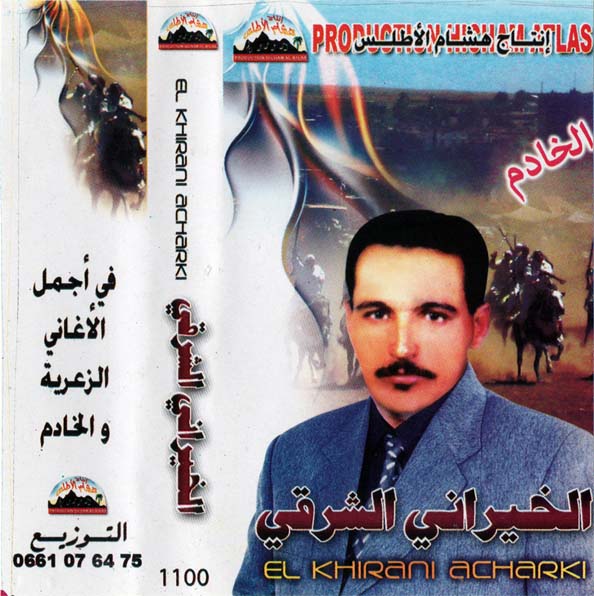
You want this tape! Long, sweaty tracks of âita zaêriya, just right for that we-can-do-this-all-night-long summer wedding vibe. The sound quality indicates a professional studio recording, but throughout the whole tape one can hear people having conversations, clapping along, ululating, encouraging the dancers and musicians, dancing on the qaâda perhaps? Maybe it's a good recording from a very rocking wedding? Whatever the source may be, it's a noisy, raucous, lively one that will do you right! Another winner from Production Hicham Atlas.
I don't know anything about the artist El Khirani Charki, though a few clips of his performances are available on YouTube. I picked up the cassette in 2012 in or around Beni Mellal.
By the way, I don't know what is the deal with the nutty taârija player in this video clip. I just saw him on Moroccan TV the other night, doing the same shtick. It's especially weird when, as here, sultry shikhat are vying for one's gaze. Perhaps he is the equivalent of the pickled ginger eaten with sushi to cleanse the (here, visual) palate, making one appreciate the shikhat even more...
El Khirani Charki - El Khadem (Hicham Atlas 1100)
01) El Khadem
I've referred to Âita with frequency in my posts, and with good reason. It's among the most important genres of Arab music in Morocco. It's well-loved in its own right and it serves as the basis for much of Moroccan chaâbi music. I wish I could give a better overall description of the genre and its variants. For those interested, I translated below a few paragraphs from Ahmed Aydoun's Musiques du Maroc to give some basic musical dimensions of âita and a few interesting tidbits of information. For a deeper analysis of the aesthetics and powerful association held between âita and regional identity, check out the work of ethnomusicologist Alessandra Ciucci.
Today's post features yet another cassette from the Hicham Atlas imprint, this time featuring a violist called Shikh al-Moutcho. I didn't find much info on him web-wise. Settatbladi.com lists an Ahmed Al Moucho, but most of the tunes with his name feature the ghaita oboe rather than the viola. (These tracks are worth checking out though - âita with ghaita is pretty unusual!)
The centerpiece of this tape (for me at least) is the 12 minute "Hsab Zaêri". I love pieces like this - short vocal couplets alternate with long passages of doing-it-to-death viola riffing, and are punctuated by syncopated accents on the bendir. In comments on a previous post, Hammer dissertated on âita zaêriya and described the practice called "Hisab Al-Za'ari" as a competition between singers.
(Hammer - hoping you may weigh in with some info on Shikh al-Moutcho - I notice that you mentioned his name in the aforementioned comments - any info is, as always, greatly appreciated!)
Unfortunately the shikhat singers featured on this recording are unidentified, and I can't tell how old these recordings may be. I picked up the tape in 2012 in Kasba Tadla or Beni Mellal. Hope you enjoy, and Happy Father's Day!
UPDATE: Forgot to mention - Track 2 "Bâd Menni" features the same melody as Najat Aâtabou's famous "Shouffi Ghirou" (as featured here). I wonder if it's a traditional melody that Najat borrowed or if this track borrows from Najat...
-----------------------
From Ahmed Aydoun's Musiques du Maroc, Casablanca: Editions EDDIF, 1992, pp. 108-109, my translation:
It is primarily in the plains bordering the Atlantic where al 'âita
is most appreciated. Specifically, the genre is practiced in the
regions of Shawiya, Dukkala and 'Abda, that is to say, in the
Casablanca-Safi axis. Al 'âita is also found in the plains of Z'ayer, in
Beni Mellal and in the Hawz, for which variants are named. The term
'âita is also used to refer the song of the Jbala, incorrectly referred
to by the name taqtüqa jabaliya. Finally we have found the term in the
hadra of the Hmadsha of Essaouira, where it refers simply to the
instrumental part that introduces the trance.
Two
different interpretations can be made of the word 'âita. According to
the first, it would be a derivation of the verb 'ayyat (to call, in
dialectical Arabic). According to the second, it would be a deformation
of ghayta (folk oboe). We prefer the first version since it is
effectively a call - nearly all of the 'âitas begin with the invocation
of Allah and the saints. The act of calling has several other
connotations - anticipating, searching, asking for inspiration.
Al
'âita takes different qualificative names by region; it is Marsawiya
along the coast, Za'riya, Mellaliya and Jabaliya. In addition to these
principal variants, there exists at Safi a special 'âita called Haçba,
its repertoire limited to several examples of the genre.
With
the exception of Za'riya, which is monorhythmic, all of the 'ayût
feature changes of rhythm, usually in three progressively faster
sections.
The 'ayüt are often sung by a group of mixed
men and women. In cases where the latter are absent, one of the men of
the group wears women's clothes and imitates women's voice and dance.
The 'âita of Wlad Hmar is a good example of this.
During
the second half of the 19th century the 'âita had its hours of glory
with the Qaîd 'Îsa ben 'Umâr al 'Abdi who was, it seems, a
connoisseur. His house attracted the best musicians and singers whose
performances were graciously rewarded.
According to
Mohamed Abu Hamid, the 'âita genre grew from its simplest form of
expression, al muqlâ' (the distich), to become over time an elaborate
composition best exemplified by the Marsawi variant.
The Marsawi is composed of two parts of contrasting rhythm and character.
Each part is comprised of strophes (qatibât) linked by cadences and
poetic transitions (hatta). The 'âita ends with a sadda, that is, a
final cadence.
The first part is slow and is called lafrâsh (literally: the bed, the bottom sheet). It begins with a
musical introduction that prepares the entry of singing. Often the
introduction is a taqsîm, then an exposition of the sung theme without
strict rhythm. The principal phrase of the song is repeated from start
to finish; in the second part, it undergoes only small changes.
The
fast-paced second section is called ghta (blanket). Here, the
rollicking rhythm drives the dance. The latter is regular, calculated -
for this reason it is called hsâb (literally: calculation). The
youngest of the chikhât performs before the audience sensual dances
(play of the belly and hips, undulating and quivering of the body,
swinging of the hair…), then the singing restarts with a dialogue
between the main chikha and the rest of the chikhat and musicians.
I noticed recently that an old post of mine on Shikh El Houcine el Khouribgui was getting a lot of hits recently. I also noticed that Moroccan TV (الاولى) had broadcast a documentary on Shikh el Houcine. (I wandered into the living room one evening and found his scratchy viola and distinctive face coming thru the TV!) I wonder if the broadcast led to web searches that led to the stash!
I was able to find the documentary on YouTube. It's all in Moroccan Arabic, including interviews with musicians that worked with Shikh El Houcine, but there are some nice performance clips as well that non-Arabic speakers may enjoy. No live clips of Shikh El Houcine, but clips of other artists performing songs associated with him, including Ould Mbarek Khribgui, Abderrahim Meskini (heard in the stash here), and Stati Abdelaziz.
I thought I had another tape of Shikh El Houcine in the stash, but alas, there were no more to be found. I did, however, find a fine tape by Shikh Mohammed al Khirani Khribgui, who was featured in a post about a year back. This tape, again from the fabulous Production Hicham El Atlas, is a great recording featuring a side-long zaêri performance, couplets following couplets, with slow, groovy riffing alternating with ta'rija-punctuated rhythmic rave-ups for shimmying. I never get tired of this stuff. Hope you enjoy it too!
PS - thanks to those who have taken the time to leave comments. I apologize for not responding recently. I'm hoping to sit down soon and write back - I do appreciate the encouragement, feedback, and conversation!
El Khirani Mohamed - Production Hicham El Atlas cassette 2001
Track 2 (excerpt) of 4
We love dem scratchy violas here at Moroccan Tape Stash! Usually, we like 'em served them up with some shikhat in old-school âita fashion. But great fiddlin' exists in Berber traditions as well. Here are two tapes of viola-driven ensembles, picked up in Beni Mellal 20 years apart.
Prelude spiel and questions about the viola in Moroccan ensembles: The European viola seems to have existed in North Africa for many many years. A couple of centuries, I'd guess. I don't know if it replaced indigenous bowed instruments in folk performance, or if it carved out its own place. Two Moroccan "art music" traditions - Arab-Andalusian âla and Soussi Berber amarg (music/song of the rwayes) - feature indigenous bowed instruments, both called rrbab, but completely different in construction and sound. The lone rebab in Arab Andalusian orchestras was joined (some would say overwhelmed) years ago by an entire section of violas. (I personally like the sound of the string section in that music.) The Soussi rrbab, on the other hand, seems to have retained its place as the sole bowed instrument inTachelhit music traditions - even modern synth pop like this.
I don't know of any indigenous fiddles out of the Middle AtlasBerber (Tamazight) areas. If they did exist, they seem to have been completely replaced by the European viola. The iconic indigenous stringed instrument for the area is the plucked lotar, most famously played by Rouicha. The rhythmic instrument of choice in the region is the bendir, heard in everything from communal ahaidous song/dance performances to izlan sung poetry to the latest synth-pop. Yet violas do abound...
Our first tape is from Mohamed Alqat (or Mohamed Qat), on the label Edition al Khair out of Beni Mellal (j-card picture above). I picked this up in Beni Mellal in 1992. The ensemble sounds like viola, oud, and a pair of bendir-s.
The use of the oud, that most Arab of instruments, seems representative of the relative fluidity between Middle Atlas Arab and Berber musical styles and traditions. Many performers in the region double in Arab and Berber music. Rouicha and Najat Aatabou both became national starts through recordings in Arabic. Even Hadda Ouakki, perhaps the most famous "traditional" Tamazight singer in Morocco, grew up performing both Berber song and Arabic âita.
This tape has a very country feel to it, and is not too far removed from âita zaêriya of the neighboring regions.
The one videoclip I found of Mohamed Qat features an ensemble with both viola and lotar:
Alqat Muhammad wal Majmuâa (Édition al Khair 55) Track 1 (excerpt) of 4
Today's second tape is from Abdelâziz Ahouzar. Yala's biography page says he's from the area of Khenifra and has been active since the 1980's. I picked up this tape in Beni Mellal in 2012.
Both tapes feature Tamazight song with men and women alternating sung verses/refrains, violas leading the ensembles, and prominent bendir. The similarity ends there, however.
Ahouzar's music has a very urban, chaâbi feel to it.Indeed, Ahouzar's catalogue, lots of which you can hear over at YalaOurnia, contains Arabic chaâbi albums in addition to offerings in Tamazight. Ahouzar's viola riffs and instrumental bridges are right out of the chaâbi playbook.
Although the bendir-s are prominently featured in the mix, Ahouzar's rhythm section features a drum kit and/or darbuka as well, adding some chaâbi propulsion. And the keyboard bass and comping give this tape a very chaâbi texture.
Some differences between the two tapes stem from the 20-year difference between them. The faux-live-audience heard at the beginning of tracks 1-4 is something that started appearing in chaâbi recordings about 10 years ago - I first remember hearing these in Daoudi's recordings. And of course, the auto-tuned voices throughout the tape give this a contemporary flavor too. I like the way it sounds on this album - the high-pitched women's auto-tuned quarter tone pitches on track 2 are fantastic!
Discographic note: This album of Ahouzar, as well as most of those featured at Yala, are released on a label called Ahouzar Phone, out of Azrou. Is this Abdelâziz' own label? Why is there a picture of a lion's face in the company logo? I don't know, but would love to find out.
Here's Abdelaziz Ahouzar at the gynormous Mawazine festival in Rabat, 2010. Like the clip of Mohamed Qat above, the ensemble here features a lotar:
Amazon has an mp3 album of Ahouzar - a steal at $2.99. Plus there's loads of his stuff over at YalaOurnia.
Some more great Âita Zaêriya for ya, straight outta Khouribga, served up by Production Hicham Atlas. Couldn't find any info on Shikh Mohammed on the interwebs. Nevertheless, these performances sound like seasoned old-school veterans, rocking out Zaêri-style.
I was gonna drop 2 albums on ya. After transferring them both, however, I realized that these two tapes actually included the same recordings with merely differing fade-ins and fade-outs. Track 3 combines pieces from both tapes.
The Big 5 - or at least the biggest 5 on Edition Motawakil. "Al-Botooula Al Khribguia" ("The Khouriba Champions" or "Tournament") is a compilation tape featuring some down-home chaâbi with a healthy dose of âita zaêriya. From left to right on the j-card:
Auto-tuned vocals abound on many of these tracks. Not everyone's cup of tea, I know. But I'm digging some of the auto-tuned shikhat (check the Track 4 sample below!) and spoken intros (Track 1).
I couldn't match all of the tracks to the titles on the j-card and vice versa - here's my best guess:
01) Wellahi Ma Sme7 Lik - unknown
02) Az-Zaêri - Lârbi Briouika
03) Hmeqtini Ya Lkas - Al-Âlami 04) Az-Zaêri - Mbark Al Meskini
05) Min Ghirek Enti Mandir Hbib - unknown
06) Az-Zaêri - Saleh Al Mzabi
07) Bkatni Hubbi - Al Hirch
08) Âoujouk As'hab Al Euro - Mbark Al Meskini
09) Kan Jat Yal Demâa - Saleh Al Mzabi
10) Az-Zaêri - Abderrahim Al Meskini
Here's another tape from my summer 2012 trip. I believe I picked this up in Beni Mellal, though the longstanding Sawt Ennachat label is out of Casablanca. The music sounds Mellali to me - heavy on the zaêriya.
On first listen, this sounded to me like pretty standard early 21st century countrified chaabi. However, a couple of cool things stood out on additional listens:
The rhythm is pretty kicking, though it stays pretty mechanical throughout. However, the darbuka player gets pretty OUT in some places, embellishing all over the place. (See track 3.)
The viola is not auto-tuned, and it hits a few unusual notes/intervals that sound great in contrast to the otherwise perfect pitches. (See track 4)
Bouchaib's country vocal phrasing and embellishment often seem to subvert the auto-tune on his voice. The shikha, on the other hand, is auto-tuned to the max. (See tracks 2 and 6)
Track 7 ditches the auto-tune for some straight-up pitch-non-perfect zaêri goodness!
Mastering note: Track 4 fades out quickly at the end of side 1 of my tape. I was able to find an mp3 of the full track over at psdojo.com and grafted it onto the end of my version. So the last 6 minutes of track 4 comes from that source. (Excuse the obnoxious voiceover at 6:30.)
El Khalfi Bouchaib - Ezzine Ihebbel (Sawt Ennachat cassette)
Here's an odd tape I picked up in Beni Mellal in 1992. It's a ghaita ensemble, but one that seems unusual to me for a number of reasons.
The ghaita is a loud piercing oboe/shawm, typically used in outdoor processions, accompanied by tbola (barrel drums). Outdoor procession music usually incorporates any and all popular songs. Tbel players may sing, but singing isn't usually that important. The main purpose of these groups is to be heard outdoors (thus the loud ghaita) and to provide tunes that keep people moving and dancing in the streets. (We've got some northern tbel and ghaitaelsewhere in the Stash.)
In some ways, the music on this tape sounds like a Beni Mellal wedding procession - the tunes are familiar and the ghaita-led ensemble strings them together one after another. Also, the sketchy production values in the recording remind me of some of my own field recordings of street processions - bad balance between instruments, ambient noise, tape speeding up and slowing down, (OK, I never actually had that problem), etc.
In other ways, though, this differs from a typical tbel and ghaita ensemble. First, there are no tbola drums, only some bnader (frame drums). The groups I've seen around Beni Mellal usually use a combination of tbola and bnader, but usually there will be at least one tbel. Second, this recording seems to feature a designated group of female singers. This is quite unusual. Women sometimes do sing in wedding processions, but I've only ever seen that happen when no professional musical group is hired for the procession, and guests and family do the drumming and singing. Here the women, of course, are part of the professional ensemble hired for the recording. And Track 5 sounds to me like an âita zaêriya, so these could actually be shikhat.
It's a strange combination. Âita is a pretty far cry (ha ha) from tbel and ghaita processional music. But here, you basically have what could be an âita/chaâbi group with the viola being replaced by the ghaita.
The only information I found online about the artist, Hassan al Faryati, is a listing for his performance at the Aita Festival in Asfi in 2008. He is listed on a program of âita haouziya, and the listing states that he is from Kelâat Es-Sraghna (between Beni Mellal and Marrakech).
I don't know if al Faryati is a ghaita player or if he's a drummer. I believe I bought 2 tapes by this artist, but only one appears to remain, and I'm not sure whether it belongs to the j-card pictured above or the one below. At any rate, enjoy this oddity from the ragged corners of the stash.
Hassan al Faryati (Edition al Khair cassette)
Track 3 (of 7)
More of that good âita zaêriya from Shikh el Moutchou. Check here for an earlier post with some info about him (courtesy of Hammer's comments) and about the âita genre (courtesy of Ahmed Aydoun's book). And check below for a sample. Grab the whole thing to hear the bitchin' 9/8 opening track. It's on Production Hicham al Atlas, so you know it's rocks!
Shikh al Moutchou and Ibrahim - Jaîdan (Hicham al Atlas 52/10)
01 Jaîdan
02 Zaêri
03 Saken
04 Ya Chabba Ya Khumriya
05 Alawah Alawah 06 Ben Mousa Saken